

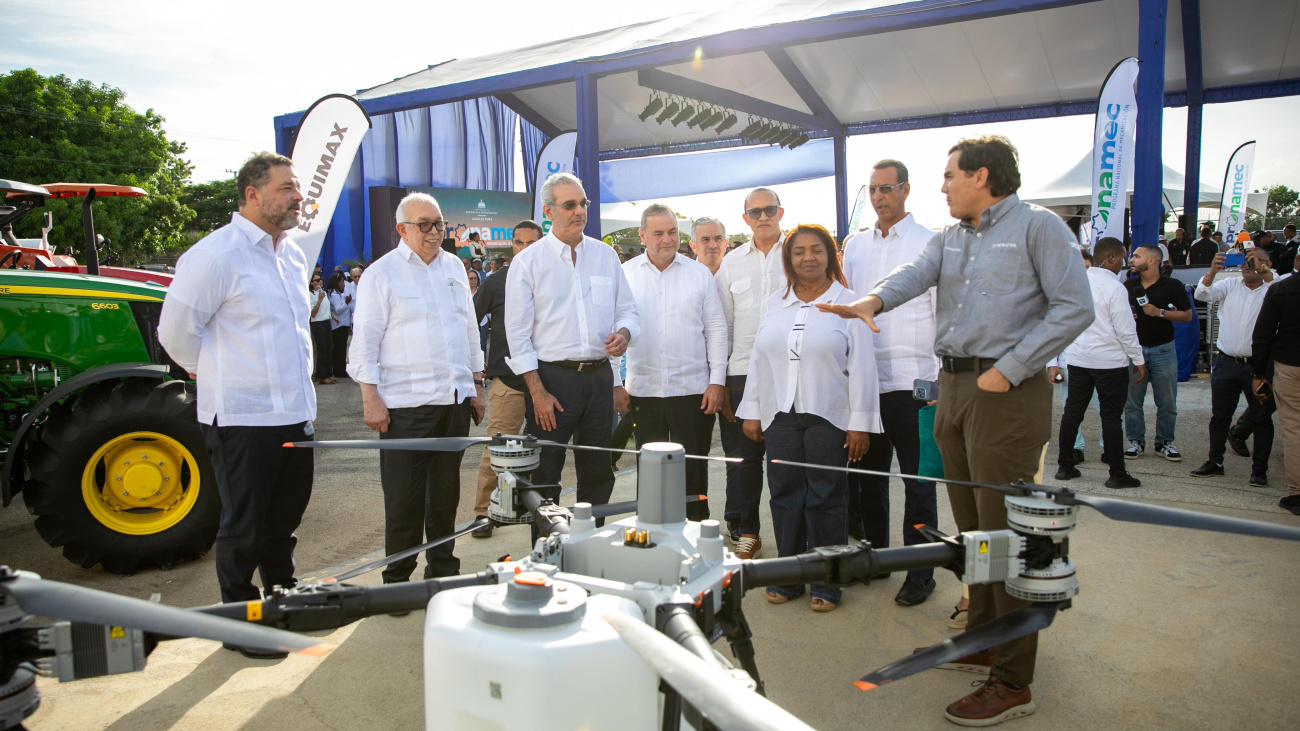

San Juan.- As a mark of the beginning of a new stage for Dominican agriculture, President Luis Abinader led the launch of the National Mechanization Program (Pronamec), which seeks to transform production processes, reduce costs, increase productivity, and decrease dependence on foreign labor.
By guaranteeing producers absolute support from the Government to make the agricultural sector more efficient and competitive, the head of State assured that it is, furthermore, “a matter of special importance for national security” that will avoid, in the future, the indefinite use of foreign labor.
“We have to support producers across the country to gradually mechanize their work; it is more economical and less complex” stated President Abinader.
Use of new technologies

Pronamec will progressively incorporate technologies and machinery in the different phases of agricultural production, from land preparation and mechanized sowing, to crop management, harvesting, and post-harvest. Likewise, new financing models will be implemented.
“We want a field where technology allows us to do in hours what previously required days; a field where the small producer has access to tools that multiply their capacity; a field that is less dependent, more efficient, and more competitive,” stated the Minister of Agriculture, Francisco Oliverio Espaillat Bencosme.
Through teaching, financing, and expansion, this program arrives to strengthen food security and the modernization of the agricultural sector, fostering the transformation of the Dominican countryside.
We recommend reading: Minister Bisonó begins construction of modern CCR in Neiba
Minister Espaillat Bencosme explained that for crops such as rice, corn, sorghum, and beans, around 90% of the process can be mechanized, while for plantains and bananas, due to their greater complexity, the goal is to exceed 60% through proper planning of planting. This process will be extended to other crops such as vegetables, tubers, and fruits.
Currently, agriculture and livestock represent approximately 5.6% of the Gross Domestic Product (GDP), generate approximately 8.8% of national employment, and contribute nearly 11.8% of exports.
Project stages
With an investment exceeding RD 200 million, Pronamec will be implemented in several stages. The first begins with the Mechanization Demonstration Plots, initiated in San Juan, and subsequently in Las Matas de Santa Cruz, Valverde, La Vega, Constanza, and Arenoso, where the machinery will be taken to train producers and determine which technologies work best according to each crop and region.

The training of specialized operators and mechanics will be the responsibility of the Ministry of Agriculture, the National Institute for Technical Professional Training (Infotep), and distributor companies, so that producers can effectively incorporate them into their productive activities.
The second stage seeks to facilitate access to equipment and technologies for small and medium-sized producers through flexible financing backed by the Agricultural Bank, Bandex, and private banks. For small producers, associative and cooperative schemes will also be promoted to share machinery and reduce costs.
The third stage contemplates taking the transformation to a national scale by strengthening and modernizing Prosema, expanding the machinery services offered by the Ministry of Agriculture and progressively increasing its coverage in the different productive regions of the country.
Support for the agricultural sector
In his words, Espaillat Bencosme highlighted the support of international organizations such as the World Bank and the Inter-American Institute for Cooperation on Agriculture (IICA).
San Juan constitutes one of the country’s main agricultural strongholds with a large-scale productive structure. It registers 20,577 agricultural producers and 27,696 plots, covering approximately 1.84 million tareas, of which more than 1.06 million are planted