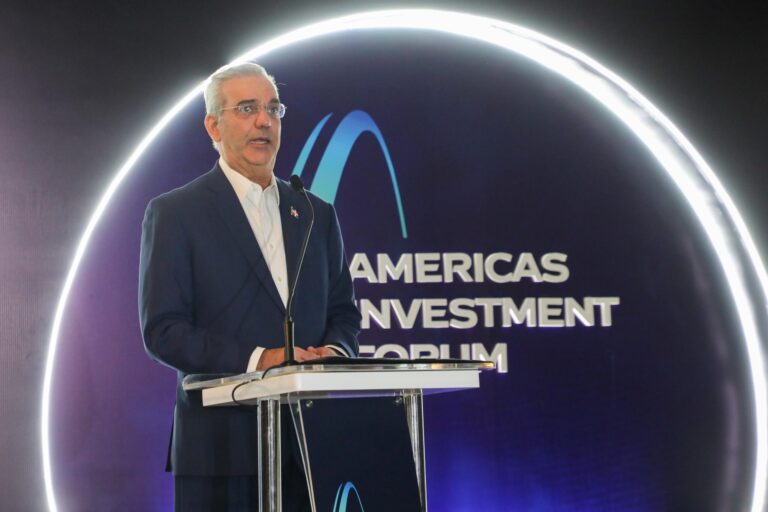


Santo Domingo.- President Luis Abinader stated this Monday that the ability to build national consensus has been one of the main factors that have allowed the Dominican Republic to strengthen its democracy, maintain social cohesion, and advance in human development indicators.
During his participation in the presentation of the 2026 Regional Human Development Report by the United Nations Development Programme, titled “Democracies under pressure: Reimagining the futures of democracy”, the president highlighted that the country’s main political parties have shared fundamental objectives that have guaranteed the continuity of public policies aimed at national development.
“There has been a lot of good sense in the Dominican political sector and political class”, expressed the head of state, while also highlighting the role of business organizations and civil society in building a common vision of progress and institutional strengthening.
Abinader maintained that democracy must be based on mutual respect and the recognition of the role played by each political actor, including the opposition, which he defined as an essential component for the strengthening of the democratic system.

He indicated that during his administration he has promoted relationships based on dialogue and consensus on issues of national interest, contributing to preserving political stability and avoiding the levels of polarization that affect other nations in the region.
You can also read:
Likewise, he highlighted the contribution of neighborhood associations and community organizations as mechanisms that strengthen citizen participation and facilitate the oversight of government actions.
Human development and institutional strengthening
The president reiterated that sustainable development requires a comprehensive strategy that combines economic growth, institutional strengthening, education, health, infrastructure, basic services, and transparency in public management.
In that sense, he pointed out that his administration is working to replace what he defined as a “vicious circle of underdevelopment” with a “virtuous circle of development,” based on solid institutions, independence of public powers, and greater opportunities for the population.
Abinader also highlighted the reduction in poverty levels in the country, noting that during the first quarter of 2025 this indicator fell to 15.3%, as a result of public policies focused on economic growth and social protection.
He recalled that poverty went from approximately 26% in 2019 to nearly 18% at the end of last year, despite the effects of the international crises recorded in recent years.
Challenges of democracy in the digital age
During the discussion, the leader also addressed the challenges that democracies face regarding the impact of social media, the speed of information circulation, and the proliferation of fake news.

He considered that political leaders must adapt to new forms of communication without abandoning their principles, maintaining permanent contact with the citizenry to listen to their concerns and respond to their demands.
Furthermore, he stated that political parties face the challenge of modernizing their structures and adapting to technological and social changes to strengthen their bond with the population and respond effectively to the needs of today’s society.