
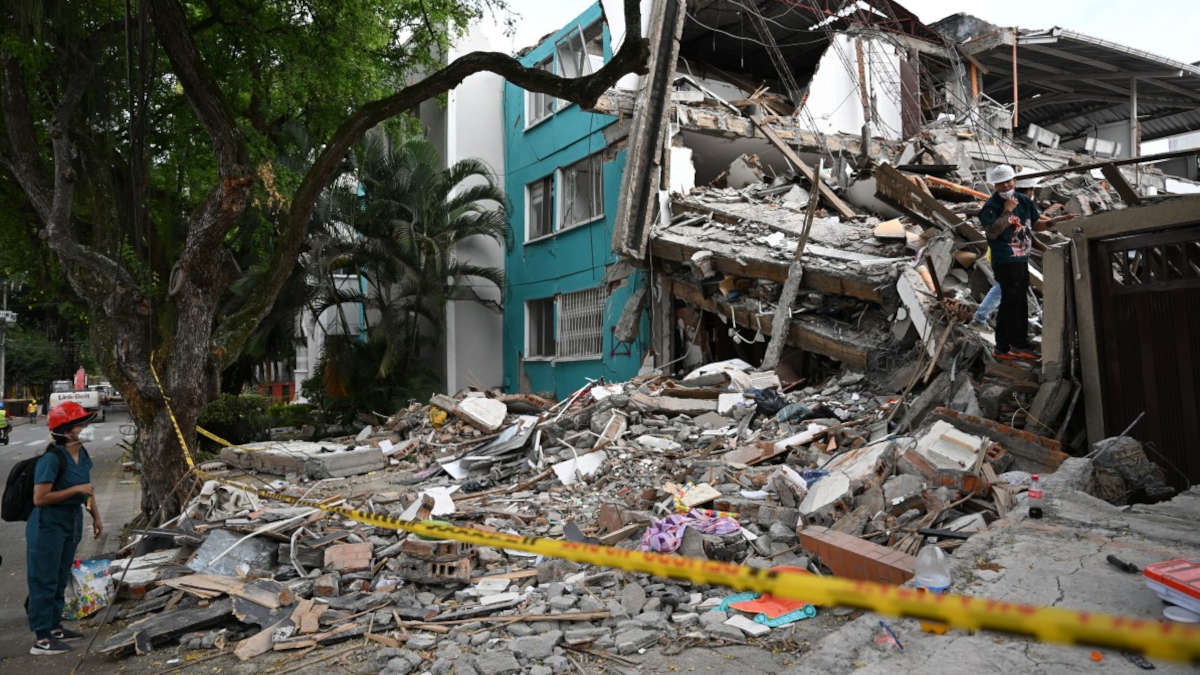

Bogotá.- A week after the earthquake that hit the center and southwest of Colombia hard, the Abelardo de la Espriella Government acknowledges that a reconstruction stage is beginning that will be “tough” and expensive, while thousands of families remain without housing, tens of thousands of children remain without classes, and rescue efforts have not ended.
In an address on Monday night, the president asserted that the reconstruction “will require resources” and will be “tough,” but said he trusts in the ability of Colombians to overcome the tragedy.
He estimated the cost of reconstruction at 30 trillion pesos (about 9.5 billion dollars), announced housing subsidies and economic relief for those affected, for which he declared an economic emergency.
San José del Palmar, the Chocó municipality that was the epicenter of the 7.4 magnitude earthquake on August 10th, and the areas of Valle del Cauca, Risaralda, and Caldas are now facing an emergency that extends far beyond rescue efforts: uninhabitable homes, closed schools, families seeking to recover their belongings, and communities in need of assistance to start anew.

De la Espriella warned that the figures are still being consolidated and that, “out of respect for the victims and their families“, his Government “will only communicate duly consolidated data“. The preliminary toll is 289 dead, 4,187 injured, and 143 missing.
You can also read: De la Espriella lowers the death toll from the earthquake in Colombia to 289
For its part, the Institute of Legal Medicine reported this Monday that it has received 304 bodies of earthquake victims and has identified 300, including 22 minors. 139 of the identified bodies come from Cali and another 107 from Pereira.
Rains worsen the situation
In the affected neighborhoods, the emergency continues to be a part of daily life. In Chiminangos, one of the hard-hit sectors of Cali, families who lost their homes sleep in small tents, receive food from community kitchens, and hope to be able to enter their former apartments to recover clothing, documents, and appliances.
The rains that began on Sunday have worsened the conditions for those remaining in these makeshift shelters and have also forced the temporary suspension of some debris removal efforts. In Pereira, families settled in Olaya Herrera Park had to protect their tents with plastic, while the ground became soaked and the San Jorge University Hospital reported flooding.

The rain also hinders emergency efforts in areas where search, rescue, and body recovery operations continue, adding a new obstacle to a response that is now entering its second week.
Shakira’s aid to Chocó
This Monday, the Colombian singer Shakira announced in Quibdó that she will dedicate “all her personal efforts” to rebuilding the Technological University of Chocó, damaged by the earthquake, and that together with the American philanthropist Howard Graham Buffett, she will promote the construction of ten new schools in the department.
“Every day that children do not go to school is a day that we pause their future, and we cannot allow that“, said the artist during a visit with Buffett to some of the affected areas and the Carrasquilla Industrial Technological College, the largest in Chocó.
Shakira explained that Global Citizen will contribute $500,000 and concert promoter Live Nation another $500,000, for a total of one million dollars destined for the reconstruction of schools. She also asked the governments of Canada, Japan, and the United Kingdom, the private sector, and other foundations to join in the recovery of Chocó.
Interrupted education
Shakira’s visit highlighted one of the main challenges of the reconstruction: the return of children to the classrooms. More than 3,200 schools have suffered damage and tens of thousands of students remain temporarily without classes.
The proposal to move classes online is impossible for many rural communities due to the lack of signal and electronic devices. In Pereira, more than 58,000 students remain temporarily out of school after authorities deemed the conditions of the city’s 165 schools critical.
On the other hand, hundreds of private vehicles and trucks with “Humanitarian aid” signs are traveling along the roads in the center and west of the country, loaded with food, water, clothing, medicine, blankets, mattresses, and hygiene items.
In addition, Colombia has received more than 220 tons of supplies from various countries and rescue teams from Israel, Ecuador, and the United States. Washington has sent nearly ten tons of shelter, water, and sanitation material and has pledged 26.5 million dollars in assistance.