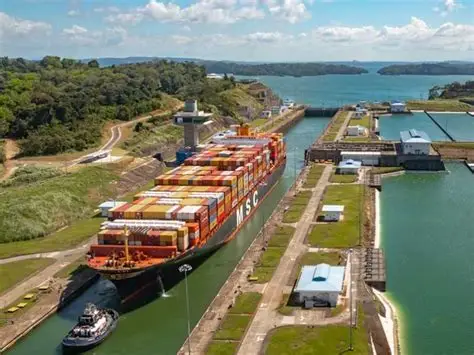
Panama.- The Panama Canal Authority (ACP) reported this Wednesday two new adjustments to the draft of ships (the submerged part) in the locks for giant vessels starting at the end of August and the beginning of September, given the projections of less water in one of the lakes that supply it.
Specifically, starting on August 26, 2026, the maximum authorized draft for vessels transiting the Neopanamax locks—which allow the passage of larger ships that do not fit through the original locks—will be 48 feet, approximately 14.63 meters, and, starting on September 3, 47.5 feet, approximately 14.48 meters, according to a statement from the ACP.
The interoceanic waterway had already applied other draft adjustments this year: since June it offered a maximum of about 50 feet or 15.24 meters, on July 3 it was reduced to 49.5 feet or 15.09 meters, and on July 24 it decreased again to 49 feet or 14.94 meters.
The measure, the statement highlights, responds to the current levels and projections of Gatun Lake—one of the two that supply the canal—for the coming weeks, caused by the El Niño phenomenon.
It points out that the adjustment does not imply changes in the number of daily transits, as happened in 2023 and 2024 due to a severe dry season driven by the intensity of the natural phenomenon.
More Read


According to a projection of the interoceanic waterway, the water levels of that lake would enter a slight decline (between 1 foot or approximately 30 centimeters) in the coming weeks until the beginning of September, although the graph shows a plateau until October.
Panamanian experts warn that this year ‘El Niño’ will be more powerful, in line with the regional trend, with warmer Pacific waters and less rainfall.
You can also read: Panama seizes 600 packages of drugs in operations in the Caribbean and the Pacific
Official information indicates in this regard that “Canal specialists maintain continuous monitoring of weather conditions and develop technical projections that allow for a more precise evaluation of the effects of the El Niño phenomenon in order to define and announce in a timely manner the management measures that might be required in the coming months”.
More Read
The Panama Canal, which connects the Atlantic and the Pacific and through which between 3% and 5% of world trade passes, is the only freshwater canal in the world. It is fed by the artificial lakes Gatun (1913) and Alhajuela (1935), which also supply more than half of the country’s slightly more than four million inhabitants.
In 2023, the country suffered a longer-than-usual seasonal drought, exacerbated by El Niño, forcing the canal to gradually reduce the draft to 44 feet or 13.41 meters in the neopanamax locks (and daily transits to 22 from the usual 36) for a year.