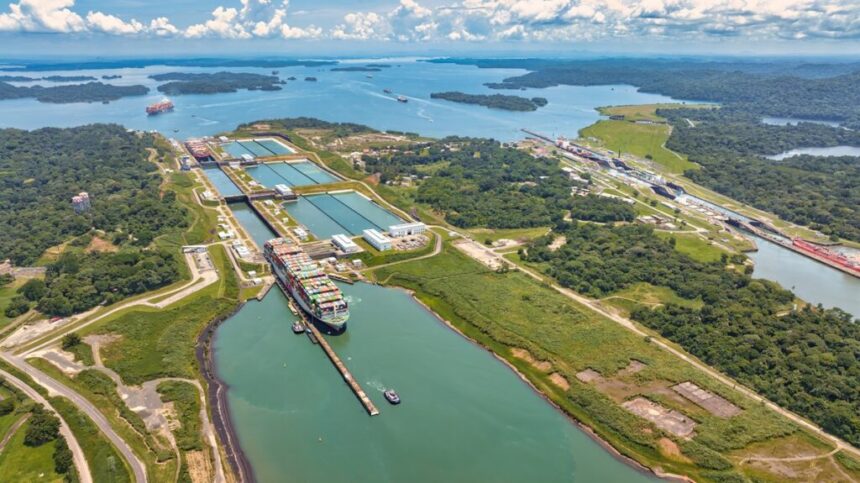
Panama City.- The Panama Canal announced this Thursday that it will restrict daily vessel transits to 32, down from an average of 36, a measure that adds to the draft reduction already in effect, in order to cope with the drought derived from a strong El Niño phenomenon this year that may last until 2027.
The Panama Canal, operational since 1914 and with an expansion in service since 2016, is the only freshwater one in the world. It is fed by the artificial lakes of Gatun (1913) and Alhajuela (1935).
In a statement, the waterway through which between 3% and 5% of global trade passes reported that starting next September 3rd, “the number of daily slots available in the Neopanamax locks (the expansion) will be adjusted to nine,” from an average of 10, “while in the Panamax locks (the century-old ones) there will be 25,” compared to the usual 26, which adds up to a total of 34 daily transits starting from that date.
“Likewise, starting September 15, 2026, the number of daily slots available in the Panamax locks will be adjusted to twenty-three (23)“, which will leave a total of 32 daily transits by that date, said the administration of the waterway that connects the Atlantic with the Pacific and has the U.S. as its main user.
“Current basin conditions, including rainfall lower than forecast in the Canal’s watershed, require additional actions to support the long-term sustainability of transit operations“, the waterway’s administration indicated in its statement.
More Read

Draft reduction dates postponed
The announcement of the transit restriction adds to the reduction of the draft – the submerged part of the ship – already in effect in the expansion through a schedule, although this Thursday the Canal notified the delay of some of the established dates.
You can also read: Panama Canal to adjust draft in locks for large ships
The entry into force of the 48-foot or 14.63-meter draft scheduled for next August 26 was postponed until September 2, and the 47.5-foot or 14.48-meter draft established for September 3 was moved to October 1.

Draft management is linked to the level of Gatun Lake, which when in optimal conditions, that is, at 89 feet or 26.11 meters, allows the expansion to offer its maximum draft, which is 50 feet.
More Read

Waiting times and auction quota adjustments
The Canal asked its customers to take into account that the reduction in daily transits “could increase waiting times for vessels arriving at the waterway without a confirmed reservation,” and recommended that they use the available booking options to avoid prolonged delays.
The navigable passage offers a reservation system for transit and an auction system for those vessels without a crossing scheduled in advance.
In 2023, with a strong El Niño phenomenon, the Canal became congested amidst a transit restriction that left them at 22 per day in November of that year.
Now, the demand for crossings through the Canal has grown, driven by market uncertainty due to the crisis in the Middle East, which has pushed auction prices above one million dollars for a slot. There have been cases of payments of up to 4 million for a last-minute transit.
In this context, the Canal “will temporarily adjust the supply of its daily auction slots“, in order to “promote a more equitable allocation process that better reflects the market composition, including the different types of cargo and the characteristics of the different segments“.
The Canal primarily serves the U.S. East Coast-Asia; U.S. East Coast-West Coast of South America, and Europe-West Coast of South America routes. It handles all types of cargo, from grains to vehicles, as well as liquefied natural gas and other energy products.