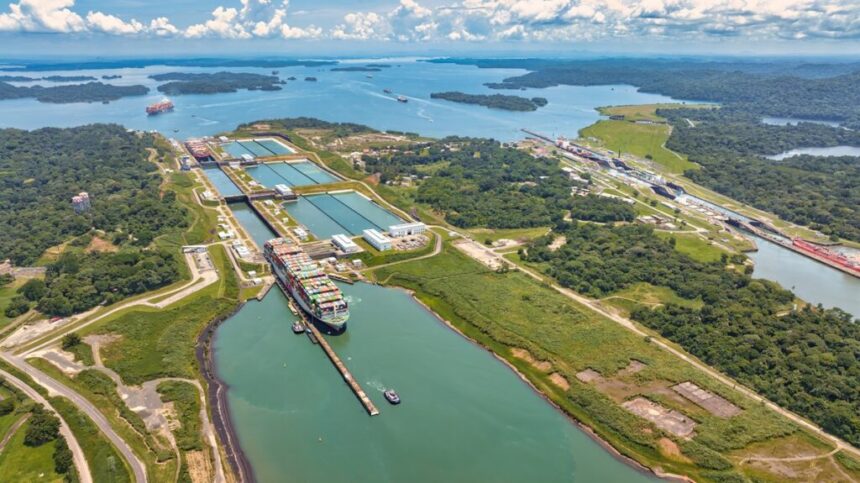
Panama.- The Panama Canal expects its revenue to grow by 6.6% in 2027, reaching 5.555 billion dollars, compared to the 5.2072 billion projected for the current fiscal year, according to the budget presented this Tuesday by this autonomous state entity.
The Canal, the only freshwater one and through which between 3% and 5% of world trade passes, expects to deliver to the Panamanian treasury a record figure of 3.937 billion dollars, of which 3.608 billion corresponds to the direct contribution (12.9% more than what was foreseen in the current fiscal year), and 329 million to the payment of income tax, social security, and educational insurance for Canal employees, as well as the employer-employee contribution.
In a statement, the administration of the passage connecting the Atlantic and Pacific oceans indicated that it bases its 2027 budget on a projection of 10,750 deep-draft vessel transits and 457.3 million tons.
“Among its main premises, it considers a scenario of challenging water conditions, with the possibility of a strong El Niño phenomenon and operational measures aimed at optimizing water resource management,” the letter said.
For a couple of months now, the waterway has been applying a reduction to the draft—the submerged part of the ship—and this September it will implement transit restrictions that will leave it at 32 per day starting on the 15th, four fewer than the average of 36 under normal conditions.
More Read

You can also read: The Government of Panama declares a state of emergency
“The Panama Canal toll structure remains unchanged for fiscal year 2027 and the draft budget does not contemplate modifications to the current rates applicable to its clients,” the official statement pointed out.

The budget includes resources for operational sustainability, asset protection, and risk management; maintenance programs, insurance, conservation, and reforestation of the Watershed; cybersecurity and technological continuity; as well as investments in training and human capital well-being, generational turnover, and capacity building, the Canal said.
The note adds that the path “also accompanies the progress of the Canal’s main strategic initiatives, including the Rio Indio reservoir project,” as well as “the energy corridor, port terminals, and the logistics corridor, as part of the long-term strategy to strengthen the competitiveness and sustainability of the route.”
More Read
All these projects require an investment of more than 8.5 billion dollars, as previously reported by the autonomous entity.
The Canal’s 2027 budget was approved this Tuesday by the Executive and must now be ratified by the National Assembly (Parliament), which is not empowered by law to change it.
The Canal connects 180 maritime routes and 1,920 ports in 170 countries. Its main user is the U.S., with about 70% of the cargo that crosses it originating from or heading to that country, followed by China and Japan.
The main routes served by the canal are the U.S. East Coast-Asia; U.S. East Coast-West Coast of South America, and Europe-West Coast of South America. All types of cargo pass through the waterway, from container ships, the star segment of the business, to refrigerated ships with fruit, as well as bulk carriers, gas carriers, oil tankers, and vehicle carriers.