

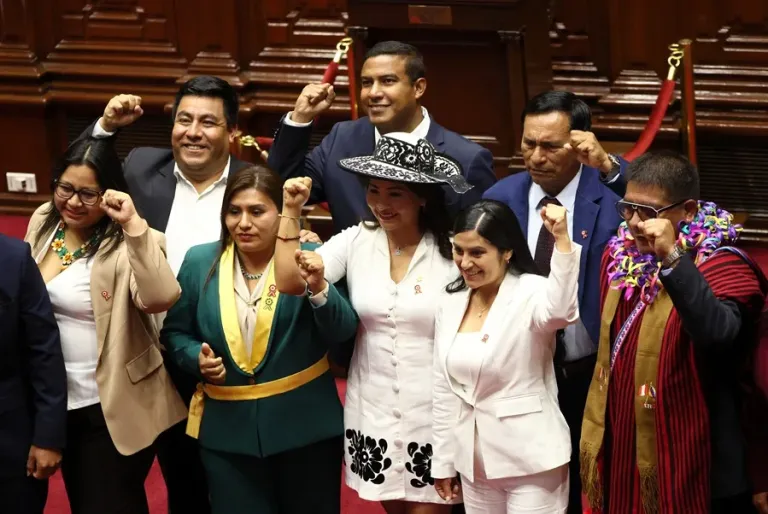

Lima (EFE).- Peru has returned, as of this Friday and after 34 years, to a bicameral parliament composed of a chamber of senators and another of deputies. For nearly a quarter of a century, the congress operated with a single chamber that became the epicenter of the political instability that has characterized the country over the last decade, with eight presidents in ten years.
The 60 senators and 130 deputies elected in the last elections held on April 12 and 13 took office this Friday for the 2026-2031 term. The right-wing Keiko Fujimori, president-elect of the country, will be inaugurated in a ceremony next Tuesday, July 28, Peru’s national day.
The Andean country had not had a bicameral Parliament since the “self-coup” perpetrated by former president Alberto Fujimori (1990-2000), father of Keiko Fujimori, on April 5, 1992. At that time, he dissolved the Legislature and intervened in the Judiciary to rule by decree until the establishment of a Constituent Assembly that drafted the 1993 Peruvian constitution, with a unicameral Congress.
The return to the two chambers
In 2018, a referendum was held on the return to a bicameral system, but the ‘No’ vote won with 90.51% of the valid votes. Congress members included a provision to bypass the reform that prohibited reelection and to be able to alternate between the two chambers.

Despite that rejection in the popular vote, Congress managed two years ago to reach enough consensus to reform the Constitution and establish two chambers. They achieved this without the need for a referendum that they would foreseeably lose, as the Legislature has a popular approval rating of less than 5% of the population.
We recommend reading:Lula does not plan to attend the inaugurations of De la Espriella or Fujimori
The first to take office this Friday were the senators. Precisely the Senate will concentrate all legislative power by having the capacity to modify the bills sent to it by the chamber of deputies.
The composition of the Senate is divided, with 30 senators linked to right-wing parties and another 30 to center and left-wing parties.

The formation of parliament
The Fujimorist Popular Force has the largest representation with 22 senators. It is followed by the far-right Popular Renewal, with 8; while the centrist Good Government Party has 7 senators.
On the other side is a left-wing alliance formed by the parties Together for Peru (14), of former presidential candidate Roberto Sánchez, who lost the presidential runoff; Obras (5) and Now Nation (4).
In the Congress of Deputies, Fuerza Popular (41) and Renovación Popular (15) total 56. The same number that can be accumulated by Juntos por el Perú (32), Obras (14), and Ahora Nación (10), while the Partido del Buen Gobierno has 18.
This parliamentary arithmetic makes it very difficult for any motion of impeachment against President Fujimori to prosper, as it requires the votes of two-thirds of the chamber. This suggests that the cycle of presidential impeachments promoted by Congress during the last decade will come to an end.