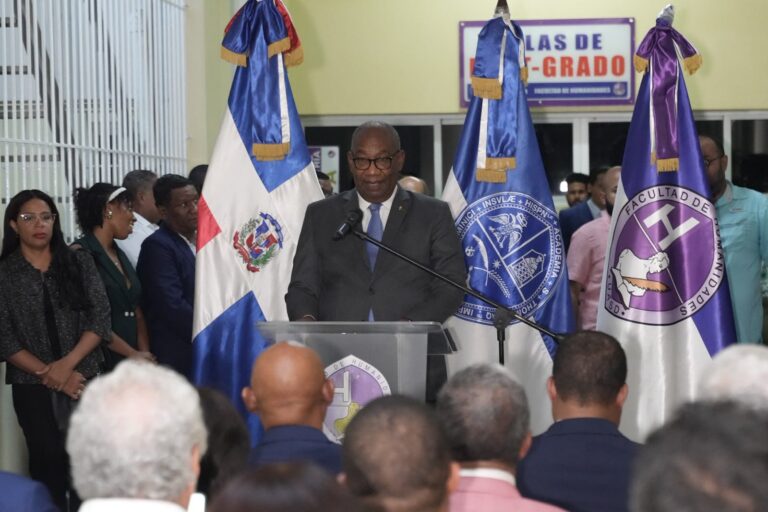

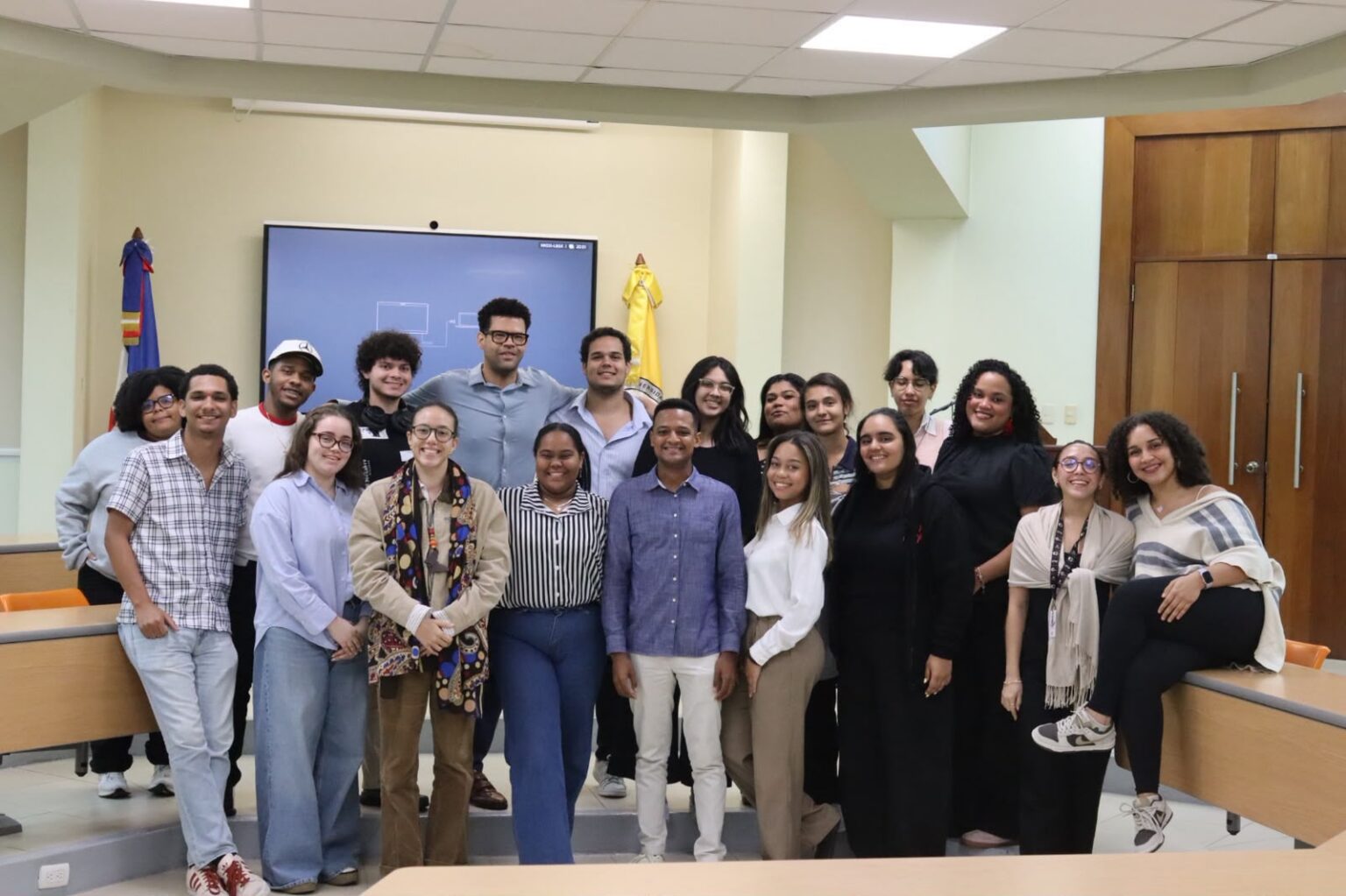

Students pursuing the degree in Audiovisual Communication and Cinematic Arts and the Telejournalism course at the Pontificia Universidad Católica Madre y Maestra (PUCMM), Santo Tomás de Aquino Campus, presented this Wednesday, July 29, the docuseries “Inventing the Future,” an audiovisual research production that examines from different perspectives the relationship between youth, employment, and labor informality in the Dominican Republic.
The official presentation was held at the VPO-04 Postgraduate Octagonal of the PUCMM, Santo Tomás de Aquino Campus, in Santo Domingo.
The docuseries was conceived and produced by students as part of the training process for the Television Journalism course, taught by Professor Erwin Villanueva, and constitutes the result of an academic exercise in research, reporting, production, audiovisual realization, and narration applied to issues of social interest.
“Inventing the Future” is composed of three chapters: “Future on the margins”, “Art without a contract” and “Training, for what?”. Although each installment develops an independent angle, all three converge on an underlying question: what possibilities do young Dominicans have to build a sustainable life project based on their work and preparation? The project was structured precisely around the relationship between youth, employment, and informality.
Three chapters, three dimensions of youth employment:

The first chapter, “Future on the Margins,” focuses on the labor insertion of young people and the difficulties they encounter when trying to access and remain in the job market. The production combines youth experiences with perspectives linked to recruitment and the business sphere, seeking to observe the phenomenon beyond statistics and bring it closer to the realities of those seeking to build their professional future.
“Art without a Contract,” the second chapter of the docuseries, shifts the investigation to the Dominican artistic and creative sector. The piece explores the conditions under which young artists attempt to turn their training, talent, and creativity into a sustainable career, in an environment often characterized by freelance work, temporary projects, collaborations, and variable income.
The research also questions the perception that labor informality is limited to low-skilled occupations. The chapter shows how professionals in creative fields can possess training, experience, and constant productive activity and, even so, face difficulties related to stability, social security, financial planning, and professional continuity.
The question that guided this part of the research was: how do young Dominican artists live and sustain their careers in a context where creativity is valued, but their work is not always formally recognized?
The third chapter, “Training, for what?”, examines the relationship between technical training, employability, and informality. Its starting point is a contradiction: the access of thousands of young people to training programs and the difficulties that may persist afterward in joining formal and stable jobs.

To develop this angle, the team expanded the research into different training models and drew on both personal experiences and institutional and specialized voices, ensuring that human stories served as the narrative axis and that data served as support for the research.
Among the sources consulted for this chapter are the Minister of Labor, Eddy Olivares, and the former Minister of Economy, Planning and Development, Juan Ariel Jiménez, Maira Morla Pineda, Director of INFOTEP, as well as young people linked to technical training programs and representatives of educational institutions.
From the classroom to a real journalistic production experience:
The process involved editorial decisions to determine which information was relevant, which testimonies allowed for representing the investigated issues, and how the data could be integrated into the stories without displacing the human component.
In this way, the production transcends the creation of three audiovisual pieces as an academic exercise and places students in front of responsibilities inherent to journalistic practice: researching, verifying, contrasting sources, documenting claims, and translating complex social issues into an audiovisual language understandable to the public.

A production made by students:
The production of “Inventing the Future” featured specific teams for each of its three chapters, distributed according to the different responsibilities required by an audiovisual journalistic production.
In “Futuro al margen” (Future on the Margins), Gissell Santana took on production and reporting; Joseph Núñez, camera and editing; Iván Reyes, research; Lia Lapaix, visual direction; and Juan José García, source management.
For “Arte sin contrato” (Art Without a Contract), production was led by Valentina Antigua; Karla Espinal was in charge of camera and editing; María Isabel Heyaime, reporting; Andrea Grullón, research; María José Melgen, visual direction; and Carla Hernández, source management.
In “Capacitarse ¿Para qué?” (Training, For What?), Felipe Blonda was in charge of production; Hannah Wagner, camera and editing; Diana Terzic, reporting; Mishell Guzmán, research; Aida Peña, visual direction; and Danna Santana, source management.
The general production coordination and talent management of the docuseries was in charge of Dániel Lajara.
The entire process was developed as part of the Telejournalism course, under the academic guidance of professor Erwin Villanueva, at the Pontificia Universidad Católica Madre y Maestra.