
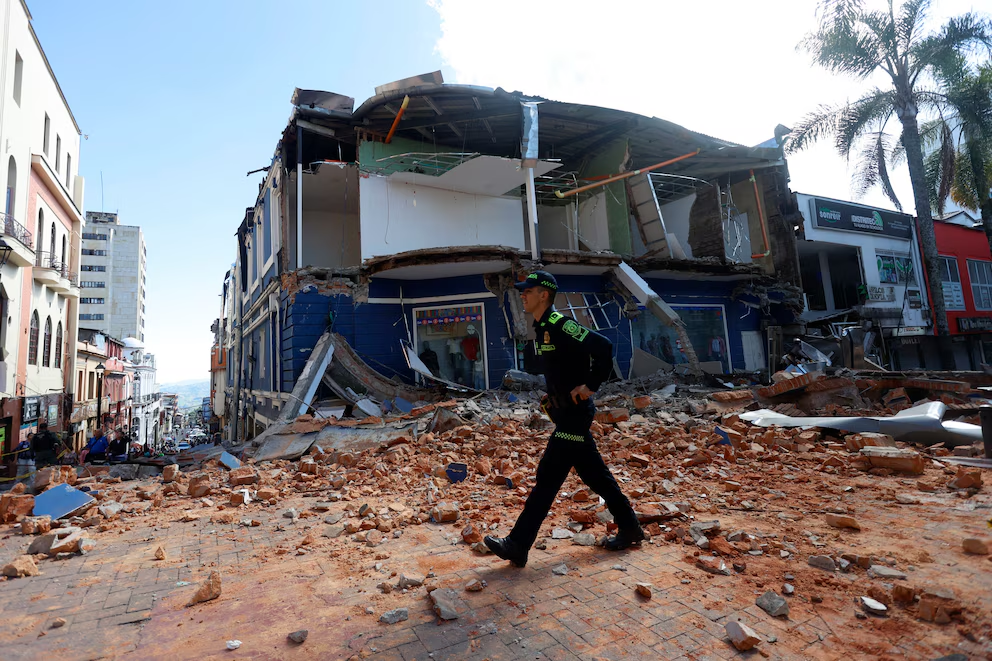

The United States Government announced this Monday $15.5 million in aid for Colombia following the 7.4 magnitude earthquake that struck the west of the country and left at least 111 dead and 87 injured, according to the latest official report. The State Department specified that the funds will be allocated for emergency shelter, food, protection, and assessments of the damage caused by the earthquake.
The announcement was made through the State Department’s official account on the social network X, where the agency expressed its solidarity with the Colombian population. “We are united in prayer with the Colombian people and are ready to support the president and his government as they assess the needs on the ground,” the U.S. agency noted in its statement.
Before the financial aid was made official, Secretary of State Marco Rubio had offered support to Bogotá and stated that the agency was monitoring the situation and was prepared to collaborate with Colombian authorities. Rubio also urged U.S. citizens in Colombia to register on the Department of State’s website and to follow the Embassy in Bogotá’s official social media accounts to receive assistance and verified information.
Other American political figures also expressed their support. Republican Senator Bernie Moreno, born in Bogotá, stated that the United States is ready to support its “great ally” and highlighted the leadership of the newly inaugurated Colombian president.

We recommend reading:
A multitude of people, including emergency personnel, carried out a rescue operation at a notary’s office in Cali.
The earthquake, according to the Colombian Geological Service (SGC), had its epicenter in the municipality of San José del Palmar, in the department of Chocó, on the Pacific coast. The movement was recorded at 7:34 local time and was felt strongly in Bogotá, Cali, Medellín, Manizales, Pereira, Armenia, and Popayán, in addition to being perceived in Ecuador and Panama. The general director of the SGC, Julio Fierro Morales, pointed out that it was the largest tremor recorded in the country in the last decade.
The cities of the Coffee Axis, especially Manizales and Pereira, are among the hardest hit, with building collapses and damage to infrastructure such as the Matecaña International Airport. The governor of Chocó, Nubia Carolina Córdoba, reported injuries and serious damage in the departmental capital, Quibdó, even though the epicenter was located far from the urban center.
The Colombian government declared a national disaster hours after the earthquake. The Vice President, José Manuel Restrepo, traveled to Manizales to lead the Unified Command Post from where the emergency response is being coordinated, and announced that he will work together with the Foreign Ministry to manage the arrival of international resources and support. The three lines of the Manizales cable car remain out of service while the total evacuation of passengers proceeds.
The response to the catastrophe constitutes the first major challenge for De la Espriella, who assumed the presidency last Friday in Cali, replacing the leftist Gustavo Petro. The 48-year-old criminal lawyer, who holds dual Colombian and American citizenship, won the election by a margin of less than one percentage point over the leftist candidate Iván Cepeda, backed by Petro, who has alleged electoral fraud without presenting evidence so far.
De la Espriella has established himself as a close ally of Donald Trump, who endorsed his candidacy and described the new Colombian president as a “great president.” Days before the earthquake, Washington had already celebrated the inauguration of the new government and announced its intention to allocate 1 billion dollars to Colombia for a security package, as part of a bilateral rapprochement that contrasts with the tensions that marked the relationship during the Petro administration. This political closeness partly explains the speed with which Washington activated its aid just hours after the earthquake.
With search and rescue efforts still underway, the challenge for the new government will be twofold: to effectively channel international aid and demonstrate management capacity in its first crisis, just three days after taking power.