

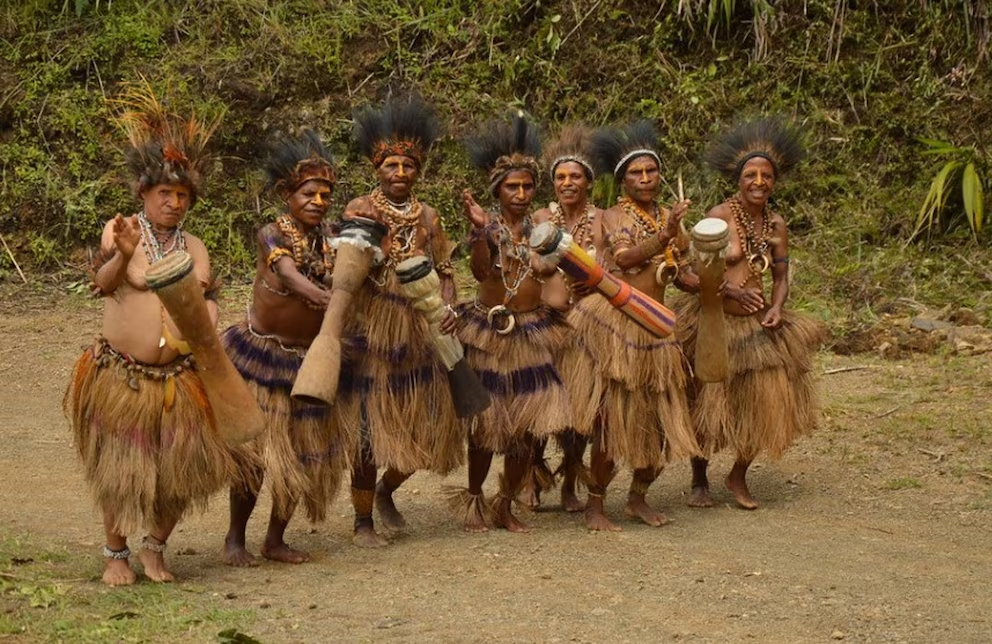
A team of European scientists managed to explain the origins of the inhabitants of Papua New Guinea, one of the most mysterious and unique populations on the planet. For years, the origin of the Papuan population was debated due to their differentiated physical characteristics. The partial similarity with sub-Saharan African groups led researchers to propose the “First Out of Africa” theory, which suggested that their ancestors followed a coastal route more than 50,000 years ago, reaching Oceania before other human groups. However, advances in genetics questioned that possibility, as previous studies did not identify clear signals of such separate migration. Now, the use of artificial intelligence confirms the link of the Papuans with the great Asian migrations, coming from a single exit from Africa that encompasses all non-African peoples. The work is distinguished by the application of advanced computational models capable of analyzing large volumes of genetic information and simulating different historical scenarios. Among the tools used are the Relative Rate of Cross-Coalescence and statistical simulation methods with deep learning. The team pointed out: “The contributions of a First Out of Africa migration might not be necessary to explain their origins.” Artificial intelligence allowed the comparison of Papuan DNA with that of other Asian and Oceanian populations, finding notable matches that reinforce the idea of a single migration originating in Africa and spreading towards Asia and Oceania. The genetic modifications found in the Papuan population are mainly attributed to a history marked by isolation and low population growth, which justifies their unique characteristics compared to other regions. Isolation in small groups and a very slow demographic expansion accentuated these differences. The discovery has profound implications for the understanding of human evolution and planetary diversity. It demonstrates that history is marked by both large migrations and periods of isolation, and that small populations can preserve unique characteristics for millennia.
How Artificial Intelligence Helped Solve the Enigma
Furthermore, the research validates the ability of artificial intelligence and advanced genomics to analyze phenomena that until recently were impossible to decipher. According to Mayukh Mondal, team leader, this type of tool will allow for a deeper understanding of the roots of civilizations. One of the distinctive features of the Papuans is their high proportion of Denisovan DNA. Denisovans, distant relatives of Neanderthals, left a genetic legacy especially marked in Oceania and Southeast Asia. The analysis determined that this inheritance probably comes from encounters that occurred in the region, which gives a particular biological profile to the Papuan population. This legacy, added to the prolonged isolation, has contributed to the development of unique biological characteristics, both visible and invisible. Mayukh Mondal explained that, although the Papuans may physically resemble sub-Saharan groups, genetics shows a clear link with Asian populations. Mondal stated: “Perhaps adaptations to tropical climates make them look more like sub-Saharan groups, although their genetics clearly links them to other Asian populations. More studies are needed to discover how evolution has shaped this extraordinary population”. The study provides another essential piece to the historical puzzle: after arriving in New Guinea, the Papuan ancestors went through a population bottleneck, with a very reduced number of individuals that remained restricted for thousands of years. Unlike other regions where agriculture favored demographic growth, the Papuans remained isolated, which left deep marks on their genetics. This explains why their genetic profiles may suggest a different or mysterious origin, when in reality it is the traces of isolation and slow population growth. The research represents a significant advance, although open questions remain. While it rules out the need for a separate African migration, the authors do not completely exclude that some early migration may have left a minor footprint. Understanding the influence of natural selection and mixing with other human species continues to be a challenge for the future. The authors emphasize that interdisciplinary collaboration and the use of artificial intelligence will continue to redefine knowledge about human history. Each advance will allow a better understanding of the complexity and richness of the origins of peoples, especially in regions as isolated as Papua New Guinea. Science, through current technologies and methods, has progressed towards the remote past, facilitating the understanding of why humanity is the way it is and where it comes from. This finding not only solves an ancient enigma, but also opens new routes to explore the remarkable human diversity.SOURCE: INFOBAE