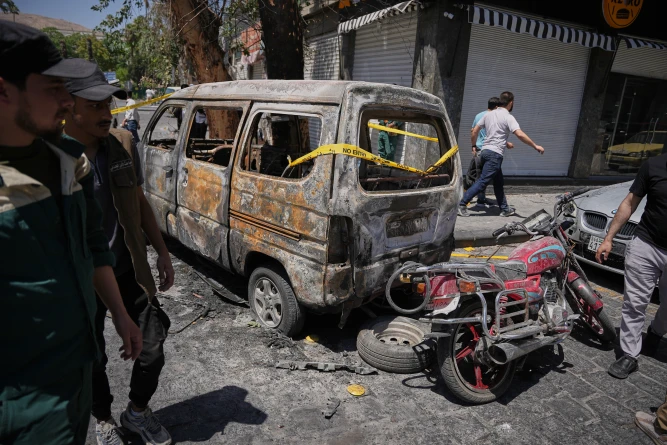

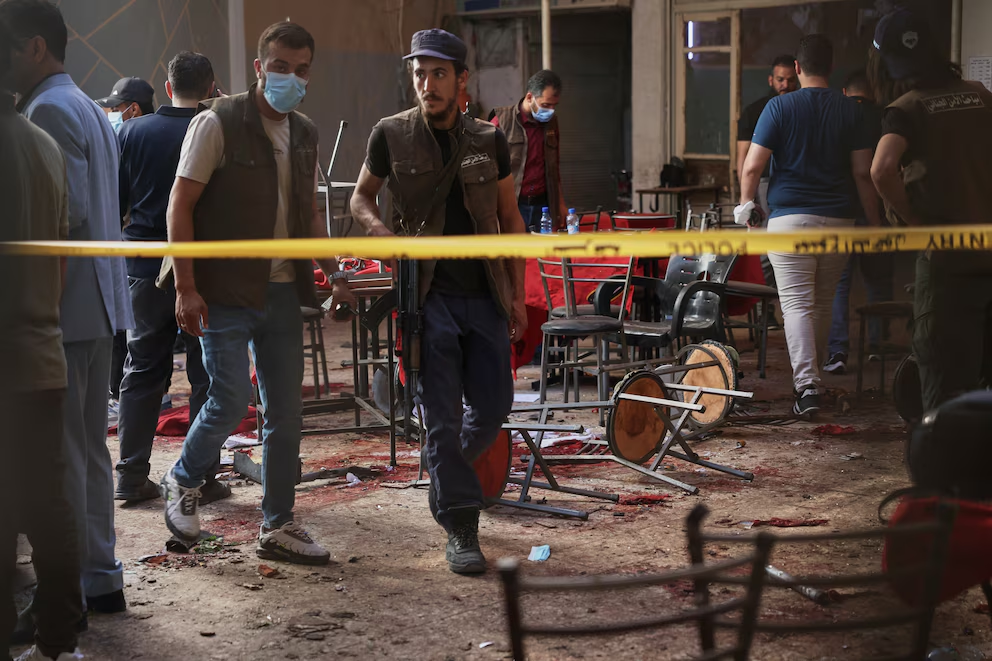

Syria’s Interior Minister, Anas Khattab, announced this Thursday the arrest of the cell responsible for the attacks that shook the center of Damascus last Tuesday, during the official visit of French President Emmanuel Macron. The attacks, carried out using two improvised explosive devices, left one dead and 36 injured and highlighted the fragility of the stabilization process that the government of President Ahmed al-Sharaa is trying to consolidate, eighteen months after the fall of the Bashar al-Assad regime.
Khattab announced the capture via the social network X, in a message reported by the official Syrian agency SANA. According to the ministry, the operation consisted of a series of simultaneous raids carried out in different parts of Damascus and its periphery, covering four neighborhoods of the capital. Two of them, as reported by the AFP agency, have a majority Alawite population, the religious minority to which Assad belonged and which for decades concentrated the country’s political and military power. The official announced that, once the investigations are concluded, the authorities will publicly reveal the identity of those detained, their roles within the cell, and the entirety of their connections and links.
The attacks took place on the morning of Tuesday, July 7, when Macron had already left the Four Seasons hotel—where he had spent the night—headed for the presidential palace to meet with Al-Sharaa. The homemade bombs were placed in two different locations: one inside a vehicle parked next to the road and another inside a trash container, about 200 meters away. The force of the explosions shattered the windows of the Ministry of Tourism, located opposite the hotel, and left a trail of metal debris and bloodstains in the area.
We recommend reading: Explosions rock the Syrian capital during French President Macron’s visit

A vehicle stops as a convoy of Syrian Interior Ministry forces passes on its way to the town of Qamishli, where the forces are deployed under a ceasefire agreement with the Kurdish-led Syrian Democratic Forces, on Tuesday, February 3, 2026, near the village of Mazraat al-Nahar, in northeastern Syria.
The final health report, according to the Ministry of Health, amounts to one death and 36 injured: 31 suffered minor injuries and were discharged after receiving treatment, while five remain hospitalized in stable condition. Four required surgical intervention and one was in critical condition, according to the Damascus Health Director, Wael Daghmash. The Ministry of the Interior explained that the devices had been located by specialized units during field operations, but that both detonated before the deactivation operation could be carried out.
Macron arrived in Damascus on Monday, July 6, becoming the first European Union head of state to visit Syria since the fall of Assad in December 2024. In the joint press conference held after the attacks, he urged not to be “destabilized” by these types of attacks and reiterated Paris’s support for the new Syrian government. His delegation included several executives from large companies, among them the CEO of TotalEnergies, Patrick Pouyanné, which underscored the economic component of the visit.
Tuesday’s attacks are part of an escalation that is worrying the new authorities. Just five days earlier, on July 2, a bomb had exploded in a café in downtown Damascus frequented by lawyers and located in the vicinity of the Palace of Justice, causing ten deaths and 21 injuries. That court is where, since May, the trials against high-ranking officials of the ousted Assad regime, accused of murder and the repression of the 2011 protests, have been held.

Although no group has claimed responsibility for the attacks, analysts point to three main lines: the Islamic State, which since February has claimed several attacks against Syrian security forces; remnants of the former regime, with an interest in destabilizing Damascus’s rapprochement with the West; and networks linked to pro-Iranian militias that maintain a presence in the country. The identity of the detainees and their connections, when revealed, will tell which of these hypotheses holds up.