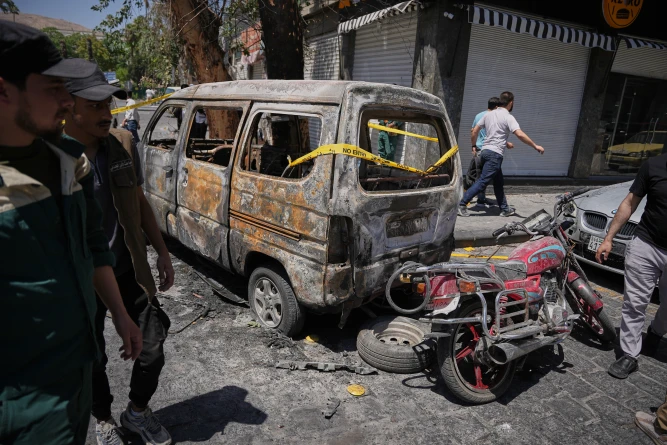
Syria.— Several explosions rocked the capital of Syria on Tuesday, injuring at least 18 people while the French president was meeting with his counterpart during a historic visit to the country, which is rebuilding after years of civil war, according to the Syrian Interior Ministry.
It was the second attack in Damascus in a week and a setback for President Ahmad al-Sharaa, who was hosting the first major Western leader to visit the city since the overthrow of dictator Bashar al-Assad by insurgent groups in late 2024. Syria’s new rulers have grappled with outbreaks of violence as they consolidate their control, but the capital had remained largely peaceful.
French President Emmanuel Macron was at the presidential palace when the explosions occurred. An Élysée Palace official stated that Macron was safe and that the meeting with Al-Sharaa continued, although they spoke on condition of anonymity to discuss his security.
“Nothing can stifle the aspiration of Syrian women and men to live in a fully sovereign, secure, pluralistic and united Syria,” Macron declared hours later. “This morning I met Syria in all its diversity. I saw dignity, courage and determination.”
We recommend reading: At least 18 injured in two explosions in the center of Damascus during Emmanuel Macron’s visit

Subsequently, Al-Sharaa and Macron announced that they had agreed to reappoint ambassadors after more than a decade, which marks a significant restoration of diplomatic relations.
“Our meeting marks a historic milestone,” said al-Sharaa. France had closed its embassy in 2012, but symbolically reopened it at the beginning of 2025.
Macron, who played a fundamental role in pressuring Europe and the United States to lift most of the sanctions imposed on Syria under the Assad regime, was in Damascus before heading to Ankara, Turkey, on Tuesday afternoon for a NATO summit that al-Sharaa would also attend.
More Read


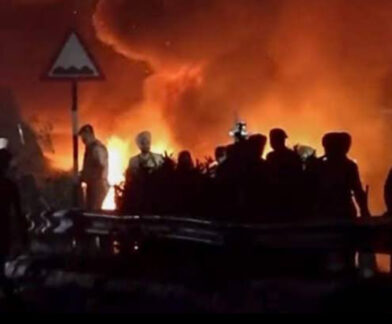
A large column of smoke was observed at the site of the explosion, near the Four Seasons Hotel, where, according to Syrian media reports, Macron was staying. Images circulated on social media of a burning van and motorcycle, as well as bloodstains on a busy street near the headquarters of the Ministry of Tourism and the National Museum of Damascus.
According to a statement released by Syrian state media, the Interior Ministry reported that one bomb had been placed in a trash container and the other in a parked car. It added that four of the injured were police officers and that no deaths were reported immediately.
On Thursday, an explosive device detonated in a coffee shop near the Courthouse, causing the death of at least 10 people and leaving more than 20 injured.
The Syrian government considers that Macron’s visit and the signing of more than a dozen agreements with Paris and major French companies represent a significant boost for the country’s new authorities in their efforts to rebuild a country devastated by a 14-year uprising that turned into a civil war under Assad’s rule.
One of the agreements consisted of initiating the process of returning approximately 51 million euros (58.3 million dollars) in illicit assets belonging to Rifaat Assad, the late uncle of Assad. Other agreements included the reconstruction of water and electricity infrastructure destroyed in the city of Homs, the provision of technical assistance to the Central Bank of Syria during its financial reform process, and the strengthening of cargo infrastructure at the Damascus airport.
“The result of this visit confirms that Syria is moving firmly toward a new phase of international alliances based on common interests and mutual respect,” a Syrian Foreign Ministry official told the Associated Press, adding that those responsible for the attack will be brought to justice. “Attempts to destabilize the country will not alter this trajectory.” The official spoke on condition of anonymity, in accordance with the rules.
More Read

The explosions pose a challenge for al-Sharaa, who has strived to impose his total control over Syria, attract minorities skeptical of his Islamist government, and win the support of Western governments, concerned about his past leadership of the Hayat Tahrir al-Sham group, formerly linked to Al Qaeda. His government has promised political and economic reforms after decades of autocratic rule.
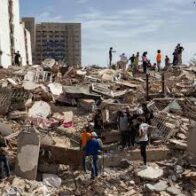
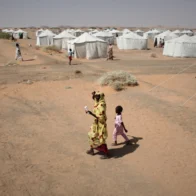
The conflict in Syria has caused the death of nearly half a million people and the displacement of millions. The infrastructure is in ruins. While other nations and companies have promised large investments, the country still needs hundreds of billions of dollars to rebuild and lift millions of people out of poverty.