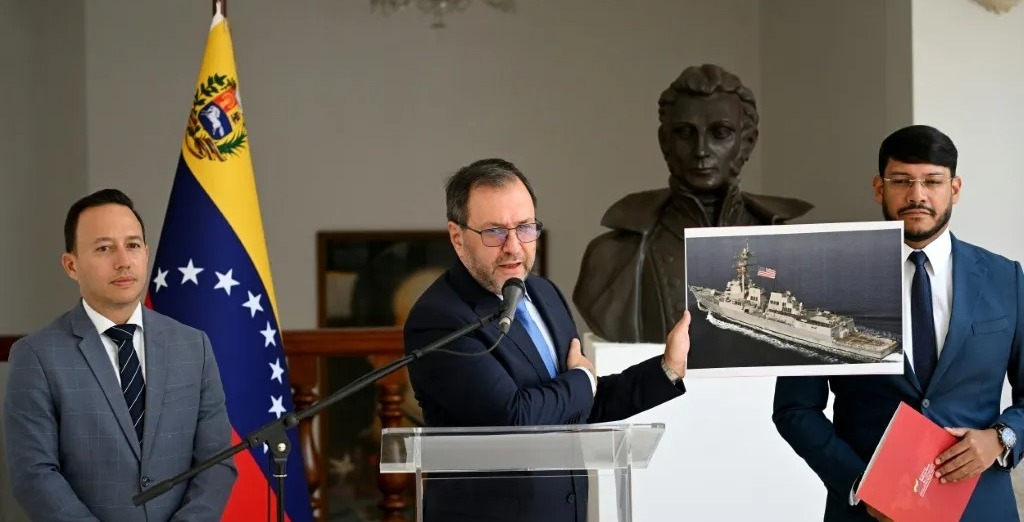
Venezuela’s Defense Minister, Vladimir Padrino López, denounced this Sunday that US aircraft frequently fly over the Caribbean Sea near the Venezuelan coasts. “Most of the time they violate operational rules, because they don’t file their flight plan, which can cause accidents,” he said at a conference on the balance of operations and deployment. According to the minister, the flights went from a daytime pattern to one of night and early morning, while in August intelligence and exploration operations against the South American country tripled. In this regard, he reported that on Saturday night intelligence aircraft were detected, tankers that supply fuel in flight, as well as RC-135 aircraft of “strategic reconnaissance and intelligence designed to collect real-time information up to 200 miles”.
Also, other planes that pass are the Boeing E-3 Sentry, which is an airborne early warning and control system. It is an airborne command post equipped with long-range rotating radar, capable of performing air and surface surveillance, electronic detection, command, control and communications functions.

Caracas’s Stance
Venezuelan President Nicolás Maduro has declared that the accusations of drug trafficking against his country are a lie “as crude and false as that Iraq had weapons of mass destruction.” In that context, he indicated that “Venezuela is not a relevant country in terms of drug trafficking” and stressed, citing UN data, that all cocaine is produced in Colombia, which “has more than 400,000 hectares of coca leaves.” Furthermore, in his exclusive conversation with RT, the Venezuelan president accused the governor of Puerto Rico, Jenniffer González, of turning the island into the epicenter of the “military operation” against the South American country. In this context, he maintained that the Bolivarian country “has eight warships, destroyers, in the Caribbean.” “That has never been seen. It is only remembered when the October 1962 crisis, when they blockaded Cuba,” he emphasized. Last August, international media announced a U.S. military deployment in the southern Caribbean to, supposedly, confront drug cartels. Similarly, U.S. Attorney General Pamela Bondi doubled the reward for information leading to the arrest of Venezuelan President Nicolás Maduro, under the unfounded accusation of leading a “narcotrafficking cartel”. Caracas denounces that these maneuvers are aimed at forcing a political change and seizing the natural resources that the South American country possesses. To counter the US deployment, Maduro called for voluntary enlistment in the Bolivarian Militia for the defense of the nation’s sovereignty. Despite the increase in friction, the Venezuelan president has shown himself open to dialogue with the US president, Donald Trump, as long as the “gunboat diplomacy” of his Secretary of State, Marco Rubio, is not imposed. In early September, the Pentagon denounced that two Venezuelan military aircraft had flown “near a US Navy ship in international waters”, which it called a “provocative” move to interfere with its “counter-narcoterrorism operations” in the area. Later, Trump threatened to shoot down Venezuelan military aircraft if they put the U.S. “in a dangerous position.” Meanwhile, Maduro declared that the country will resort to armed struggle if it is subjected to aggression. In this context, he pointed out that Washington “must abandon its plan for a violent regime change in Venezuela and throughout Latin America and the Caribbean.”