
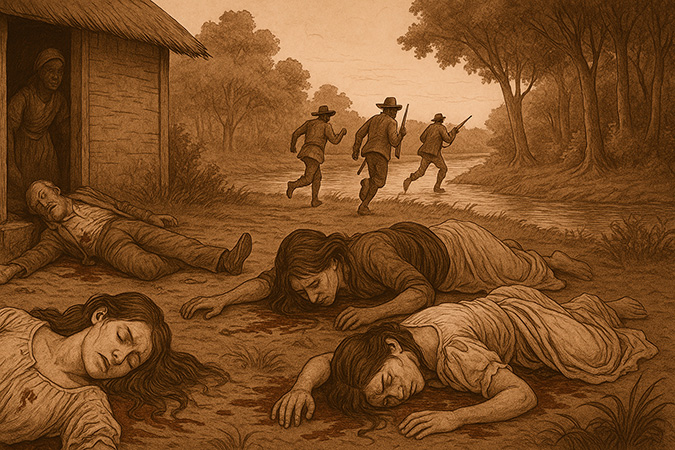
This crime occurred on an estate located on the outskirts of Santo Domingo, near the Ozama River, in the Galindo community. According to the literary chronicle of the writer César Nicolás Penson, included in his work Cosas añejas published in 1891, armed men broke into the family residence, murdering the father of the young women, Don Andrés Andújar, and then attacking his three daughters, who were raped and dismembered. The only surviving witness was Isabel, a mute slave who remained hidden during the crime.
A Literary Story Turned into a Symbol
Penson’s text turned this episode into a symbol of the horrors attributed to the Haitian occupation of 1822. The story, full of drama, was transformed into a recurring narrative in Dominican education and in the nationalist collective imagination.
For decades, Las Vírgenes de Galindo have been presented as martyrs of Dominican identity, victims of an act of barbarity committed —according to Penson’s version— by Haitian soldiers.
Historical Controversy and Documentary Review
However, subsequent investigations have revealed a more complex reality. Historians have identified the assassins as Pedro Cabial, Manuel de la Cruz, and Alejandro Gómez, three common criminals who were tried and convicted by the Haitian authorities themselves, which dismantles the idea of an action ordered from the military power.

These findings have sparked a debate around the use of the case as a political symbol, and have prompted a reflection on how literature and official history have shaped a version of events for nationalist purposes.

The Construction of a National Memory
Despite the controversy, Las Vírgenes de Galindo continues to be one of the most widespread stories when addressing the period of the Haitian occupation. It is a narrative that mixes real events, political interpretations, and collective emotions, demonstrating how stories of the past can be told —and reinterpreted— according to the needs of the present.
Today more than ever, this story demands to be reviewed with a critical eye, which recognizes the sensitivity of the event, but also the need to separate emotional memory from documented historical truth.