


Santo Domingo.- To commemorate the 150th anniversary of the death of the father of the nation, Juan Pablo Duarte, President Luis Abinader stated that the best tribute to the founder of the Republic consists of turning his ideals into public conduct and civic commitment, preserving national independence, strengthening democracy, and aggrandizing the nation through justice, work, and unity.
During the ceremony, the president highlighted that, a century and a half after his physical passing, Duarte’s legacy, example, and thought continue to live on in the national consciousness and in the foundations of the Dominican Republic.
“One hundred and fifty years have passed since his departure, but the nation that Duarte dreamed of continues to call upon us. It is up to us, and to the generations to come, to preserve its independence, strengthen its democracy, and make it greater through justice, work, and national unity,” expressed the head of State.
President Abinader maintained that Duarte should be recognized as one of the great precursors of Dominican constitutional thought and recalled that his independence project, more than simple political separation, sought to promote the construction of a truly free, sovereign Republic sustained by the rule of law.

We recommend reading:
“For Duarte, independence and the law were inseparable. Sovereignty had to reside in the nation; power had to be subject to the Constitution; and all authority had to exercise its functions with legitimacy, responsibility, and respect for the rights of the citizens.”
Likewise, he pointed out that the Duarte ideology remains fully valid every time national sovereignty is defended, constitutional norms are respected, democratic institutions are strengthened, and the collective interest is placed above particular interests.
The president also highlighted that true patriotism is expressed in the fulfillment of duty, honest work, respect for others, and a vocation for service, values that marked the life of Duarte, who sacrificed his wealth, tranquility, and even his own safety for the sake of national independence.

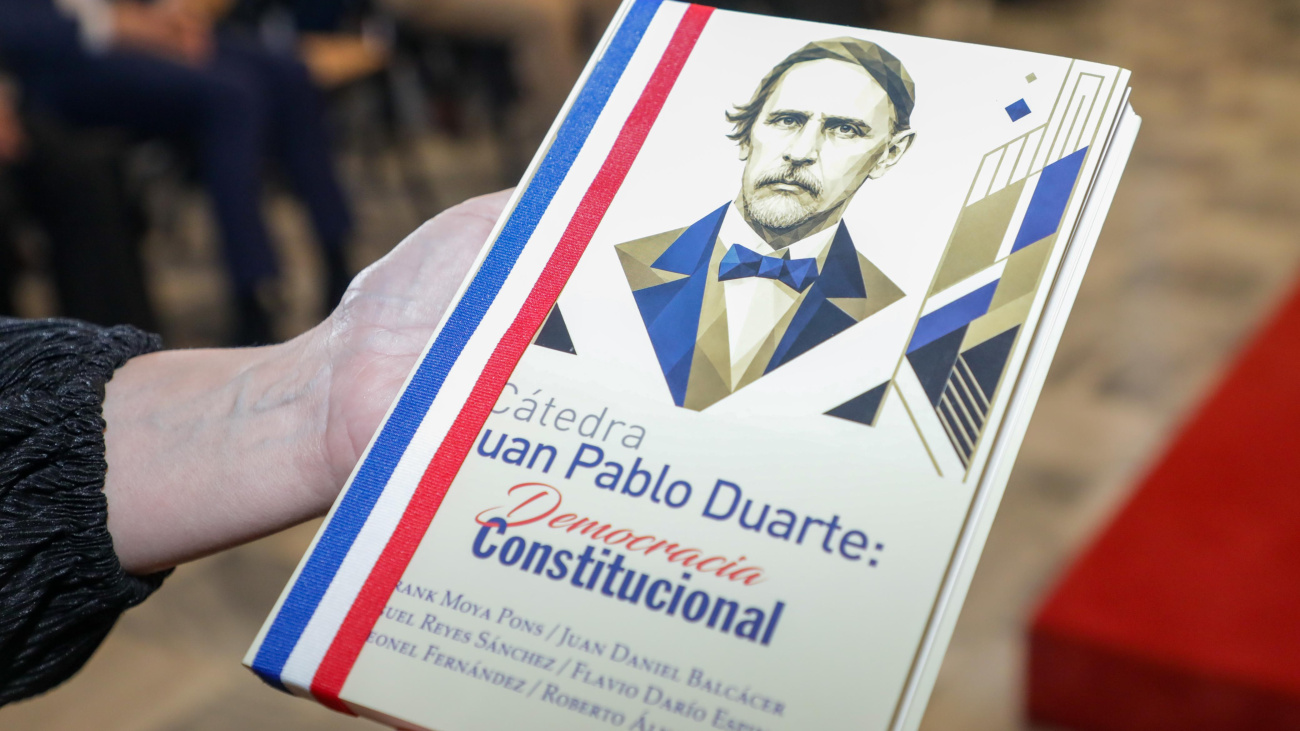
Juan Pablo Duarte Chair: Constitutional Democracy
As part of the commemoration, Miguel Reyes, president of the Dominican Academy of History, announced the release of the book Juan Pablo Duarte Chair: Constitutional Democracy, which gathers valuable reflections on the construction of the Dominican State, independence, and national identity, as well as sovereignty along with the democratic and constitutional dimension of Duarte’s thought.
He explained that the book allows for an appreciation of the relevance of Duarte’s thought from different perspectives, presenting Duarte not only as the founder of the Republic, but also as a political thinker, constitutional precursor, defender of national sovereignty, and a benchmark for a public life guided by law, justice, and the common good.
Reyes pointed out that the publication constitutes a reference tool for researchers, teachers, and students, as well as a way to preserve historical memory, encourage study, and strengthen citizenship. The publication was produced jointly by the Dominican Academy of History and the Constitutional Court.

Commemorative medal
During the event, the commemorative medal for the 150th anniversary of the death of Juan Pablo Duarte, minted especially for the occasion, was also presented.
“The book and the medal represent two expressions of the same national purpose: to keep Duarte’s memory alive and reaffirm the principles that gave rise to the Dominican Republic,” expressed President Abinader.
Meanwhile, the president of the Permanent Commission of Patriotic Efemerides, Juan Pablo Uribe, highlighted that the medal is of great historiographical value and a total of 150 were issued to symbolize the 150 years since his passing
The event was attended by the Administrative Minister of the Presidency, Andrés Bautista; the Minister of Defense, Carlos Antonio Fernández Onofre; the Minister of Culture, Roberto Salcedo; the Minister of Higher Education, Science and Technology, Rafael Santos Badía, and Constitutional Court judge Manuel Ulises Molina, as well as academics and historians.