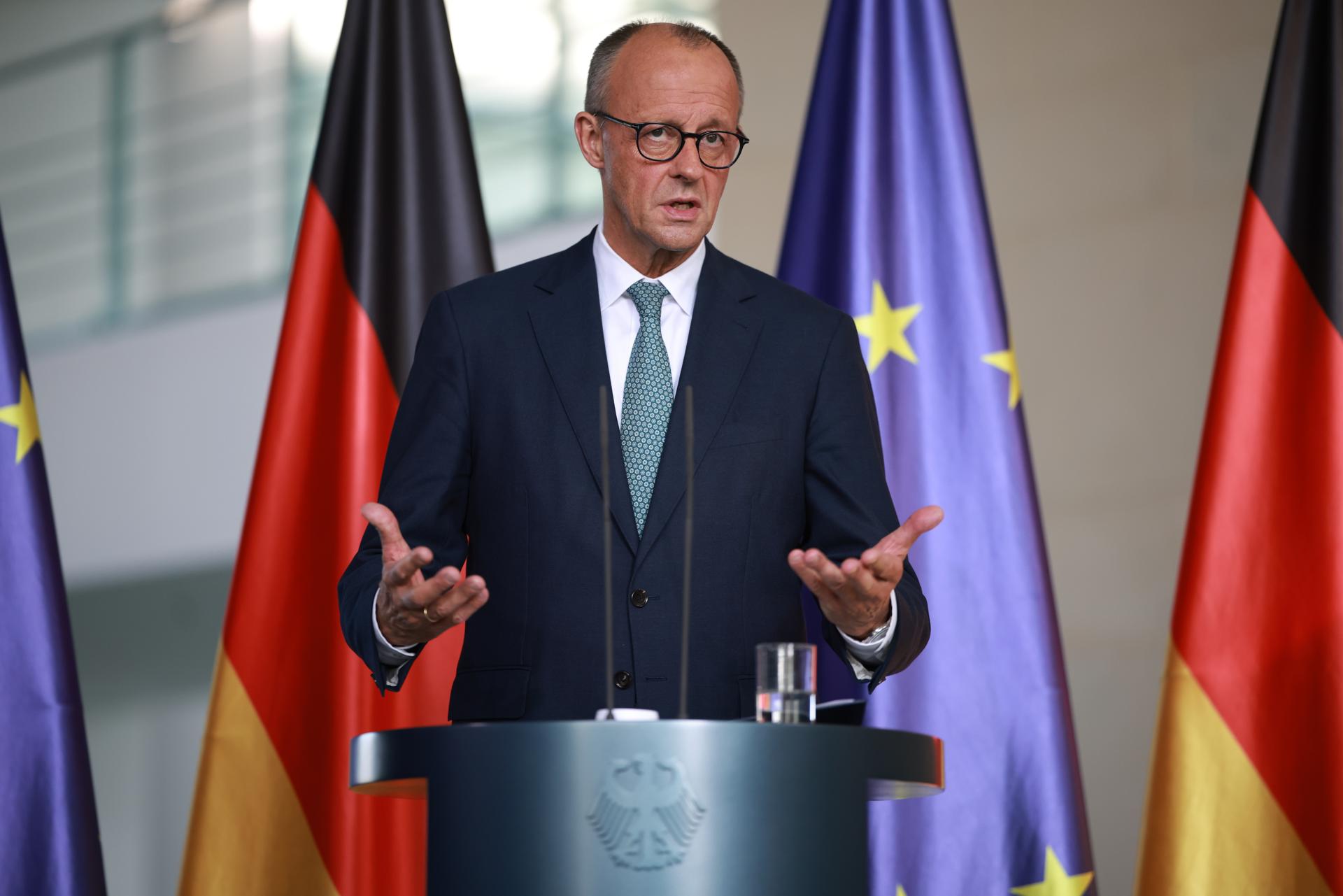
Berlin.- German Chancellor Friedrich Merz announced this Friday that his Government will suspend exports to Israel of weaponry that could be used in the Gaza Strip until further notice, after Benjamin Netanyahu’s Executive approved a military plan on Thursday to occupy the city of
Gaza.
Merz stated in a statement that this plan does not allow to understand how Israel intends to achieve the objectives of disarming Hamas, achieving the release of the hostages and quickly undertaking negotiations for a ceasefire.
“Under these circumstances, the Federal Government will not approve any exports of military material that could be used in the Gaza Strip until further notice,” Merz emphasized, in what is an unprecedented decision for a German Government.
The conservative chancellor pointed out that Israel has the right to defend itself against Hamas terrorism, but expressed his “deep concern” for the suffering of the civilian population in Gaza.
“With the planned offensive, the Israeli government bears an even greater responsibility than before to supply them (the civilians),” Merz stressed, who did not explicitly condemn the plans to take control of the city with a million inhabitants located in the north of the enclave.
On the contrary, he stressed that Israel must allow comprehensive access for humanitarian aid and also for UN organizations and other non-state institutions, as well as improve the humanitarian situation in a lasting way “following the steps in the right direction of recent days”.
In addition, Merz urged the Israeli government “urgently” “not to take further steps towards an annexation of the West Bank”.
The Israeli government’s security cabinet approved a plan early this morning that includes taking Gaza City and, according to Israeli media, displacing its million inhabitants to the south, hours after Netanyahu announced on the American network Fox News that his intention is to occupy the entire Palestinian enclave.
The previous German government, under Social Democrat Chancellor Olaf Scholz, informally suspended arms exports – but not military material – to Israel for some months last year, according to export authorization records, but never confirmed it publicly and sales resumed in the fall of 2024.
Since his arrival in power in May of this year, Merz has been subjected to increasing pressure both in Germany and abroad to harden his stance regarding Israel.
Although at first he flatly ruled out the possibility of imposing any type of sanctions, in recent weeks he hardened his rhetoric and affirmed that he reserved the option of taking measures if Israel did not reconsider in the face of the diplomatic efforts of the group known as E3 (Germany, France and the United Kingdom).