Gaza City/Jerusalem.- The malnutrition crisis in
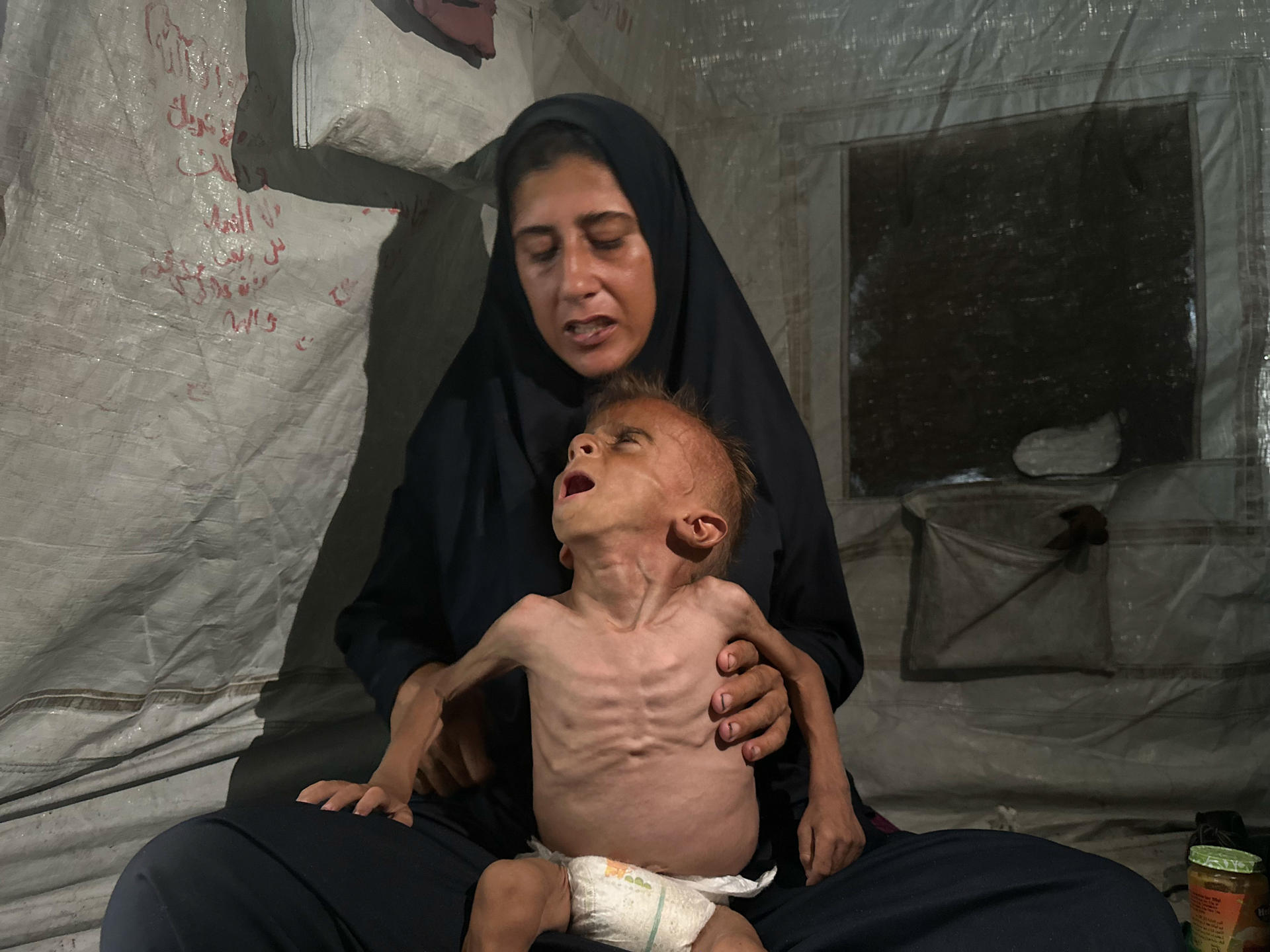
Gaza gained visibility with images like that of little Mohamed Motawaq, with a swollen belly and skeletal arms. Israel assured that theirs was the photo of “a sick child” used by the press to spread a false famine in Gaza, something that the child’s mother not only denounces, but also assures has worsened his condition.
Hidaya receives EFE for the second time in her tent, this time after a video from the Israeli Ministry of Foreign Affairs on social media has questioned the situation of her son: “They have used the photo of a sick child to spread ‘fake news’ (…) This child suffers from a rare genetic condition that affects his muscles,” the recording alleges.
With Mohamed in her arms, Hidaya (31 years old) confirms that her son has a muscular weakness, but the conversation is permeated by the fear that hunger will kill him.
“Before, when he was receiving treatment, he weighed 9 and a half kilos, but during our displacement to Abu Sahira (on the coast of Gaza City), his health deteriorated due to the closure of border crossings (in March) and the scarcity of food, which caused him malnutrition and further aggravated his condition,” he explains.
Today it weighs 6 kilos. According to the World Health Organization (WHO), the average weight of a child of his age is around 11 kilos.
Hidaya looks tired, with dark circles under her eyes. She tries to manage her son, who alternates between crying and a continuous whimper. When mentioning Israel’s statements, she grimaces.
“Mohamed wasn’t like that, he was radiant, he laughed, he could hold the cell phone and the food with his hand. Today he can’t hold the cell phone or stand up,” he emphasizes.
Faced with increasingly severe muscle weakness without food or nutritional supplements to treat it, Hidaya points out that her son’s chest swelling is a direct consequence of malnutrition (a symptom of protein deficiency).
From July 2024 to 2025, 791 cases of severe acute malnutrition (its most deadly form) were recorded in children aged zero to 10 years old, the Gazan Ministry of Health told EFE. The WHO places 320,000 children (the entire population under five years old) as susceptible to suffering from it.
Accusations against the child Osama
Another case “denied” by Israel is that of Osama al Raqab, five years old. His photograph was the cover of the Italian newspaper Il Fatto Quotidiano.
Israel’s Foreign Ministry assured on July 28 that Osama, who was evacuated to Italy for treatment and is now visibly recovered, actually has cystic fibrosis.
In April, his mother met with EFE, assuring that the doctors had recommended “feeding him more meat, eggs, chicken. More protein and fatty foods like nuts.” But there was none of that. Israel then maintained the total blockade of Gaza (March 2-May 19): it had been more than seven weeks since food had entered.
“We thought he might have cystic fibrosis and we did the chloride test (in sweat) twice, but they came back negative,” Ahmad al Farra, the pediatrician at Nasser Hospital in Khan Yunis (south) who oversaw his case in Gaza, tells EFE in an exchange of messages.
Al Farra shares photographs of the blood tests performed on him at Nasser. Medical sources consulted by EFE indicated that these tests, among other low values, reveal moderate-severe anemia that may be chronic.
“She has hypochromic microcytic anemia. It’s due to an iron deficiency, this is seen in cases of severe acute malnutrition,” confirms Al Farra.
Between 11,000 and 13,000 people need to be evacuated to receive medical treatment abroad due to the lack of resources in Gaza, including 4,500 children, according to the WHO.
Cerebral Palsy and Malnutrition
“My daughter has cerebral palsy, atrophy in the brain,” explains Dina Raed Abu Harbid, 23 years old. Alaa, three and a half years old, is fed through a tube in a bed in a shared room at the Gaza City Patient Friends Society Hospital, the only one that treats malnutrition in the north of the enclave.
Alaa entered the hospital weighing 6.1 kilos and, thanks to the treatment, has managed to gain weight to 7.2. A girl of her age weighs an average of 15 kilograms. Cerebral palsy can favor the minor having a low weight, although for her mother it is not the only reason.
“Of course, she has two different illnesses. But before the war, my daughter was striving, she was supporting herself,” she laments.
Said Salah, the center’s director, says he could live with some normalcy despite his paralysis, but the shortage of food and supplements in the hospital hinders his recovery.
“The immune system worsens, infections cross, and the patient becomes even more complicated. What needed a week (of treatment) turns into needing several,” he explains, due to the lack of medications in the center.
When mentioning the accusations that the famine is a fabrication by Hamas, he draws a half-smile and raises his eyebrows with irony.
“Leave Hamas out. Let international media enter Gaza and see it (…). If Unicef, WHO, and all health workers say there is malnutrition in Gaza and the reporters who enter say there is malnutrition, and only one side says there isn’t, then it’s unbeatable,” he states.