The Pentagon announced this Friday the withdrawal of 5,000 soldiers stationed in Germany, in a decision that Defense Secretary Pete Hegseth formally ordered and that must be completed within six to twelve months. The measure, advanced by CBS News based on senior defense officials who were not identified, comes amid a worsening of tensions between President Donald Trump and German Chancellor Friedrich Merz over the war against Iran.
Pentagon spokesman Sean Parnell confirmed the order in a statement: “This decision follows a thorough review of the Department’s force posture in Europe and recognizes the requirements of the theater of operations and conditions on the ground”. Parnell did not answer questions about whether personnel would be relocated to other NATO countries.
The immediate trigger was a series of statements by Chancellor Merz to university students this week, in which he stated that “the Americans clearly have no strategy” and that he could not see “what strategic way out” they would choose. Merz added that the Iranians were “very skilled at not negotiating”, leaving the American envoys to travel to Islamabad “and then leave without any result”, and that the “entire nation” was being “humiliated” by the Iranian leadership. We recommend reading:Trump responded on his Truth Social platform, accusing Merz of believing that “it’s okay for Iran to have a nuclear weapon” and of “not knowing what he’s talking about.” “No wonder Germany is doing so badly, both economically and in other aspects!”, wrote the Republican. The day before, Trump had also urged the chancellor to take care of “fixing” his “broken” country and end the war in Ukraine before “interfering” in the conflict with Iran.

President Donald Trump and German Chancellor Friedrich Merz meet in the Oval Office of the White House in Washington, D.C., USA, on March 3, 2026. REUTERS/Jonathan Ernst
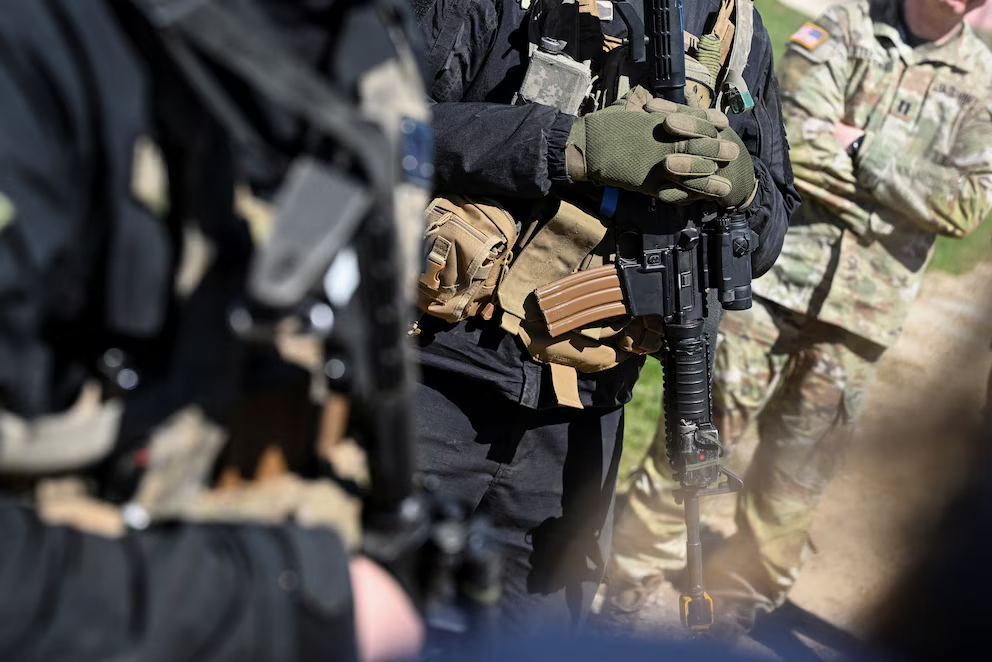
A senior Pentagon official who spoke on condition of anonymity specified, according to Reuters, that the reduction would bring troop levels in Europe to figures similar to those before 2022, before the Russian invasion of Ukraine prompted a reinforcement under the Joe Biden administration. Specifically, a combat brigade currently deployed in German territory will be withdrawn, and a long-range fire battalion that the Biden administration had planned to send to Germany at the end of this year will not be deployed. The decision is framed within Trump’s sustained pressure on his European allies to send their warships to contribute to the reopening of the Strait of Hormuz, a vital passage for global oil shipments that remains practically closed since the beginning of the conflict, generating turbulence in the markets and unprecedented disruption in the energy supply. Faced with the refusal of Italy and Spain, Trump also insinuated that he could withdraw troops from both countries. “Italy has not helped us at all and Spain has been horrible”, declared the president. Merz had initially backed the US and Israeli attacks against Iran, initiated on February 28 without prior consultation with NATO partners, as indicated by the Chancellor himself. Over time, his stance shifted towards increasing criticism, which has earned him reproaches from Washington. The German Foreign Minister, Johann Wadephul, tried to ease the tension on Thursday by assuring that his government would examine any reduction of forces with “calm”: “The United States needs these bases”, he stated, referring to Ramstein, Landstuhl and Grafenwöhr. Germany cedes the land of the facilities without charging rent and provides support staff to the US forces. Soldiers stand next to a barbed wire fence during a press day as part of the U.S. Army’s Combined Resolve exercise at the U.S. Army training facility in Hohenfels, Germany, on April 30, 2026. It’s not the first time Trump has threatened to reduce the military presence in Germany. In 2020, his administration proposed moving 12,000 troops, either to other NATO countries in Europe or back to the United States, but Congress blocked the measure, which Biden later reversed. At that time, Trump had accused Berlin of being “delinquent” for allocating to defense a figure well below the 2% of gross domestic product (GDP) target set by NATO. The German budgetary situation has changed substantially under the Merz government: according to projections, Germany will spend 105.8 billion euros on defense in 2027, with total spending expected for next year equivalent to 3.1% of GDP. That effort had received praise from US officials, although it has not been enough to contain the diplomatic escalation unleashed by the chancellor’s statements on the war with Iran.