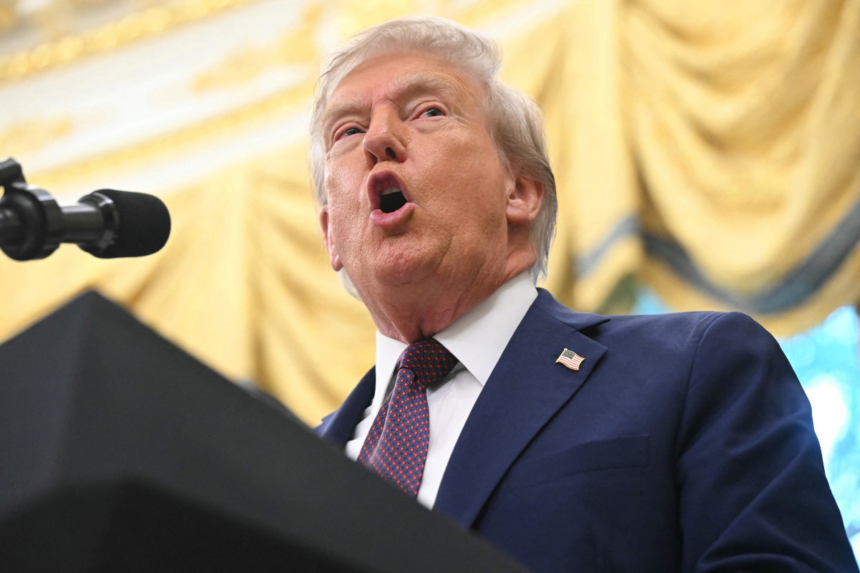
Washington.- U.S. President Donald Trump is, for now, maintaining his commitment to a negotiated solution with Iran to ease the crisis surrounding the Strait of Hormuz, despite pressure from Saudi Arabia for Washington to intervene militarily against the Houthis and the new spike in oil prices.
The position of the White House was exposed after Saudi Crown Prince Mohammed bin Salman directly asked Trump for military support to halt the advance of the Houthis, allies of Iran, on the Red Sea coast.
Read more: Trump calls Nvidia CEO and dismisses fears about artificial intelligence
Trump declined to order U.S. strikes against the Yemeni group, although Washington maintains its intelligence support for Saudi Arabia. U.S. officials have indicated that the administration’s priority is to prevent the conflict from spreading to a new front and to focus its efforts on the crisis with Iran and the security of maritime routes.
Strait of Hormuz
The decision places Trump before a growing dilemma: Riyadh is demanding a military response, while Washington is trying to keep a diplomatic channel open with Tehran, at a time when attacks against Saudi energy facilities and routes threaten to further reduce the global crude oil supply.
The situation has been complicated by the advance of the Houthis in Yemen. The group took strategic positions on the Red Sea coast, including the port of Mokha, and expanded its control over areas near the Bab el-Mandeb strait, one of the main maritime routes between the Red Sea and the Indian Ocean.
More Read

Bab el-Mandeb has gained greater importance due to the difficulties facing navigation through the Strait of Hormuz. The possibility of using alternative routes to transport Saudi oil to international markets has been affected by attacks and instability in Yemen.
Saudi Arabia also suffered attacks against energy infrastructure, including its East-West pipeline, a key route for transporting crude oil to the Red Sea without using the Strait of Hormuz. The disruption of the pipeline threatens to affect a significant portion of the global supply if repair work is prolonged.
The Saudi strategy of using alternative routes had gained importance since the conflict began to hinder transit through Hormuz. The goal was to reduce dependence on the strait and maintain oil exports to Europe and other markets.
More Read

However, the Houthi advance on Bab el-Mandeb and the attacks against Saudi infrastructure have reduced Riyadh’s room for maneuver.
For this reason, Mohammed bin Salman requested greater U.S. involvement from Trump. According to officials cited by U.S. media, the president rejected direct military intervention for now, although he authorized contacts between Saudi officials and U.S. military commanders to analyze intelligence and other forms of assistance.
The White House is thus trying to prevent an operation against the Houthis from ending up expanding a war that already involves the United States, Iran, and several regional actors.

Strait of Hormuz
While Washington talks about the possibility of reaching an agreement, Tehran maintains a tougher stance.
General Mohsen Rezaei, a member of Iran’s top security body, rejected the possibility of talks with the United States as long as the conditions set by Iran are not met.
The Iranian position leaves little room, at least for now, for immediate negotiation on the reopening of the Strait of Hormuz, precisely the point that Trump intends to resolve through diplomacy.
More Read

The planned talks between Iran and Gulf countries regarding navigation through the strait were also postponed, amid differences between Arab governments and the growing confrontation between Saudi Arabia and the Houthis.
Oil under pressure
Uncertainty is already reflected in the markets. Brent, the international benchmark, once again exceeded 108 dollars per barrel, while West Texas Intermediate (WTI), used as a benchmark in the United States, remains above 100 dollars.
The market fears that a prolonged disruption of Gulf export routes will reduce global supply and keep energy prices high.
The fear is not limited to the closure of Hormuz. Attacks on Saudi infrastructure and the crisis in Bab el-Mandeb are creating a second pressure point on global energy trade.
Analysts have warned that a prolonged disruption of the Saudi pipeline, combined with limited transit through the Strait of Hormuz, could push oil back toward levels of $120 per barrel or even higher, depending on the duration of the restrictions.
For Trump, the problem transcends foreign policy. More expensive oil means higher fuel, transportation, and production costs, and it can fuel U.S. inflation once again, just as the president faces political pressure ahead of the November legislative elections.
For now, the White House is trying to maintain a balance: avoid a new military intervention against the Houthis, keep pressure on Iran, and, at the same time, find a negotiated exit that allows for the normalization of navigation through the Strait of Hormuz.
While Washington bets on diplomacy, the crisis spreads across the region’s main energy routes and the oil market once again reflects the fear that the conflict will affect global supply for a prolonged period.