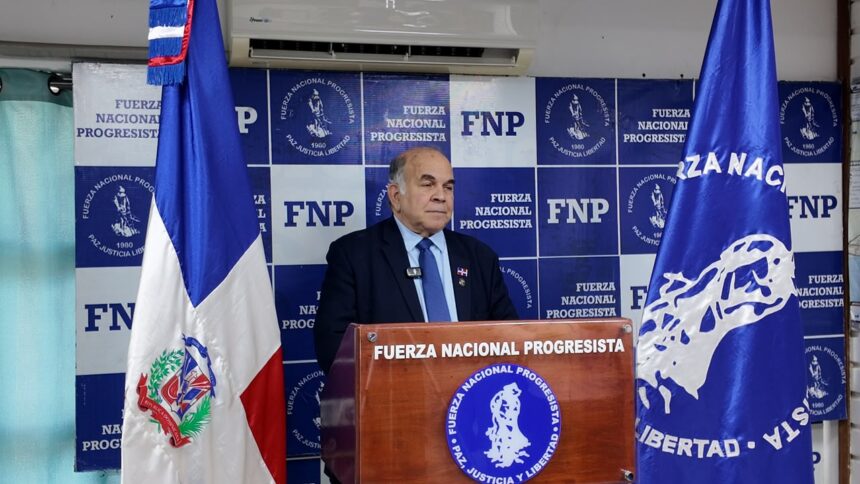
Santo Domingo.- The president of the National Progressive Force (FNP) and vice president of the Union of Latin American Parties (UPLA/IDU), Pelegrín Castillo, demanded that the Dominican Government declare a state of emergency to reinforce the defense of the border region in the face of what he described as a dangerous evolution of the Haitian crisis.
Castillo expressed concern, in particular, about a supposed anthrax outbreak in Haiti and warned that, if it were to enter Dominican territory, it could cause damage he described as “catastrophic,” maintaining that the Dominican Republic has historically been free of such diseases.
Read more: Pelegrín Castillo announces initiative “Dominicans, Let’s Confront the Haitian Invasion and Occupation”
During a press conference, the political leader also questioned the conditions for holding the elections scheduled for December in Haiti.
Referring to remarks attributed to the Secretary General of the Organization of American States (OAS), Albert Ramdin, regarding alleged links between political actors and criminal groups, Castillo maintained that currently there are no minimum conditions to guarantee free and credible elections.
The leader also asked the Dominican Government to “distance itself” from what he described as a “cynical masquerade” regarding the Haitian electoral process and to take a firmer stance on the Haitian crisis.
More Read
Haitian crisis and border
Castillo considered that border defense must occupy a priority place within the national and hemispheric security strategy.
In that sense, he reiterated his position that the situation in Haiti must be addressed through the strengthening and reconstruction of its own institutions, without shifting that responsibility to the Dominican Republic.
Request a review of DR-CAFTA
The president of the FNP urged the administration of U.S. President Donald Trump and Secretary of State Marco Rubio to promote a new stage of hemispheric relations based, as he proposed, on greater cooperation and strategic partnership between the countries of the continent.
More Read
In that context, he proposed reviewing and rectifying the Dominican Republic-Central America-United States Free Trade Agreement (DR-Cafta), especially regarding the protection of basic agricultural production.
Castillo particularly defended the Dominican rice sector, considering its production fundamental to the food security of the country and the region. He stated that the Dominican Republic must not sacrifice this sector and linked food security with national and continental security.

Question technological concessions
Another point raised by Castillo was the awarding of concessions for the exploitation of frequencies he considers strategic and their relationship with critical infrastructure, such as 5G technology and the Digital Wallet system.
In his view, these processes should be examined and approved by the National Security and Defense Council and by the Constitutional Court. He also proposed evaluating their possible revocation or readjustment.
Reject mandatory Creole
Castillo also rejected any legislative proposal that would make the teaching of Creole mandatory in Dominican schools, citing security arguments.
The FNP leader maintained that, instead of normalizing the migration situation through these types of measures, the country must focus on protecting its territory and reversing what he described as an “invasion with occupation.”
UPLA on the Haitian crisis
Castillo’s approaches were accompanied by a resolution from the Union of Latin American Parties, issued during its annual conference, in which the organization considers that the Haitian crisis represents a vulnerability to the collective security of the continent.
The UPLA supported the proposal to strengthen a regional defense architecture called the “Shield of the Americas” and stated that democratic nations must coordinate efforts against threats such as transnational organized crime and other forms of destabilization.
The organization also rejected any pressure for the Dominican Republic to assume a role that compromises its sovereignty or territorial integrity. It maintained that no country should be turned into a “containment zone” for an international crisis it did not cause.
At the same time, he proposed that the international community should promote a support scheme for the reconstruction of Haiti on Haitian territory, with technical and political assistance aimed at strengthening its institutions, the rule of law, and public administration.
Finally, the UPLA called for a review of the international efforts made so far regarding the crisis in Haiti and requested greater coordination between the governments of the region and multilateral organizations to combat arms trafficking and the criminal networks operating in that country.
Castillo concluded that the defense of the Dominican border must be considered an essential component of any hemispheric security strategy and reiterated that Haiti’s stability must be addressed primarily through the reconstruction of its institutions.