Bogotá (EFE).- The fever to fill the World Cup albums brings together thousands of fans every four years who seek to complete the collection of stickers of their favorite players, a craze that has turned shopping centers, parks and squares in Colombia into improvised scenarios where strangers negotiate the exchange of repeated stickers.
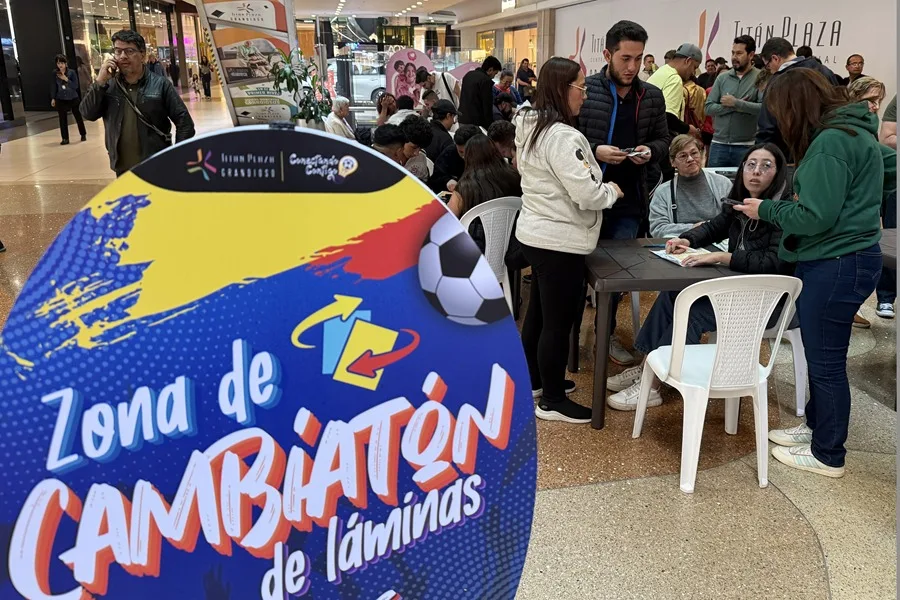
In the Gran Estación shopping center in Bogotá, in front of the Panini store, dozens of people gather, arriving with their lists written by hand or in an Excel file, for the more analog, while others use applications created to organize their collection.
Trading Card Exchanges Bring Generations Together in Bogotá
Fotografía que muestra a un joven pegando laminas en el álbum del Mundial de Fútbol 2026 en Bogotá (Colombia). EFE/ Carlos Ortega
The most recurring question among those interested is: “Do you have slides to trade?”
Then the business begins, children, young people, adults and the elderly pull out piles of repeated stickers while their attentive eyes look for that card that has been evading them for days among the piles of others.
Some parents who seem to relive the excitement of other World Cups accompany their children amidst the hustle and bustle to find names like Lionel Messi, Cristiano Ronaldo or Lamine Yamal, the most sought-after gems, capable of stopping conversations and provoking endless negotiations.
Among them is Diego Casas, a fan who is already experiencing his third World Cup filling the album on his own, as he used to do with his family.
“For me it’s very important because it’s like having the memory of the World Cup, of the players who were there,” he explained to EFE.
Collectors keep the World Cup tradition alive
Fotografía que muestra una persona con laminas del álbum del Mundial de Fútbol 2026 en Bogotá (Colombia). EFE/ Carlos Ortega
Although many people buy complete boxes of envelopes to quickly finish the collection, Casas maintains that he enjoys the exchange process and acknowledges that he prefers to go through the meeting points and negotiate the missing cards with other fans.
“I really like this dynamic of coming to change and what it means to keep alive a tradition that must continue to move forward,” he comments.
However, it acknowledges that this edition has been more difficult to complete because the organization system of the stickers has changed compared to previous World Cups, as players are now numbered from 1 to 20 in each team, and that has complicated the process for many collectors.
Fotografía que muestra personas intercambiando laminas del álbum del Mundial de Fútbol 2026 en Bogotá (Colombia). EFE/ Carlos Ortega
Exchanges not only occur in shopping centers but also in places where laminates are traditionally exchanged every four years, such as the Pablo VI neighborhood, where there are even street stalls where for 1,000 pesos (about $0.25) people can get the player they are missing.
Even so, the big stars, shields and commemorative cards can cost up to 50,000 pesos (about $14), which many are willing to pay to complete their collection.