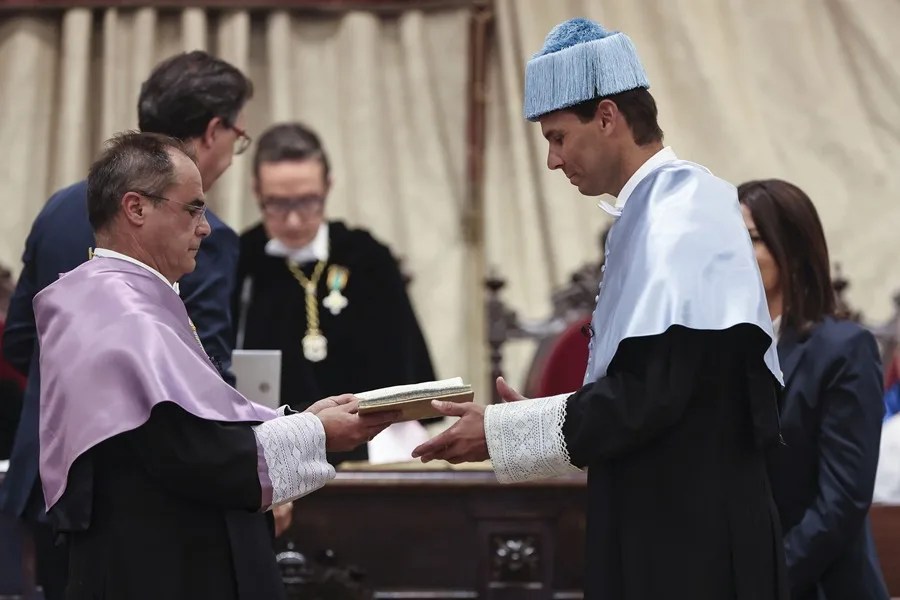
Salamanca (EFE).- Tennis player Rafa Nadal, new honorary doctor by the University of Salamanca, defended this Friday the value of sport as a “bridge” of “coexistence, cordiality and mutual respect” in a world marked by a “constant division and polarization”, which he has asked to combat with education.
You may be interested in:FIFA President reiterates the role of football as a vehicle for peace and unity
Before the assembly of doctors of the academic institution of Salamanca, gathered in the Paraninfo of the historic building for the investiture ceremony, Nadal has received a recognition that he considers as a result of the education received from his family, present at the event, and of the experience lived on the courts and his travels around the world.
In statements to journalists after the event, when asked about his references to the role of sport as an antidote to polarization, Nadal argued that this activity “has always been a point of union”: “It can serve as an inspiration for many other things that in this world, today, I think are wrong,” he detailed.
“I couldn’t be happier,” Nadal summarized at the beginning of his emotional thank you speech, in which he quoted former South African President Nelson Mandela to adhere to his conviction about the transformative power of sport: “Sport can create hope where there was only despair,” summarized the first athlete to receive the honoris causa from the University of Salamanca.
Nadal has assumed that his school and university have been the lessons he learned in training and matches against his rivals, among which he has highlighted discipline and daily effort, but also a “healthy ambition” in which “the end does not justify the means”.
“Nothing is achieved without daily effort, without commitment and without taking care of the small details, it is of little use to dream big if you do not work with intensity and with clear objectives on a day-to-day basis. It is the routine and the constant and silent effort where great successes really begin to be forged”, he added about his career.
Injuries and Resilience
The Prince of Asturias Award has highlighted that, beyond the many titles and awards obtained, the injuries and the uncertainty associated with them that he faced in his career taught him one of the “most valuable lessons”, to understand that “what is important is not only to return, but to return with enthusiasm, with energy and with the desire to keep fighting, even if the circumstances are not ideal”.
He has also maintained that it would have been “impossible” to face such a demanding career “without passion and without love”, also useful for reformulating the concept of ambition over the years: “It was a very valuable learning to understand and internalize that true ambition does not only consist of wanting to achieve a goal, but in trying to surpass oneself every day without ever losing sight of what really matters, the values that they taught me in my family.”
The lesson from his parents to the teenage Nadal
In this regard, Nadal has shared with the audience an anecdote he experienced at 15 years old, which he now sees as a lesson from his parents that he has appreciated and intends to reproduce with his son, present at a ceremony that he will have to watch on video, because he fell asleep in his mother’s arms.
At this point, the Balearic tennis player recalled that when he was a teenager and was «very excited» about being able to play the Roland Garros junior tournament for the first time, his parents prevented him because the dates coincided with the exams.

The University of Salamanca has proposed to build an alliance with the Rafa Nadal Foundation to collaborate in the development of future sports training centers and in other social areas that this entity already works in other Spanish cities. “Our relationship has only just begun,” stated the rector of the Salamanca academic institution, José Manuel Corchado, in the welcome speech to Nadal as a doctor honoris causa, at the event held in the Paraninfo of the historic building of the University. Asked about this issue at the end of the event, Nadal has been cautious about how that intention of the rector can materialize, although he has shown himself open to talk in the future. “We have spoken briefly about possible collaborations, what may happen in the future we will discuss and hopefully we can collaborate. Personally, collaborating with an institution like the University of Salamanca will always be an honor,” he summarized. The rector has highlighted that it is the first time that an athlete has been invested as a doctor honoris causa by the University of Salamanca, which he has linked to the values that the tennis player represents, among which he has cited effort, overcoming, and excellence.