

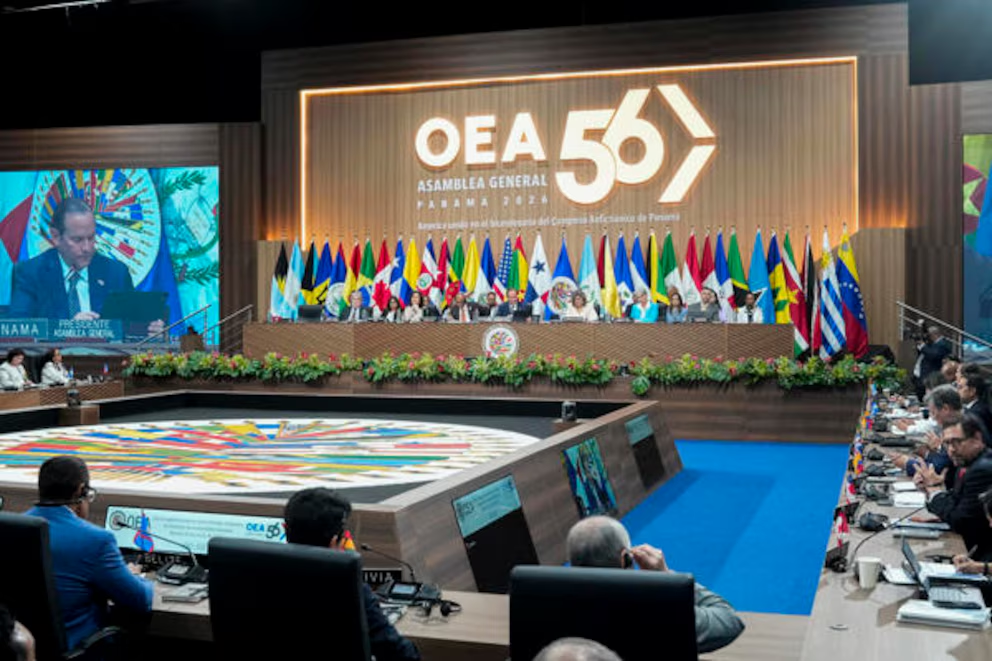

The Organization of American States debated the crisis in Nicaragua at least 64 times since 2018, but that monitoring resulted in only 11 resolutions of condemnation and failed to achieve changes regarding the regime of Daniel Ortega and Rosario Murillo, according to an assessment published by the Nicaraguan media outlet La Prensa.
Alexa Zamora Arana, an expert in international relations, argues: “The countries that make up the OAS are not willing to take more belligerent actions regarding contexts of dictatorships.” This phenomenon, she says, has been repeated in the recent past with other regimes, which increases the perception of insufficiency in multilateral mechanisms to resolve serious political crises.
A former diplomat consulted by La Prensa observes that the OAS mechanism “seems to be falling short and is very limited” in the face of omissions or lukewarm responses toward these regimes. Both analysts agree that the functions and powers of the OAS are restricted by the lack of consensus and real commitment from several of its members. “What they can do is increase their actions beyond condemnation, but this requires a political will that is not seen in all countries,” the source stated.
Ortega’s response and the exit from Nicaragua
The Nicaraguan regime’s response has been one of open confrontation. Ortega and Murillo have ignored the organization’s mandates, and following Nicaragua’s official exit from the OAS in 2022, the dictatorship confiscated the organization’s offices in Managua. In response to this act, the OAS issued a new resolution of condemnation on May 13, 2022.

The Chair of the Permanent Council of the Organization of American States (OAS) and Ambassador of Dominica, Steve Ferrol, speaks during a special meeting to analyze the political situation in Nicaragua, at the OAS headquarters in Washington, D.C., USA, on August 5, 2026. REUTERS/Kylie Cooper
Despite Nicaragua’s withdrawal, La Prensa reminds that the country must continue to respect international human rights treaties, and that the other members of the inter-American system remain obligated to work for democratic restoration. Zamora warns that the presence of a non-member state that violates these principles represents a threat to the entire region in areas such as security, migration, and the fight against drug trafficking.
The analysis by La Prensa highlights that part of the problem lies in the lack of commitment from some governments to promote democratic values and human rights. A former diplomat cites the silence of neighboring countries regarding the situation in Nicaragua as an example.
Expert Zamora interprets that many OAS member countries avoid intervening deeply for fear that coordinated action could have domestic repercussions. “It is as if they were thinking: I dare not get involved because this could come back to me,” she explained
Ramdin, the United States, and the Somoza precedent
The OAS Secretary General, Albert R. Ramdin, recently warned in The Washington Post, an American newspaper, about the need for a “unified and firm hemispheric response” to the disappearance of the electoral system in Nicaragua. “When repression crosses borders, it ceases to be a local matter,” maintained Ramdin in that article, cited by La Prensa.
In contrast to regional paralysis, La Prensa refers to the progress achieved by the United States through bilateral actions, such as the exile of 222 Nicaraguan political prisoners in 2023, the result of a direct negotiation between the dictatorship and the Joe Biden administration.
The past of the OAS offers a precedent: during the dictatorship of Anastasio Somoza Debayle, the organization went so far as to request his resignation, which was accepted by the dictator in 1979 following a formal request from the member foreign ministers. Although Somoza’s fall was due to multiple factors, in his resignation letter he expressly cited the disposition of the OAS.
The possibility that the OAS repeats a similar action against Ortega exists on a formal level, since the General Assembly declared the 2021 presidential elections “illegitimate,” but the lack of coordinated political will has prevented going beyond condemnation. Zamora concludes that “countries understood in that context the need to act in a coordinated manner to respond to the threat posed by the Somoza dictatorship, just as the Ortega Murillo dictatorship is today.”