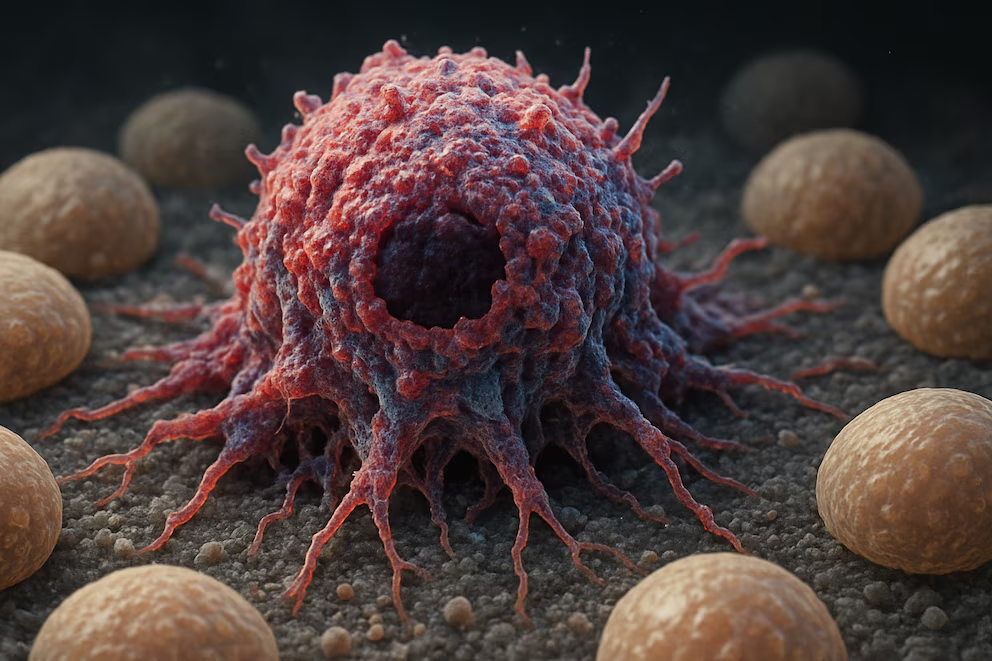
The World Cancer Day, a date that motivates the medical community, patients and organizations to focus on a disease that still represents one of the leading causes of death globally, according to the WHO: “In 2020, almost 10 million deaths were attributed to this disease, that is, almost one in six of those recorded.”
In the case of ovarian cancer, the lack of specific symptoms, late diagnosis, and inequalities in access to care worsen its impact on the lives of thousands of women. In Argentina, it constitutes one of the greatest challenges within the group of gynecological tumors.
Although it is not at the top of the list of the most frequent, its prognosis is usually unfavorable because most diagnoses are detected in advanced stages. The new medical strategies and comprehensive support seek to improve both survival and quality of life of those facing this pathology.
Challenges in the Detection and Diagnosis of Ovarian Cancer
Ovarian cancer is notable for its silent nature and the difficulty in identifying it in early stages. According to information released by the Ministry of Health, with data from the Global Cancer Observatory (Globocan), in Argentina more than 2000 cases of this condition were reported in 2020. Although other gynecological tumors such as those of breast or uterus have effective methods of early detection, ovarian cancer lacks a simple test and reliable for early diagnosis at the population level, according to experts.
Dr. Valeria Cáceres, oncologist and director of the medical area at the Ángel H. Roffo Institute of Oncology of the University of Buenos Aires, explained: “Ovarian cancer is usually diagnosed at advanced stages because it is silent. Its initial symptoms are usually non-specific and are easily confused with frequent digestive or gynecological discomforts such as persistent abdominal distension, early satiety, mild pelvic pain, changes in bowel habits or fatigue. These are signs that many women normalize or attribute to stress, age or other benign problems, and that can also go unnoticed in the initial medical consultation”.
The specialist added: “Today we do not have a simple, accessible and reliable test that allows its detection before it gives clear symptoms”. The location of the ovaries in a deep area of the abdomen also makes the appearance of obvious signs difficult until the tumor process is advanced.
This cancer can manifest through symptoms that are not very specific and are often confused with other common conditions. Among the most common signs are persistent abdominal distension, feeling full quickly when eating, weight loss, mild pelvic pain, fatigue, and changes in bowel habits.
Dr. Ana Laura Mendaña, clinical oncologist at the Alexander Fleming Institute, stated: “When symptoms become intense or persistent, the disease is often already advanced”. In this context, timely consultation and actively listening to bodily symptoms become especially relevant to shorten diagnostic times.
In Argentina, cancer mortality exhibits a sustained downward trend during the last decade. According to data from the Ministry of Health of the Nation, the annual average decrease is 2.3% in men and 1.3% in women. This decline is observed mainly in high-prevalence tumors such as prostate, colon-rectum and lung in men, and breast, colon-rectum and cervix in women. In 2024, lung, colon and rectum, breast, pancreas, prostate, stomach and cervix cancers accounted for 60% of deaths from this cause. Despite these advances, cancer continues to be the leading cause of death from disease in people between 5 and 59 years of age in the country.
Regarding ovarian cancer, it usually appears in women over 40 years old and the risk increases with age. Among the factors that increase the likelihood of developing the disease are certain hereditary genetic alterations, such as mutations in the BRCA genes. These mutations can be passed from parents to children and increase the risk not only of ovarian cancer, but also of breast cancer.
In addition, the presence of overweight, obesity and a family history of cancer are also considered risk factors. Homologous recombination deficiency is another genetic alteration that can influence the appearance of the tumor; this deficiency means that cells lose one of their main ways of repairing DNA damage, which favors the development of cancer.
From a clinical perspective, there are different types of ovarian tumors. Epithelial carcinomas are the most frequent subtype, followed by germ cell and stromal tumors. The American Cancer Society describes that epithelial tumors form in the outer layer of the ovaries and can be classified as benign, of low malignant potential or malignant, the latter being the most lethal and with the greatest capacity to spread to other organs.
The definitive diagnosis of ovarian cancer is only achieved through a biopsy, as Dr. Cáceres emphasizes in a document from the Instituto de Oncología Ángel H. Roffo: “The biopsy is the only definitive way to diagnose ovarian cancer”. Treatment usually requires a multidisciplinary approach that integrates oncology, surgery, imaging diagnostics, and pathological anatomy.
Access, Innovation, and the Patient Experience
Inequalities in access to care, delays in diagnosis, and lack of adequate information generate additional obstacles in the patients’ journey. Emotional support and practical assistance during and after treatment are critical needs for many women, who experience episodes of anxiety, depression, and sleep loss, although only a minority have access to formal psychological support.
María Alejandra Iglesias, president of the civil association SOSTÉN, emphasized the importance of considering the human dimension in this context: “The human experience of ovarian cancer involves recognizing the barriers on the path to diagnosis, making geographical and socioeconomic disparities visible, and promoting care approaches that integrate quality of life, psychosocial support, and continuity of care.”
In terms of treatment, the arrival of new therapies for advanced cases brings renewed expectations. Doctor Ana Laura Mendaña stated that “it represents a great contribution, different from the therapeutic strategies we historically had, and it arrives after nearly a decade without significant novelties, which represents an advance in the management of this disease.”
In the framework of the World Cancer Day, which was celebrated yesterday, it is relevant to reinforce awareness about the importance of timely consultation and early diagnosis. In the face of the absence of effective screening methods, actively listening to symptoms and equitable access to medical care appear as key tools to modify the prognosis of the disease.