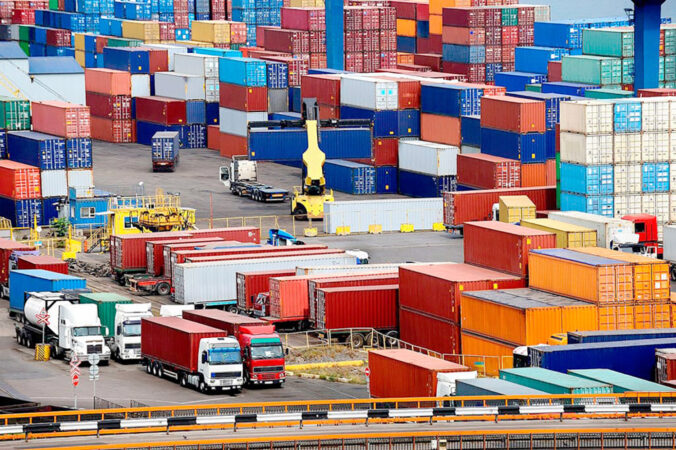
Santo Domingo.- The products exported by the Dominican Republic are increasingly diverse, as are the destinations or final markets, reaching total exports of more than US$5,639.01 million so far this year (January-May), an increase of 8.6% compared to the same period last year.
According to the Ministry of Industry, Commerce and SMEs (MICM), this boost was led by the national regime, whose exports increased by 27% in FOB value and 21% in volume, compared to 2024.
In 2025, the country has been exporting to six new destinations, totaling about 151 export destinations.
This diversification has reconfigured the order of importance of our main trading partners, although the United States remains the main destination.
However, India became the second destination for Dominican exports, with US$556 million already exported there, due to the shipment of gold, platinum-plated gold, and raw gold for non-monetary use, representing these products 92.2%, and to a lesser extent whole cocoa, in beans, roasted and raw.
The third destination is now Haiti, with US$453 million exported so far this year, a country that traditionally vied for second place with Switzerland.
The products exported to Haiti are more diverse than to other destinations, but it is worth highlighting the export of clothing and cotton fabrics, Portland cement, rods, soybean oil, wheat flour, among other food products.
The fourth destination is now Puerto Rico. Exports to that neighboring island already exceed US$293 million, mainly due to the export of medical instruments and devices, as well as utensils for human and animal surgeries, electrical circuit breakers, roasted and non-decaffeinated coffee, rods and household items.
Canada is in fifth place, with US$202 million exported, essentially due to shipments of gold, platinum-plated gold and raw gold for non-monetary use, and to a lesser extent, medical instruments and apparatus.
The presence of the Netherlands in sixth place is noteworthy, with US$160 million exported, represented by dried bananas, cocoa beans, oils, and medical instruments and apparatus.
Tobacco consolidates
Tobacco is currently the second-largest export product of the Dominican Republic, in terms of FOB value, surpassed only by medical supplies.
As of May 2025, US$397 million in cigars have been exported, plus US$32 million with the shipment of stripped tobacco leaves and another US$70 million in unstripped leaves.
The country has 29 tobacco-growing areas distributed across 15 provinces, with more than 150,000 tareas planted and a production of 330,000 quintals of tobacco, the Tobacco Institute (Intabaco) reported in June.
More and more provinces are planting the product. Santiago leads with about 51% of the market, but Montecristi, Santiago Rodríguez, Dajabón, Valverde, Puerto Plata, Espaillat, La Vega, Monseñor Nouel, Sánchez Ramírez, Monte Plata, Hato Mayor, San Juan, Azua and Elías Piña also produce.
More than 127 formal tobacco factories operate, of which 27 belong to free zones and 50 are emerging, generating more than 110,000 direct and indirect jobs and US$1.34 billion annually in exports, according to Intabaco data.
Promotion of Exports
The Executive Director of the Export and Investment Center of the Dominican Republic (ProDominicana), Biviana Riveiro Disla, attributes the volume and diversity of exports to the implementation of the National Export Promotion Plan of the Dominican Republic 2020-2030, launched in November 2020.
“This plan, launched by the president in November 2020, is already more than 80% executed in its nearly 300 measures, and one of the strategic axes, apart from the promotion of exports and training, is the diversification of markets,” explains Riveiro.
Chinese market, a challenge
Although the relations between the Dominican Republic and China were formally opened in May 2018, the potential of this market is still not being taken advantage of by Dominican exporters, due to the barriers that reaching a country like that represents for an emerging economy.
One of the main barriers is distance. A container takes approximately 40 days to reach China from the Dominican Republic, which is a long time for perishable products, as they would be very ripe or damaged upon arrival. In addition, a product needs at least 10 days in the stock of the markets for its commercialization.
Excluding perishables, it would then be necessary to explore processed agri-food products, which can withstand that amount of days.
“Forty days is not something any product can withstand; that’s why the first approach in a market of this type we prefer to start with the agro-industry, because they are already processed products and the possibilities of losing a container are less,” explained Riveiro about distant markets like the Chinese.
The Reviews
While some products manage to reach more markets, other traditionally exportable goods, such as bananas (especially organic), lose market share.
The Secretariat of Agricultural Affairs of the Dominican Liberation Party denounced that in just three years, banana exports have plummeted by 44%, leading to the disappearance of nearly 500 producers, equivalent to 20% of the total.
Furthermore, it reported a reduction in weekly production from 400,000 boxes to almost half, and the loss of about 30,000 jobs.
“This is about the agricultural sector which, until a few years ago, was the main export crop of the Dominican Republic. The yield per tarea (unit of land) dropped dramatically, from 2 boxes to only 1.2, while production costs have skyrocketed by 30%,” said former senator Adriano Sánchez Roa, current secretary of Agricultural Affairs.
The banana producers, organized in the Dominican Banana Producers Association (Adobanano), held a meeting with the Permanent Commission of Agro-industrial Affairs of the Senate, where they proposed some measures to recover this important subsector for export, including a banana incentive law.
Another factor that banana growers say has affected the subsector is the mass deportations of Haitians, many of whom work on the plantations.
They indicated that the inability to market those products that were previously exported in the local market, along with the lack of labor, keeps the subsector in crisis.