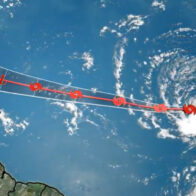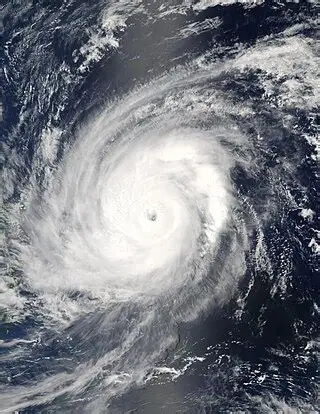
Beijing.- Typhoon Saudel made landfall this Friday in the eastern Chinese province of Zhejiang, where it is leaving strong winds, heavy rains, and disruptions to air transport, with more than 200 flights canceled early in the day at several airports in the east and southeast of the country.
According to the state agency Xinhua, the center of Saudel, the eighteenth typhoon of the season according to Chinese nomenclature, made landfall around 08:05 local time in the coastal area of the city of Taizhou.
At the time of impact, the system had winds of 35 meters per second, and a minimum central pressure of 975 hectopascals.
Hours earlier, the National Meteorological Center had located Saudel over the East China Sea, about 130 kilometers east of Wenzhou, still as a strong typhoon, with maximum winds of 42 meters per second near its center.
The agency expects the cyclone to move west-northwest at about 20 kilometers per hour and gradually lose strength after making landfall, although it warned that its circulation will continue to bring wind and rain to the eastern coast.
More Read

You can also read: Typhoon Saudel approaches the Chinese east coast after Nangka’s passage through the south of the country
The most intense rainfall is expected between this Friday and Saturday in the aforementioned Zhejiang and the central and northern parts of the neighboring Fujian province, with accumulations that could locally reach between 250 and 280 millimeters.

The impact on airports was uneven early this Friday, according to data from the Feichangzhun platform consulted by EFE around 08:35 local time.
Wenzhou, one of the cities closest to the typhoon’s landfall area, recorded only 1% of normal operations, with 82 flights canceled, while Ningbo stood at 7% with 36 cancellations, both cases with large-scale cancellation warnings.
More Read

In Shanghai-Pudong, 91 flights were recorded as canceled, although the airport maintained 78% normality, while Hongqiao, Hangzhou, Xiamen, and Fuzhou operated with greater stability despite some cancellations.
Saudel arrives after Narra, which made landfall this week in Hainan and Guangdong after causing flooding in the southern region of Guangxi and raising the number of preventive relocations or evacuations in southern China to more than 57,000.
The succession of both systems is framed within a summer marked in China by typhoons, torrential rains, floods, and landslides, with dozens of deaths and preventive evacuations of hundreds of thousands of people.