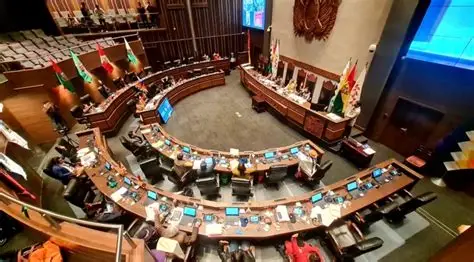
La Paz.- The Chamber of
Deputies of Bolivia approved this Wednesday a bill to protect children and adolescents from sexual violence in digital environments and that, among other aspects, establishes new criminal figures to punish ‘grooming’ or cyber-pedophile deception and the dissemination of child abuse material online.
The lower house plenary approved in general and in detail and unanimously the ‘Law for the Protection of the Sexual Integrity of Girls, Boys and Adolescents in Digital Environments’ project, specified the Attorney General, Roger Mariaca, whose office was the promoter of the document.
Mariaca specified that the project was also approved days before in the Senate, so that “it simply remains that, according to procedure, the president of the State”, Luis Arce, “can carry out the promulgation” of the law, for which there is a period of up to ten days.
The Attorney General maintained that the new rule “leaves a very important legacy in relation to the protection” of children and adolescents in digital environments, “a sector so vulnerable that it needed this attention from the authorities.”
Quoted in a press release from the Public Ministry, Mariaca also pointed out that the advancement of technologies brought “multiple benefits”, but at the same time also generated “new risks that threaten the safety and integrity” of minors.
“This bill will allow the Bolivian State to have updated legal tools to prevent, investigate, and punish sexual crimes in the digital environment more effectively,” he affirmed.
According to the Prosecutor’s Office, the main objective of the rule “is to establish legal protection mechanisms against sexual offenses that originate through the digital environment”, to reinforce the safety of children and adolescents and promote a “responsible and supervised use of technologies”.
The project includes the implementation of new criminal offenses to punish ‘grooming’, the dissemination of online child sexual abuse material, and the recruitment of minors for sexual purposes through social networks and other digital platforms, among others.
It also proposes inter-institutional coordination mechanisms for the prevention, care, and protection of victims, and will allow the use of digital undercover agents to investigate these crimes, according to the Public Ministry.
For its part, the lower house specified in a statement that the approved project establishes a sentence of 10 to 15 years in prison for those who distribute, sell, rent, exchange, or market digital content of child pornography.
In addition, it punishes with 4 to 8 years in prison those who contact minors by electronic means for sexual or erotic purposes through the sending of messages, images, videos or other “inappropriate content”.
Mariaca highlighted the work of the prosecutors who worked on the project, in addition to the commitment shown by the parliamentarians to approve the law in both chambers.