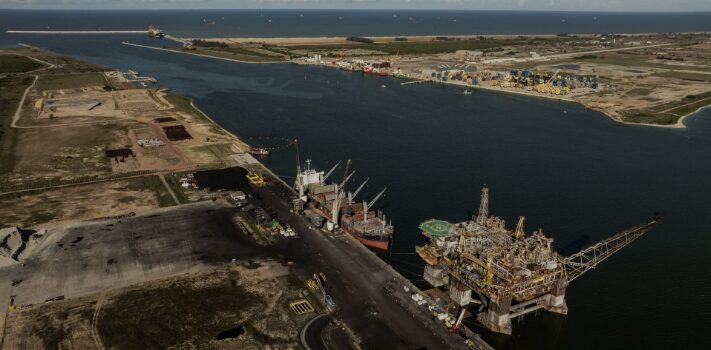
São Paulo.- Brazil authorized this Monday the controversial exploration of maritime oil reserves off the Amazon, less than a month before hosting the UN climate summit (COP30) in which it wants to present itself to the world as a leading country in environmental preservation.
The state-owned oil company Petrobras received a license from the Brazilian Institute of Environment (Ibama) to explore an area considered vulnerable by environmentalists located 500 kilometers from the mouth of the Amazon River, a decision that questions the government’s commitment to combating climate change according to NGOs.
The authorization comes after a process that has lasted almost five years and has been characterized by constant tensions between the oil company, which sees this region as its biggest bet for future production, and Ibama, which initially opposed giving the green light.
In fact, this autonomous entity linked to the Government rejected Petrobras’ first request in 2023 due to “technical inconsistencies”, but then the oil company appealed and provided more information to try to reverse the decision.
Ibama defended this Monday in a statement the “rigor” of the licensing process and said that Petrobras “substantially” improved the project presented at the beginning, especially with regard to response plans for possible emergencies such as a spill at sea.
Energy Minister Alexandre Silveira, a proponent of oil exploration in the region, celebrated the authorization by ensuring “the future of Brazil’s energy sovereignty.”
In economic terms, the area has a potential of 10 billion recoverable barrels and can attract investments of 300 billion reais (55 billion dollars / 48 billion euros) to a country that is already the seventh largest crude oil producer in the world, according to the Government.
Criticisms from Environmentalists
Despite the joy shown by some authorities, the decision comes at an awkward moment, just as Brazil prepares to host COP30 in November in the city of Belém, the first time the largest international climate event is held in the Amazon.
Brazilian President Luiz Inácio Lula da Silva has presented it as “the COP of truth” and has boasted about curbing deforestation in the world’s largest tropical forest, where logging fell by 30% in 2024 thanks to increased enforcement actions.
“It will be the moment for world leaders to prove the seriousness of their commitment to the planet,” declared the president this Monday, during a meeting with foreign ambassadors.
The diplomat André Corrêa do Lago, chosen by the Brazilian Government to preside over the conference, has pointed out in several of his letters to the international community the importance of “moving away” from fossil fuels.
In this context, civil society rushed to denounce the contradiction of the country wanting to present itself as a leader of the climate agenda while authorizing the exploration of crude oil reserves in an area near natural reserves, indigenous territories, and coral reefs.
You can read: Ecuador’s Indigenous movement claims the Government “confuses dialogue with threat”
For the Climate Observatory, a network that brings together 130 organizations, issuing the license is “disastrous” for the environment and means “sabotaging” COP30.
Furthermore, environmentalists maintained that the decision clashes with the Government’s commitment to reduce the emission of polluting gases by between 59% and 67% from now to 2035.
The scientist Paulo Artaxo, a member of the Intergovernmental Panel on Climate Change (IPCC), said in a note that opening new oil areas “will further aggravate” global warming, whose main cause is the burning of fossil fuels, and defended the search for alternatives.
“Brazil has the opportunity to explore its enormous potential in solar and wind energy generation (…), we must not waste it,” he stated.
WWF’s office in Brazil pointed out that the region near the future wells is home to 80% of the country’s mangroves and warned that the strong currents at the mouth of the Amazon make the containment of a spill “extremely” difficult.