Costa Rica this week presented a public complaint about the massive theft of gold in its territory border north, pointing out the operation of a criminal network that extracts gold-bearing material and transfers it to Nicaragua where it is collected and processed by Chinese mining companies.
The exhibition was held before deputies during the presentation of the report Salvemos Crucitas, where the Minister of Public Security, Mario Zamora, described the growth of illegal mining in that region.
Zamora maintained that the phenomenon ceased to be isolated and acquired characteristics of transnational organized crime, with logistics, financing and stable routes to mobilize large volumes of gold-bearing sediment out of the country.
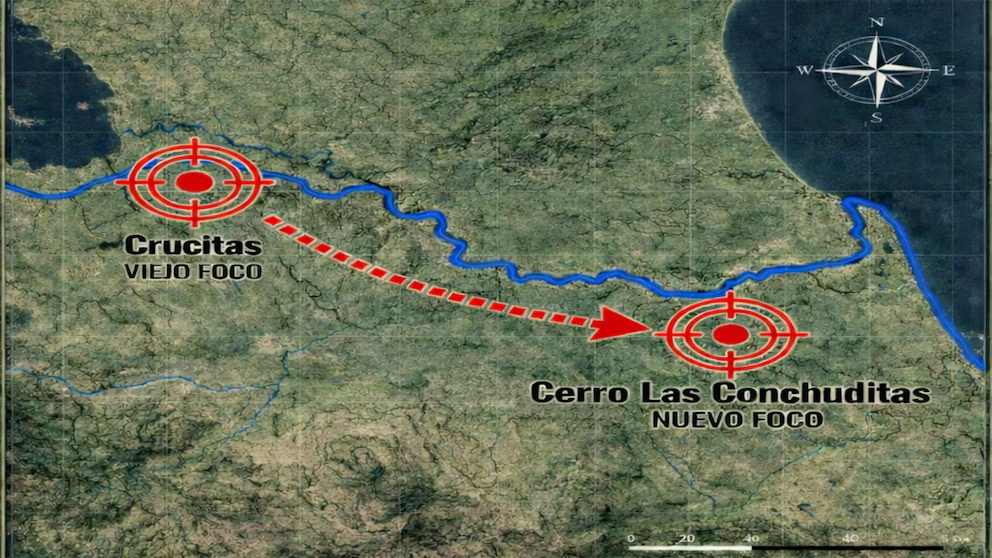
According to official data, illegal mining went from affecting around 900 hectares to exceeding three thousand hectares in a short time, incorporating new areas such as Cerro Las Conchuditas.
“This phenomenon affects not only the ecological sovereignty of our country, but also the sovereignty in general terms of our nation, since 90% of the coligalleros (artisanal miners) are foreign citizens, essentially Nicaraguans who cross the border to participate in this illicit activity,” Zamora pointed out.
The Costa Rican Minister of Public Security detailed that in each operation they seized approximately 3,000 sacks of sediment, each weighing 50 kilograms.
“We have seized more than 16,000 sacks to date. The average weight of these sacks is 50 kilograms. We are talking about 150 metric tons (of sediment) in just 3,000 sacks,” he pointed out.
He added that the sediment bags are transferred to Nicaraguan territory, which he called “organized crime”, and there they are bought by Chinese mining companies that do not question the origin of the acquired material.
According to the Costa Rican minister, the informal miners manage to extract between 15 and 20 percent of the gold contained in the sediments, but Chinese companies have extractive techniques that allow them to recover up to 95 percent of the gold from the sediment.
In 16 thousand seized sediment bags, each weighing 50 kilograms, Costa Rica would have lost at least 800 tons of sediment with potentially exploitable gold-bearing content.
Nicaraguan economist Enrique Sáenz states that for several years Nicaragua has reported gold exports greater than what it produces. “The official reports between what is reported as production and what is reported as export do not match,” he says.
For Sáenz, part of the explanation lies in that material stolen from Costa Rica that is exported as Nicaraguan gold. “It’s like you had 6 hens that lay one egg a day each and you, instead of selling the 6 eggs, sell 9. Where do the three eggs you sell that your hens don’t lay come from?”, he exemplifies.
The environmentalist Fundación del Río has identified 14 Chinese companies that would be linked to the Nicaraguan mining sector, to which the Nicaraguan regime handed over 67 mining lots covering more than 966 thousand hectares, equivalent to 8.4% of the territory of Nicaragua.
Amaru Ruiz, president of the Río Foundation, points out that several of these concessions were granted in the vicinity of the southern border, including the El Castillo and La Guinea lots, which together cover 61,054.3 hectares. Both were awarded to the Chinese mining company Thomas Metal and are located in the department of Río San Juan, in the border strip with Costa Rica.
The River Foundation sent a letter to the ambassadors of China in Nicaragua and Costa Rica to inquire about alleged environmental and commercial breaches linked to mining concessions granted to Chinese companies, possible violations of international treaties, cross-border impacts, inconsistencies in exports, and financial risks and impacts on indigenous territories.
In the letter, which still has no response, the inconsistency between export reports is exposed. “According to export databases, there is a gap of 32.1 million dollars between the 17.1 million dollars that Nicaragua reports having exported and the 49.2 million that China reports having imported in minerals (under the SAC 26 code), which could be related to intentional under-invoicing and the ambiguous and opaque tariff classification that generates millions in losses,” it indicates.
Formal mining in Nicaragua reports lower gold production than exports, according to official data. In 2020, official production was 8.5 tons and exports were 11.8 tons; in 2021, production was 10.8 tons compared to exports of 16 tons; and in 2022, with a production of 11.5 tons, 16.4 tons were exported.
In 2024, Nicaragua exported approximately 19.5 physical tons of raw gold worth about 1.3539 billion dollars, according to foreign trade data based on reports from the World Trade Organization-WITS, despite the fact that the previous year its gold production was 12.5 tons.
The Costa Rican government’s complaint seeks for the deputies to approve bill 24,717, which would authorize open-pit gold mining in Crucitas, Cutris de San Carlos, with the argument of stopping illegal mining and pollution.
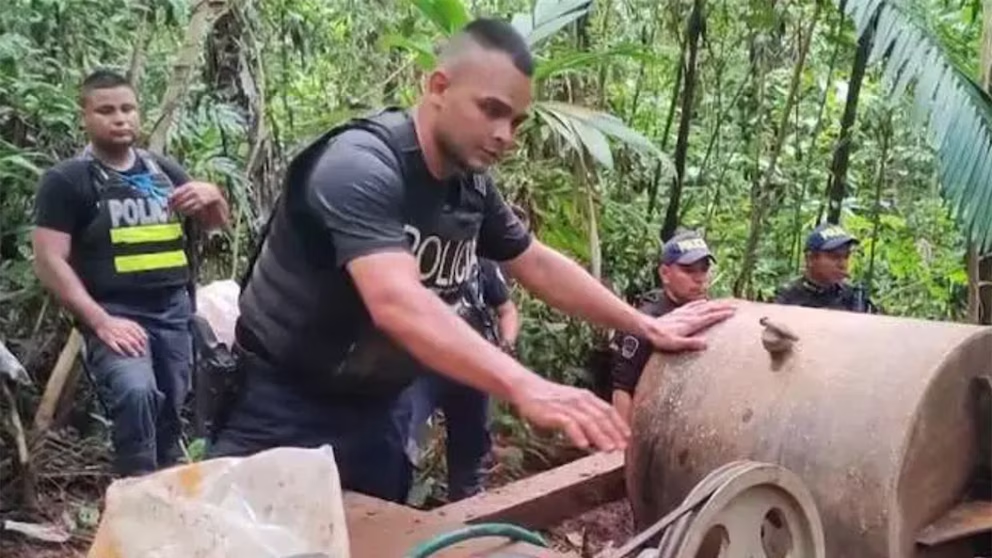
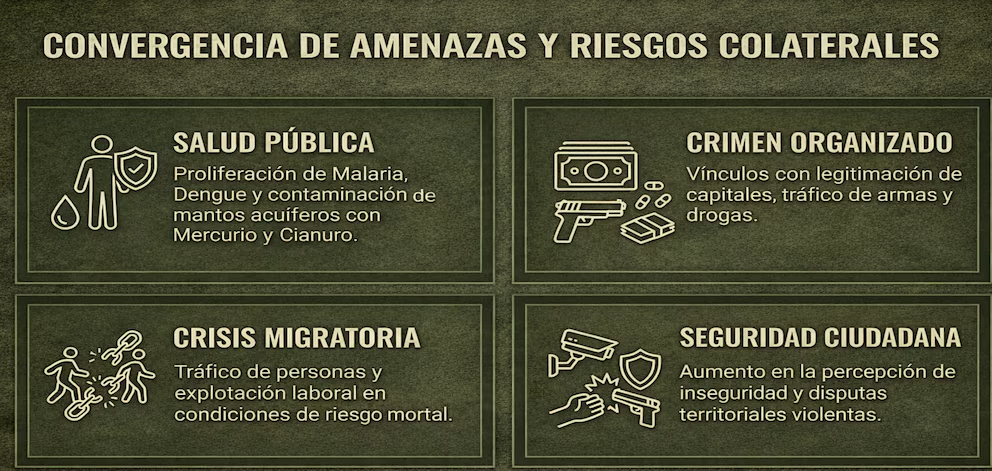
Minister Zamora explained that transnational organized crime evolved its modus operandi, moving from relatively artisanal techniques to semi-industrial ones that employ machinery, power plants, and more advanced tools, which led to a growth in the affected areas and greater violence in the area.
According to the official’s statement, Costa Rica not only loses large quantities of gold that go to Nicaragua, but also allocates approximately one million dollars monthly to combat organized crime in that illegal extraction zone.
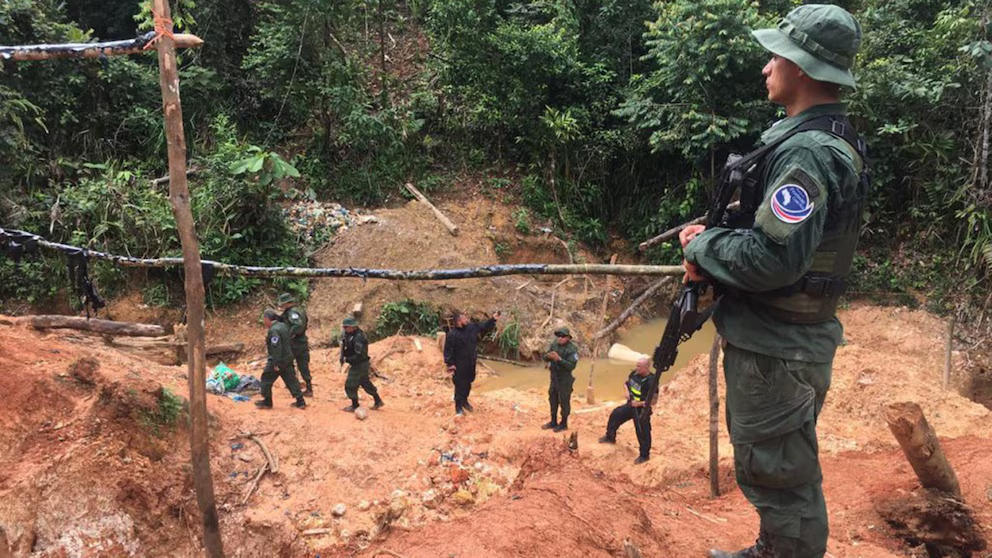
In the area, according to Zamora, 200 members of the Public Force were deployed, who destroyed more than 114 illegal extraction tunnels, apprehended 125 people in flagrante delicto and made more than 3,692 arrests for related crimes.