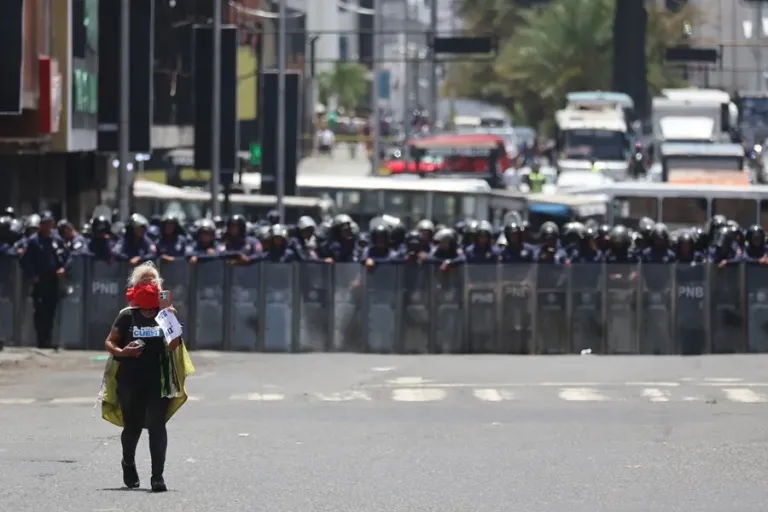
Geneva.– The UN Independent International Fact-Finding Mission on Venezuela warned this Wednesday that the Venezuelan State’s repressive apparatus remains “intact,” despite some limited improvements recorded in terms of human rights.
In its new report on the country’s situation during 2026, marked by the U.S. intervention on January 3rd that culminated in the capture of then-president Nicolás Maduro, the mission noted that certain progress has been made, but this has not been accompanied by institutional changes that guarantee its permanence.
The mission president, Peruvian expert Sofía Macher, explained that the reduction of some of the most severe forms of repression represents a significant change, but does not imply a transformation of the system that allowed those practices.
The report notes that laws used to criminalize dissent remain in force, while intelligence services and security forces maintain similar structures. Furthermore, the mission indicated that no measures have been adopted to disarm or dismantle the so-called “colectivos,” armed civilian groups identified as a source of intimidation and violence.
The UN also reported that journalists and other members of civil society continue to face obstacles in carrying out their activities. Likewise, at least 19 officials previously identified by the mission as responsible for serious human rights violations remain in key positions.
More Read
Among the positive aspects, the mission recorded a significant reduction in prolonged detentions and enforced disappearances, in addition to the release of hundreds of people detained for political reasons. It also observed a slightly greater margin for protests, public meetings, and activities of civil society organizations.
Reports of torture persist
Despite these advances, the mission stated that it continues to document cases of torture and ill-treatment against people detained for political reasons.
The report mentions cases of forced intubation and prolonged confinement in underground cisterns within the El Rodeo I maximum-security prison. It also denounced that at Fuerte Guaicaipuro, a military facility, some people were allegedly held in cells similar to underground pits and subjected to food deprivation, exposure to cold, and other degrading conditions.
We recommend reading: The UN warns that all human rights “are at risk” due to the advancement of AI

Since January 3, the mission has received information on 64 new cases of torture. Furthermore, it noted that hundreds of people continue to be subjected to detention conditions it described as deplorable, some of which have allegedly led to deaths in custody due to mistreatment or lack of medical attention.
According to data from non-governmental organizations cited in the report, between 300 and 500 people remain detained for ideological reasons, despite the releases recorded.
The mission also indicated that, of the 214 arbitrary detentions for political reasons reported during the last 12 months, about 200 occurred before Maduro’s capture. However, after January 3, a pattern of short-term arrests used to intimidate activists, opponents, journalists, and other sectors of society has been identified.
Sofía Macher warned that, as long as repressive structures are not dismantled, judicial independence is not guaranteed, and those responsible for human rights violations are not investigated and sanctioned, any political opening will remain fragile and reversible.
Mission member, Canadian Alex Neve, called on the United States and other influential actors to intensify their efforts to promote human rights changes in Venezuela. At the same time, he noted that their actions must not contribute to further violations or facilitate the commission of international crimes.
More Read

UN analyzes the role of the “colectivos”
In addition to the report on the situation in Venezuela during 2026, the mission will present another document to the UN Human Rights Council, focusing on the armed civilian groups known as “colectivos”.
The report maintains that these groups are not marginal organizations, but rather form part of the state repressive apparatus.
The mission noted that its consolidation and expansion during the governments of Nicolás Maduro and Hugo Chávez responded to a political strategy to strengthen the support bases for the pro-government project through mechanisms of violence and coercion.
The document also highlights links between the collectives and State agencies, including the incorporation of some of their members into the Bolivarian National Police and the participation of active or retired members of the armed and security forces in these civilian groups.