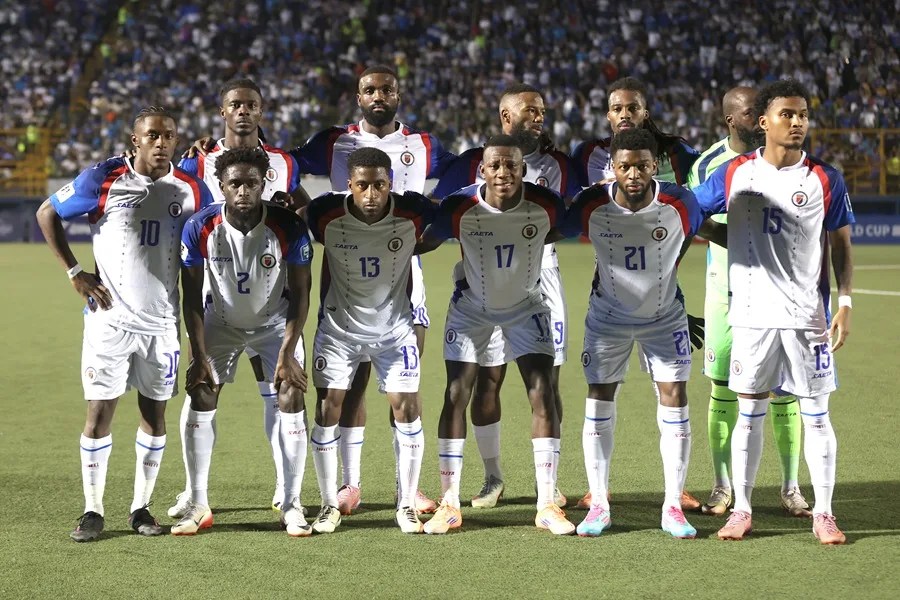
Sports Writing. – The Haitian national team achieved one of the most moving feats in world football: qualifying directly for the 2026 World Cup after a 52-year absence, a feat built far from home, without its own stadium, and amidst the deep crisis facing the Caribbean country.
You may be interested in:Cibao FC seeks the decisive comeback against Defence Force in the Concacaf Caribbean Cup 2025
While Port-au-Prince suffers from the violence of armed groups that even occupied the Sylvio Cator Stadium, its football temple, a group of players without a sporting home found in exile the strength to restore hope to an entire nation.
Historical Ranking after 52 years
The selection known as
Les Grenadiers, a name taken from Haitian military tradition, returns to a World Cup for the second time in its history, after its debut in Germany 1974. Since 2021, it has not played a single match on Haitian soil, using Curaçao as an adopted venue due to insecurity.
Despite this, they managed to prevail with character and resilience throughout the qualifying process, even coming back from a 0-2 deficit against Costa Rica for an epic 3-3 draw, driven by a ‘hat-trick’ from Duckens Nazon, the emotional leader of the team. That reaction marked the turning point that culminated in the 2-0 victory over Nicaragua, a result that sealed the World Cup ticket.
A country in crisis, a team that resists
The classification takes on a special meaning for a deeply wounded nation. Following the assassination of President Jovenel Moïse in 2021, gangs consolidated their control in several areas, generating a power vacuum that severely affected daily life.
In this context, former senator and commentator Patrice Dumont summarized the impact of the sporting achievement:
“The team’s victory will not solve the deep problems of Haitian society. But it is a relief. Even with hunger, one can be proud. Hunger does not prohibit joy.”
The Legacy of Emmanuel Sanon
The ranking also revives the memory of Emmanuel “Manno” Sanon, the greatest legend of Haitian football. Sanon scored Haiti’s only two goals in the 1974 World Cup and snatched from Dino Zoff a record of 1,143 minutes without conceding a goal.
His spirit, linked to resistance and national pride, is once again present in this new generation, which is fulfilling a dream that the idol could not see in life.
The diaspora, the team’s silent engine
Another key piece of the World Cup journey has been the Haitian diaspora, which has not only filled stadiums outside the country but has also financially supported the team. The official jersey, manufactured by the Colombian brand Saeta since an alliance that was born after the 2010 earthquake, became a symbol of identity and support.
After the classification, more than a thousand orders were registered in a few hours, demonstrating that, although far from home, Haitians keep the connection with their team alive.
A Triumph That Transcends Sport
Without playing a single match in their country and facing adversities that transcend sports, Haiti has achieved the greatest gesture of collective resilience in decades. Their qualification for the 2026 World Cup is a powerful message to their people: even in the midst of darkness, football can ignite a spark of hope.