Periodista egresada de la Universidad Autónoma de Santo Domingo (UASD). Le gusta escribir sobre política e historias humanas que puedan transformar vidas. Actualmente cursa un master...
Share
6 Min Read
SHARE
Caracas.– Venezuela and the U.S. agreed in January to the repatriation of migrants, which also allowed both governments to agree on other issues in recent months, despite not maintaining diplomatic relations since 2019, and amid growing bilateral tension marked by the U.S. military deployment in the Caribbean.
However, Venezuela announced on Saturday that the U.S. suspended “unilaterally” the migration agreement, after U.S. President Donald Trump declared the airspace of the South American country “closed.”
Based on the migration agreement, U.S. aircraft have landed in Venezuelan territory in recent months. Since 2019, commercial air traffic between both nations remains suspended.
But Trump’s message, which Caracas repudiated by criticizing that it “unusually” tries to “give orders and threaten” its sovereignty, deepened the uncertainty surrounding air operations over Venezuelan territory after the warning, last November 21, from the US authorities, who asked to “exercise extreme caution” when flying over this country and the southern Caribbean.
The U.S. Federal Aviation Administration (FAA) warning triggered a cascade of temporary flight cancellations to Venezuela, to which the government of that country responded by revoking concessions to six airlines, amid the already strained situation with Washington following the air-naval deployment it has maintained since August in the Caribbean.
What the agreement consists of and what its results were:
The Agreement
In January of this year, both countries reached an agreement that allowed the beginning of the deportation flights of thousands of Venezuelans who lived in US territory, after the visit to Caracas of Trump’s special envoy, Richard Grenell. The envoy then obtained the release of six of his compatriots detained in Venezuela, who returned with him on a plane.
Since the agreement came into effect, according to a statement released this Saturday by the Venezuelan Foreign Ministry, 75 repatriation flights were carried out for 13,956 Venezuelan migrants who were “received with love and absolute solidarity”.
On November 21, the Government of Venezuela reported the arrival of 200 repatriates on a flight from Phoenix. According to the Ministry of Interior and Justice, 163 men, 32 women, and five children were on board.
Repatriation of Children
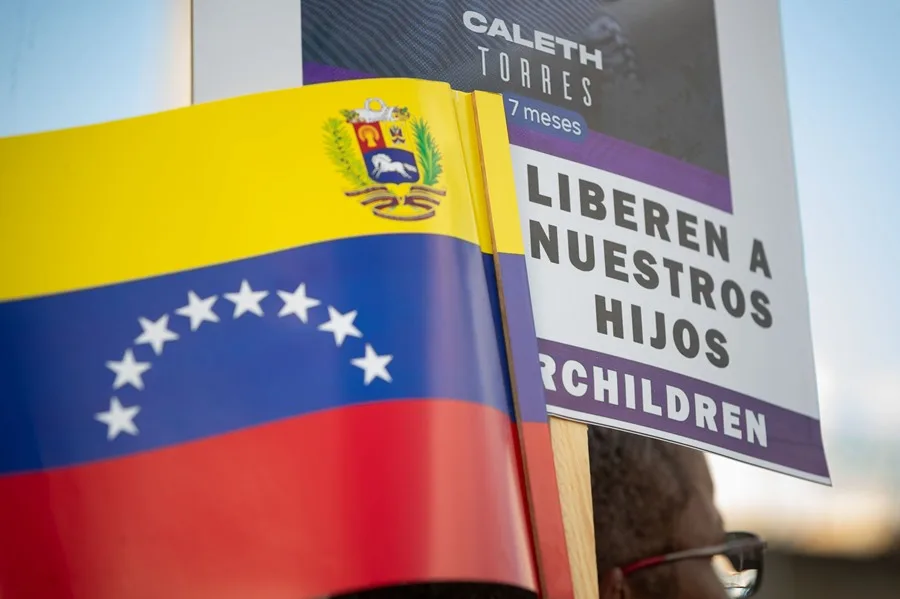
The Chavista Executive denounced the separation of Venezuelan children from their deported parents from the U.S., an act it called a “kidnapping.”
The most emblematic case was that of a two-year-old girl who, according to local authorities and her family, was separated from her mother, who was deported to the country on April 25th.
The little girl, who became the protagonist of campaigns and marches to demand her return, arrived in Venezuela on a migrant flight last May.
She was received at the Simón Bolívar International Airport, which serves Caracas, by the first lady, Cilia Flores, and the Minister of Interior and Justice, Diosdado Cabello, and taken to the Miraflores presidential palace, where she was awaited by her mother and grandmother, as well as Maduro.
Last September, the president of the government program Gran Misión Vuelta a la Patria, Camilla Fabri, said that there were more than 60 children “detained” in the United States.
Excarcerated from El Salvador
On July 18th, following an agreement between both governments, 252 Venezuelans whom the U.S. had sent in March to a maximum-security prison in El Salvador, accused, without prior trial, of belonging to the criminal gang Tren de Aragua, returned to their country.
That same day, ten other Americans were released.
Likewise, Maduro’s Executive released a group of Venezuelan political prisoners as part of the “exchange,” as reported then by the US Secretary of State, Marco Rubio, although the Venezuelan Administration denied that there was any relationship between these releases and the repatriation of migrants.
A group of opponents claimed to have been part of the negotiation process with the Venezuelan Government to achieve the release of political prisoners. Former Spanish President José Luis Rodríguez Zapatero also participated, as revealed at the time by the elected deputy Stalin González.
Chevron
Two months after Grenell’s visit, Maduro assured that the end of the license to the oil company Chevron affected the deportation flights from the United States.
However, 15 days later, the president of the Venezuelan Parliament, Jorge Rodríguez, announced the resumption of repatriation trips, after denouncing a blockade by the State Department of deportation operations.
Subsequently, last July, Maduro announced that Chevron received a license to continue operating in Venezuela, after Washington and Caracas agreed to the release of migrants sent to the Central American country.
Periodista egresada de la Universidad Autónoma de Santo Domingo (UASD). Le gusta escribir sobre política e historias humanas que puedan transformar vidas. Actualmente cursa un master en Comunicación Política y Marketing Digital.