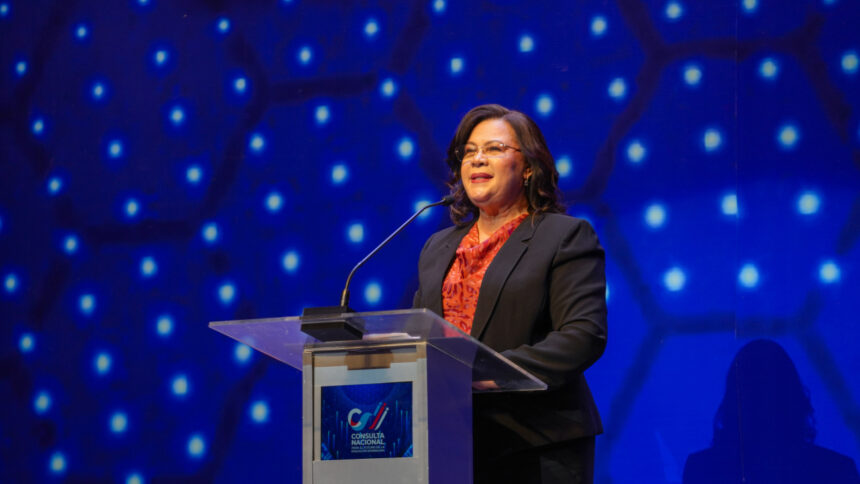
Santo Domingo.- The Director General of the National Institute for Technical Professional Training (Infotep), Maira Morla Pineda, affirmed that the transformation of Dominican education will be possible through a broad national commitment, supported by dialogue, participation, and a vision that recognizes technical-professional training as one of the fundamental pillars for the country’s economic and social development.
The official thanked the participation of thousands of citizens and institutions who, with their contributions and experiences, helped build a shared vision for the future of national education. She expressed this during the ceremony where the results of the National Consultation for the Transformation of Dominican Education were presented to President Luis Abinader.
“Great transformations are built by listening, participating, and engaging in dialogue. This consultation demonstrated that every contribution counts, that every experience adds value, and that an entire country can come together to define the future of its education,” he/she expressed.
He highlighted that this process made evident the commitment of students, teachers, families, public servants, business owners, workers, churches, media outlets, former ministers, former presidents, and Dominicans living abroad, who agreed on the need to build an education capable of responding to the challenges of the present and the opportunities of the future.
He also pointed out that quality, relevance, and dignity synthesize the spirit of the consultation, considering that the Dominican Republic requires training connected to people’s needs, grounded in values, and closely linked to work as an instrument of human development, inclusion, and social progress.

We recommend reading:
In line with that vision, the director of Infotep defended, in the various regional and sectoral forums of the consultation, the need to consolidate an educational system more articulated with technical-professional training, capable of responding to the demands of the productive apparatus, innovation, technological transformation, and the skills required by the 21st-century labor market.
In that context, he reiterated that technical-vocational training must occupy a strategic place within the country’s new educational vision, expanding opportunities for labor insertion, strengthening entrepreneurship, and promoting lifelong learning, without losing sight of values-based education and the integral development of individuals.
More Read
Likewise, he maintained that the results of the consultation represent a historic opportunity to consolidate a more integrated educational system, in which technical-vocational training contributes to closing the gap between education and employment, fostering innovation, and generating the capabilities demanded by the sustainable development of the Dominican Republic.
Finally, Maira Morla Pineda thanked President Luis Abinader for promoting an initiative that she described as a historic exercise in democratic participation, by allowing Dominican society to contribute directly to the construction of a nation project based on quality, equity, relevance, and human development.