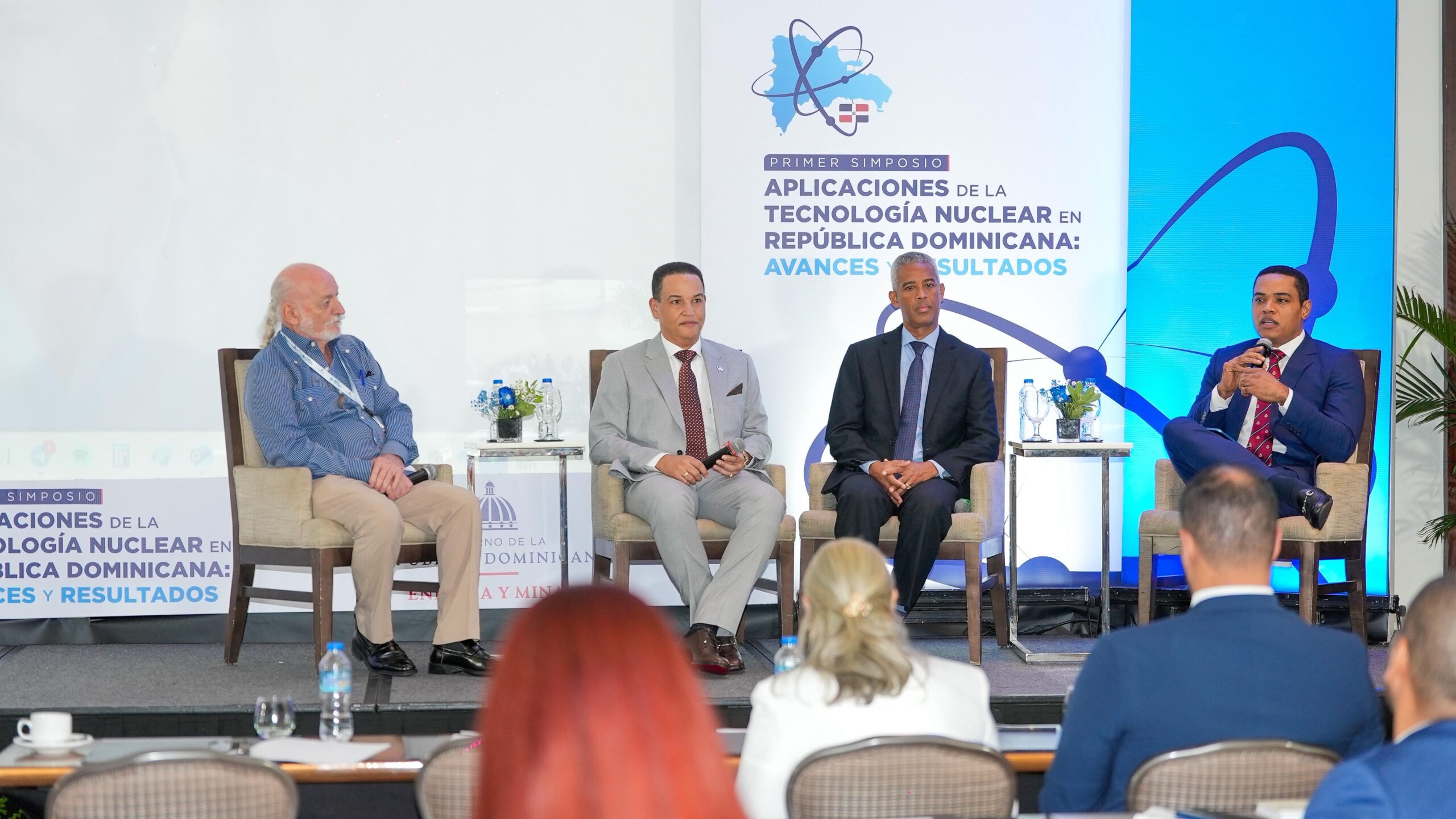
More than 10 institutions presented the progress and results of national projects related to the peaceful use of nuclear energy, in favor of health and the national economy, during the first symposium on applications of that technology in the Dominican Republic.
In an event organized by the Vice Ministry of Nuclear Energy, of the Ministry of Energy and Mines (MEM), in collaboration with the International Atomic Energy Agency (IAEA), the participation of Minister Joel Santos, the Vice Ministers of Nuclear Energy, Gaddis Corporán, and of Energy, Alfonso Rodríguez, and Manuel López San Pablo, from the coordinating body, was present.
Regarding this, Santos highlighted that nuclear energy has been, for decades, a field surrounded by both great challenges and transformative opportunities. He emphasized that the symposium is the reflection of a shared will, the result of articulated work between public institutions, research centers, international organizations, and universities.
“This meeting marks a milestone in our institutional and national history, as we gather to reflect on the progress made, not only the agreements, but these advances achieved and to outline together the future of nuclear technology in our country,” said Santos.
In line with the minister’s words, Corporán stated that the actions carried out by the Government with nuclear energy, together with the other institutions, “have been a well-defined path with vision, commitment and a lot of cooperation that, despite the obstacles, is committed to science and technology as an instrument for the sustainable development of our country.”
More Read
The Vice Minister noted that this technology is no longer an abstract concept, and that, although it has often been synonymous with war disasters, it has become a vital tool for generating development and well-being for Dominicans.
During the event, the Universidad Autónoma de Santo Domingo (UASD) and the MEM signed an inter-institutional cooperation agreement, with the purpose of strengthening academic training, research, and knowledge generation in key areas such as mining, hydrocarbons, nuclear energy, and energy efficiency.

That agreement was signed by Editrudis Beltrán, rector of that university, and Minister Santos, who agreed that the pact will help to more clearly convey the message of the importance that those three sectors have for the economic future of the nation.
More Read
During the event, three panels were also held related to the impact that nuclear energy has had on different sectors of national life.
In addition, experts and representatives from different institutions presented the results of the implementation of projects using nuclear energy, and how it has contributed to the development of different projects related to public health, such as cancer treatment, agriculture, hydraulic resources, livestock, among others.
Among these initiatives, experts in the field demonstrated the effectiveness of the Sterile Insect Technique (SIT), a control method that involves mass rearing and sterilization, through radiation, of insects causing a specific plague.
Also, they detailed how technology has been used to understand body composition, using stable isotope techniques in healthy children between six and 24 months of age; the impact of technology on the control of agricultural pests, with emphasis on Ceratitis capitata Wiedemann, Mediterranean fruit fly; on the analysis of stable isotopes to verify the origin and authenticity of the mango Mangifera indica; the impact of the use of nuclear techniques in agriculture, with emphasis on rice and banana crops, among others.
The event took place at the Intercontinental Hotel, where the oncologist surgeon José Ramírez, director of the National Cancer Institute, Rosa Emilia Sánchez Pérez de Tavares (Incart); Herwin Speckter, medical physicist at the Center for Diagnosis, Advanced Medicine and Telemedicine (Cedimat); Gerson Polanco, from the Cancer League; Massiel Álvarez, from the Ministry of Public Health; Juan Clase Salas and Freddy Contreras, from the Ministry of Agriculture; Edian Franco, from the Institute of Innovation in Biotechnology and Industry (IIBI); Narkiss Almonte, from the National Energy Commission (CNE); Alfaniris Vargas and Francisco Paulino, from UASD, also participated.