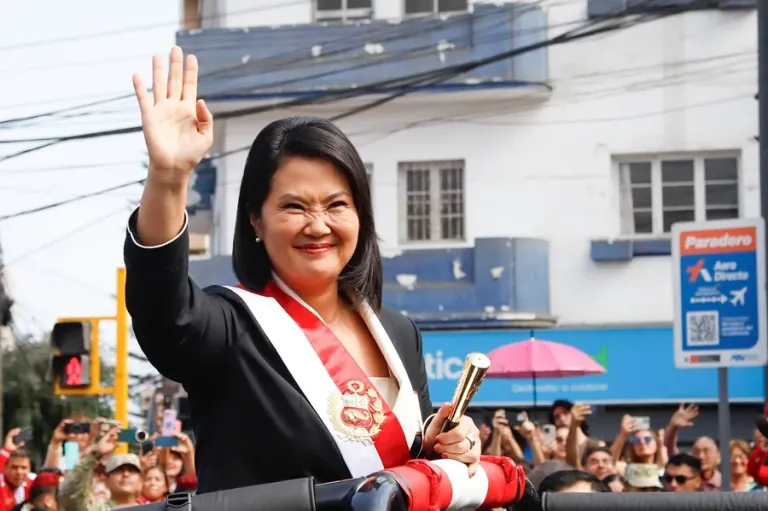
Lima.- The President of Peru, Keiko Fujimori, led this Wednesday the traditional civic-military parade for her country’s independence, which was followed by thousands of citizens through the streets of Lima, amidst a celebratory atmosphere, and in which invited delegations from six countries also participated, including Spain.
The ruler, who took office on Tuesday, arrived at the central Avenida Brasil, which runs through five districts of the Peruvian capital, on the edge of an open vehicle, received greetings from the crowd as she passed, while being guarded by a large security contingent.
Fujimori was accompanied by her prime minister, Luis Galarreta, and the members of the ministerial cabinet, while the high commands of the Armed Forces and the National Police of Peru (PNP) also attended, as well as the main national authorities.
The preliminary protocol act
Previously, the brand-new president recognized herself as the supreme commander of the Armed Forces and the PNP during a protocol activity held in the Honor Courtyard of the Government Palace.
The Presidency of Peru highlighted that the ‘Great Military Civic Parade and Procession’ is “one of the most representative and anticipated patriotic acts in the country, and marks the culmination of the celebrations for the anniversary of the national independence,” which was proclaimed 205 years ago.
More Read
We recommend reading:

In the parade, which lasted for more than three hours, about 3,000 members of the Armed Forces, the National Police, volunteer firefighters, ministries, and state agencies such as the National Institute of Civil Defense (Indeci) marched, in addition to musicians and dancers from all over the country.
The parade participants
After the honors paid to the ruler, the march opened with the passage of the international delegations, made up of cadets from military schools, naval academies, and specialized forces from Spain, Chile, Ecuador, Colombia, Italy, and Panama.
More Read
Aircraft, vehicles, and special units were also displayed, including those for warfare, public security, and emergency combat, in addition to traditional dances from the different regions of Peru being presented.
Among the figures who paraded was retired general and current Fujimorist senator Marco Miyashiro, who led the delegation of the Special Intelligence Group (GEIN) of the PNP, which in 1992 captured the leader and founder of the subversive group Shining Path, Abimael Guzmán.
Also participating was the retired Army general and new Minister of the Interior, César Astudillo, as a member of the Chavín de Huántar military group, which in 1997 freed 71 of the 72 hostages of the Túpac Amaru Revolutionary Movement (MRTA) alive at the Japanese ambassador’s residence in Lima.
The official activities for Peru’s independence had as their central act on this occasion the taking of power by right-wing politics, which solidified the return of Fujimorism to the Government, almost twenty-six years after her father, Alberto Fujimori (1990-2000), resigned by fax from Japan after a massive corruption scandal in his administration was uncovered.