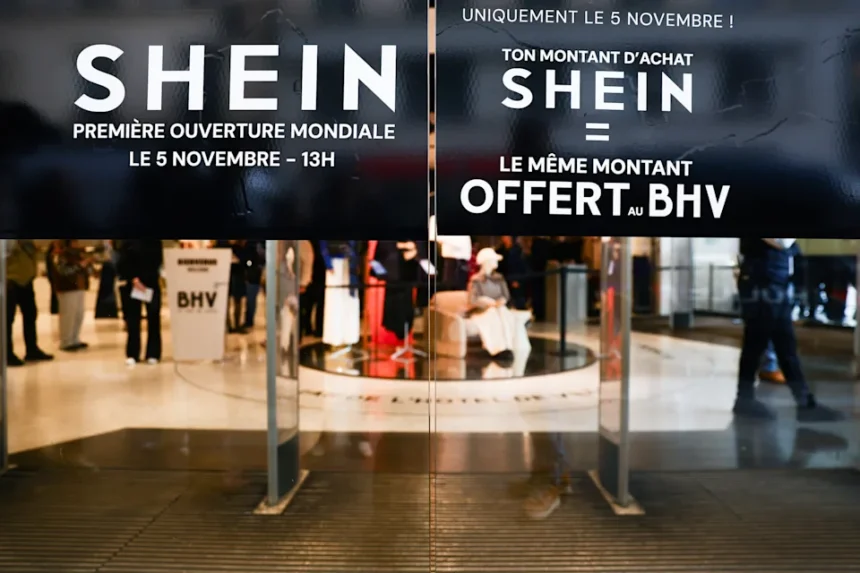
China.- The ‘fast fashion’ platform Shein debuted flat this Tuesday at the opening and with drops of up to 10% in the minutes that followed, after carrying out an anticipated IPO in Hong Kong following years of ups and downs and frustrated plans that caused a 73% drop in its valuation since 2022.
Specifically, the shares began the day at 48.56 Hong Kong dollars (6.19 dollars or 5.33 euros), exactly the same price that the company had set for the sale of some 280 million shares, although in the minutes following the start of the session they began to show a downward trend, which fell by 9.97% by 09:36 local time (01:36 GMT).
The local newspaper South China Morning Post had already reported that Shein’s shares had fallen by up to 28% this Monday in the ‘grey market’, platforms where securities that cannot be traded through an authorized market at that time are traded unofficially.
The figure set by Shein, practically in the middle of the range it had advanced, represents a collection equivalent to 1.735 billion dollars and a valuation of 26.305 billion dollars, well below the 98.2 billion it reached in 2022, after its third-to-last funding round.
In fact, the terms of the offer include payments of up to 3.5 billion dollars, in both stock and cash, to compensate its strategic investors for that loss; that figure is practically double the amount raised, which Shein will mostly allocate to technological improvements and global expansion.
You can also read: French justice rejects suspending Shein’s activity
A long road
Likewise, when analyzing this operation, which the consultancy firm Moby described as “too little and too late,” the specialized company indicated that Shein also forced it to mitigate the risk of its financial backers redeeming their investments, an option that would be suspended if the company went public.
Among those backers are foreign funds such as General Atlantic or Tiger Capital, as well as domestic firms like Boyu or the digital giant Tencent, which have already committed 383 million dollars to secure around 22% of the offered shares, although that rate would be diluted if Shein makes use of its overallotment option to issue another 42 million shares.

Shein’s IPO comes after its frustrated plans to sell shares in New York and London, in the latter case due to the last-minute intervention of Chinese regulators, which ultimately led it to opt for Hong Kong as a middle ground between international investors and the authorities of its country of origin.
More Read

Furthermore, the platform faces a major problem in two of its main markets, the United States (24% of its revenue) and Europe (35%), as both territories have revoked tariff exemptions for small packages that had facilitated the company’s penetration: in the North American country, its revenue already fell by 14% in the first quarter.
Competing with the ‘big ones’
The company warned that it will pass on the additional costs to its customers in both markets, anticipating in the case of Europe a “short-term negative impact” on its sales volume in order to protect margins that, in net terms, already fell from 8.7% to 4.9% in 2025 due to higher logistics and marketing expenses, the latter perhaps due to increasing competition in its sector from the also Chinese Temu or traditional rivals like Inditex.
In any case, Shein remains one of the big names in the global ‘fast fashion’ sector, ranking in third place with a 1.9% share, just behind Nike (3%) and Inditex (2.5%), according to data from the Chinese consultancy CIC, which estimates the total value of this market at 1.7 trillion dollars.
The current Shein was founded in 2012 as ‘SheInside’ -a name that changed to the current one three years later- by Chris Xu, who remains its CEO and who, until this very year, had resisted making public appearances.
Shein’s explosion came with the rise of e-commerce during the COVID-19 pandemic, although its success also put it in the crosshairs of great scrutiny due to its environmental and labor impact, the sale of illegal products, or deceptive business practices.