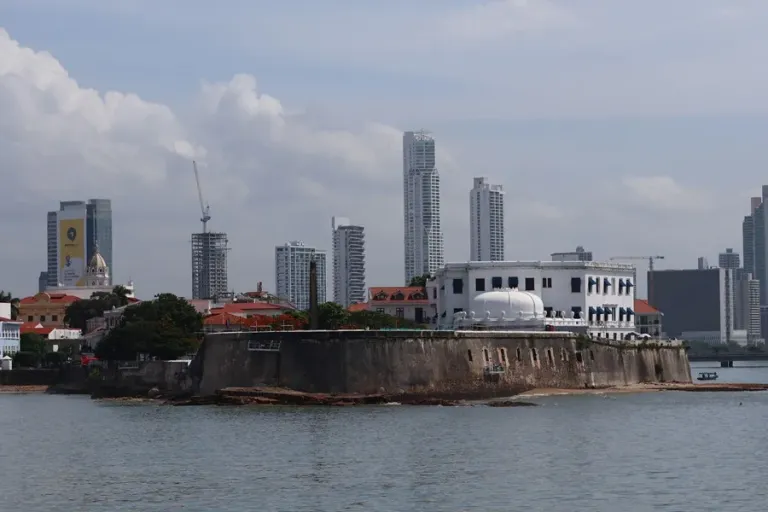
Panama City .- When the new Panama City was born in 1673, located on a peninsula near the original site, which had been abandoned due to a devastating fire, it was decided to fortify it with a wall that today, more than 300 years later, still stands and is the subject of a restoration guided by the standards that govern UNESCO World Heritage sites.
It is the Colonial Wall of Punta Chiriquí, located in what is currently known as Casco Antiguo, which is a World Heritage site and considered one of the main vestiges of the city’s colonial defensive system.
The settlement “was a walled city that had a moat around it on the land side. Panama had this entire defense system for the protection of the new city,” the director of the Old Quarter Office, architect Amber Zambrano, commented to EFE.
The restoration includes the Plaza de Francia, originally a parade ground, and expanded in 1920 to become a memorial honoring the French workers who lost their lives during the first attempt to build the Panama Canal in the 19th century.
We recommend reading: Tobacco, alcohol, and agrochemicals fuel illegal trade in Central America
More Read

A wall that astonishes with its resistance
The Punta Chiriquí wall, known as Las Bóvedas, began construction in 1673 along with the founding of the city’s new site. Between 1756 and 1790, it was straightened and the vaulted complex was built, according to historical records.
“It is super interesting that this wall has a plaster, a render, which is a mixture of lime and sand, that despite the passage of years is in very good condition. It does have certain effects from microflora and so on, but being 300 years old, it is in very good condition,” stated Zambrano.

In fact, the damages being repaired correspond to “repairs subsequent to the original construction,” including “the parapet from when the Plaza de Francia was built as such,” the official explained.
More Read

Due to its characteristics, the Punta de Chiriquí was considered as the site to build the new Spanish Royal Houses, but ultimately only a barracks and warehouses were constructed. In the last third of the 18th century, the long building known as Las Bóvedas was erected, which was used to store supplies and provisions, as official documents explain.
In the center of the bastion was the parade ground, where a large cistern or underground reservoir was built, designed to collect and store water, mainly from rain.
A new landscaping for the square and the wall
The project at the Plaza de Francia provides for the recovery and restoration of the busts of the figures involved in the failed construction of the French canal, of the internal plaques of the arcade and of the hemicycle, stated Zambrano.
In the square stands the bust of the French diplomat and businessman Ferdinand de Lesseps (1805-1894), who attempted to build the Panama Canal following the success of the Suez Canal, as well as those of Armand Reclus, Lucien Bonaparte Wyse, León Boyer, and Pedro J. Sosa, who were key figures in that failed project.
“We are going to have a completely new Plaza de Francia, with new landscaping; there will be a reformulation of what the landscaping is, of what the green area of the plaza is, and to be able to narrate the history in a more coherent way,” emphasized the director of the Office of the Old Quarter.