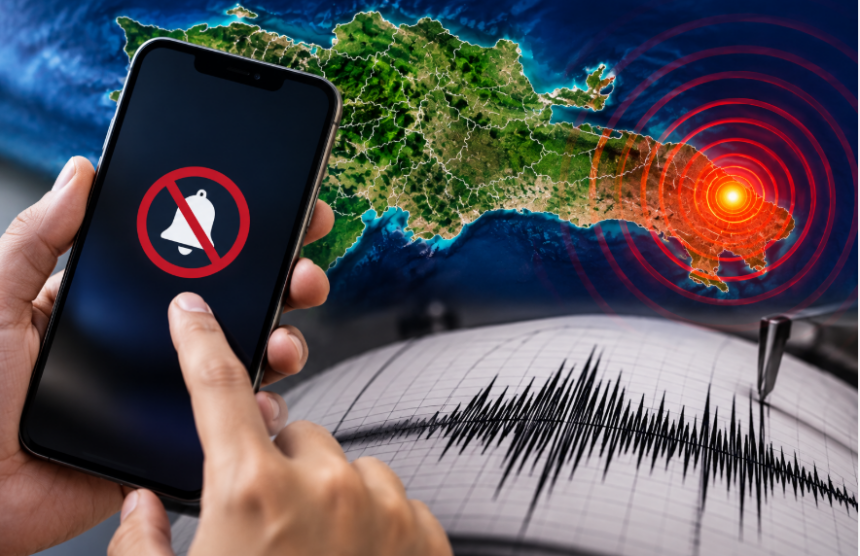
Santo Domingo.– The seismic movements recorded this Sunday, September 27, 2026, in the Dominican Republic not only caused concern among the population, but also raised questions among citizens who claim that their cell phones did not issue the earthquake alert that some Android devices can generate in the event of such occurrences.
The situation gained greater relevance following a day of seismic activity in the country. During the morning, the National Seismology Center of the Autonomous University of Santo Domingo (UASD) recorded a magnitude 4.3 movement, with an epicenter near San Antonio de Guerra, Santo Domingo province, and a depth of 95.7 kilometers. The tremor was felt in different parts of Greater Santo Domingo and no damages or affected persons were reported.
Hours later, a new movement was felt strongly again in different locations across the country. The first calculations released regarding this latest event initially placed it at a preliminary magnitude of 5.5, with its epicenter in the northern area of La Romana, according to initial reports from geologist Osiris de León. As usually happens after an earthquake, those preliminary parameters may be revised later by specialized agencies.
We recommend reading:New earthquake of up to 5.5 shakes DR after several movements recorded this Sunday
Why did some cell phones not send an alert?
The absence of an alert drew particular attention among Android phone users, given that Google maintains its Earthquake Alerts System available in the Dominican Republic, according to the official updated list of countries compatible with the service.
More Read
Google explains that Android phones can send alerts about nearby earthquakes of magnitude 4.5 or higher, using the device’s approximate location to determine which users might be affected.
This means that the system does not necessarily send an alarm to all cell phones in the country simply because an earthquake with a magnitude greater than 4.5 occurs.
The company warns that not all earthquakes can be detected and that initial estimates of magnitude and intensity may contain errors. Furthermore, an alert may arrive before, during, or after the shaking begins.
More Read

Therefore, the fact that citizens felt the tremor without previously receiving a notification does not allow us to conclude on its own that the system has failed.

Internet and configuration also have an influence
To receive Android earthquake alerts, Google states that the device must have an active Wi-Fi or mobile data connection. The feature can also be enabled or disabled from the Safety & emergency section of the phone’s settings.
Users can check this by going to Settings > Safety & emergency > Earthquake alerts. On some models, the location of this option may vary.
The system also uses the approximate location of the devices to determine which phones should receive the warning.
Not all phones work the same way
The tool described by Google corresponds specifically to the Android ecosystem. On other devices, such as iPhones, the availability of certain emergency alerts depends on the systems enabled for the country and the corresponding configuration.
The absence of notifications on some phones during this Sunday’s movements raises questions about how many users actually received the warning and how far in advance, something that would require additional technical information to establish.
More Read

Meanwhile, Google makes it clear that its tool should be considered a complementary safety system and not a guarantee of warning for all earthquakes.
You can also read:4.3 magnitude earthquake felt in Greater Santo Domingo
The movements recorded this Sunday once again highlight the importance of knowing the tools available on mobile devices, keeping emergency functions enabled, and following the information issued by the National Seismological Center and civil protection agencies.