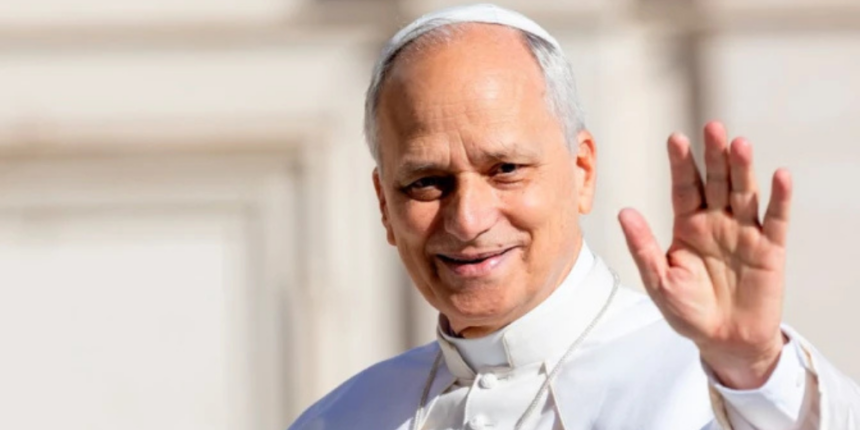
Paris, France.– Pope Leo XIV‘s meetings with victims of sexual abuse in Spain and France, as well as his request this Sunday to the French bishops to maintain maximum vigilance regarding this issue, constitute a “very strong message” for national Churches and show the “path” regarding the need to listen to and care for victims.
This was the view expressed, in an interview with EFE, by Marie Derain de Vaucresson, founding president of the Independent National Body for Recognition and Reparation (INIRR), who the day before personally delivered to Leo XIV a report on the victims of sexual abuse within the Catholic Church in France.
Read more: Leo XIV will preside over a vigil and celebrate two masses during his visit to Uruguay
“By doing so (meeting with victims) in Spain and in France, he shows the way to national Churches, to bishops, to priests and even to all the faithful about the need to be attentive to people who are victims of sexual violence. And that is a very strong message,” declared Derain de Vaucresson.
In his view, the Pope also has “an extremely strong exemplary value” and “sets an example for everyone, at all levels, including society,” as he did this Sunday when asking the bishops of France to remain vigilant regarding this issue.
“If the Pope encourages in such a decisive way, it means that the mobilization of the victims and of actors like me, who have intervened until now, has borne fruit,” he expressed.

Although the head of the INIRR considers the personal dimension of Leo XIII‘s meetings with victims to be important, she points out that dialogue alone is not enough.
“Today it is no longer so much about becoming aware that sexual violence exists and what the systemic problem is that it responds to. We already know that,” she insisted.
“What matters today —he added— is to truly provide solid responses to the victims in terms of support”.
More Read

Leo XIV and abuses
For Derain de Vaucresson, Leo XIV “arrives at a moment when he must decisively advance this issue”.
Before the Pope’s meeting this Sunday with seven victims in Lourdes, in southwestern France, the founding president of the INIRR wanted to send him a message of gratitude and encouragement.
“I would like to thank you for taking on this matter in your responsibility as pope,” he expressed.

“And I would really like to encourage you to stand firm, because working with victims, providing answers, is demanding,” he acknowledged, because the victims, he said, “remember it all the time.”
“That means we can never let our guard down and that we owe it to them not to let our guard down, to provide responses at the appropriate level,” he added.
Abuse report
Derain de Vaucresson was able to greet Leo XIV on Saturday as he left the mass celebrated at the Place de la Concorde in Paris and had about 30 seconds to speak with him and hand him the INIRR report.
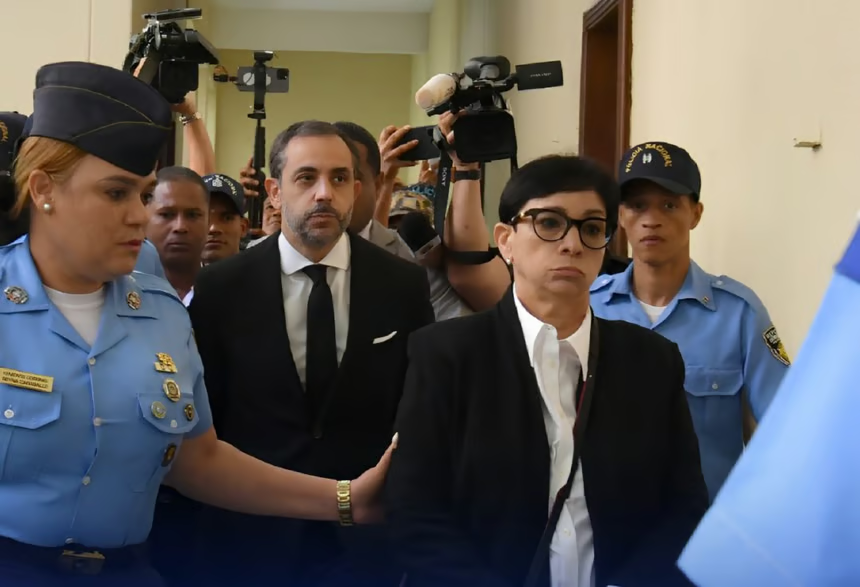
The document, presented to the press last Tuesday, points out that, of the 330,000 victims identified in a 2021 investigation, slightly fewer than 2,000 had turned to the INIRR and their cases had been recognized and compensated.
As he explained, he asked the Pope to encourage national episcopal conferences around the world and Vatican services to offer “a response and care” to the victims.
The pontiff’s response, according to his account, was brief: “It is important.” “And I added: the victims are counting on you.”
Derain de Vaucresson did not have the opportunity to ask him directly, during that brief exchange, to make a firm statement regarding sexual abuse, but he considered that his message was implicit.
“When it is said ‘the victims are counting on you’, I think he understands well,” he stated.
Model for other countries
Derain de Vaucresson believes that the work carried out over five years by the INIRR can serve as a reference for other countries, although he acknowledged that “there is always room for improvement, especially to take cultural dimensions into account.”
“Not even between Spain and France is it exactly the same,” he pointed out.
However, he considered that the model could be transferred to other countries, since “from the moment we think that our way of doing things is transferable, there is totally the possibility of developing this type of structure in any other country”.