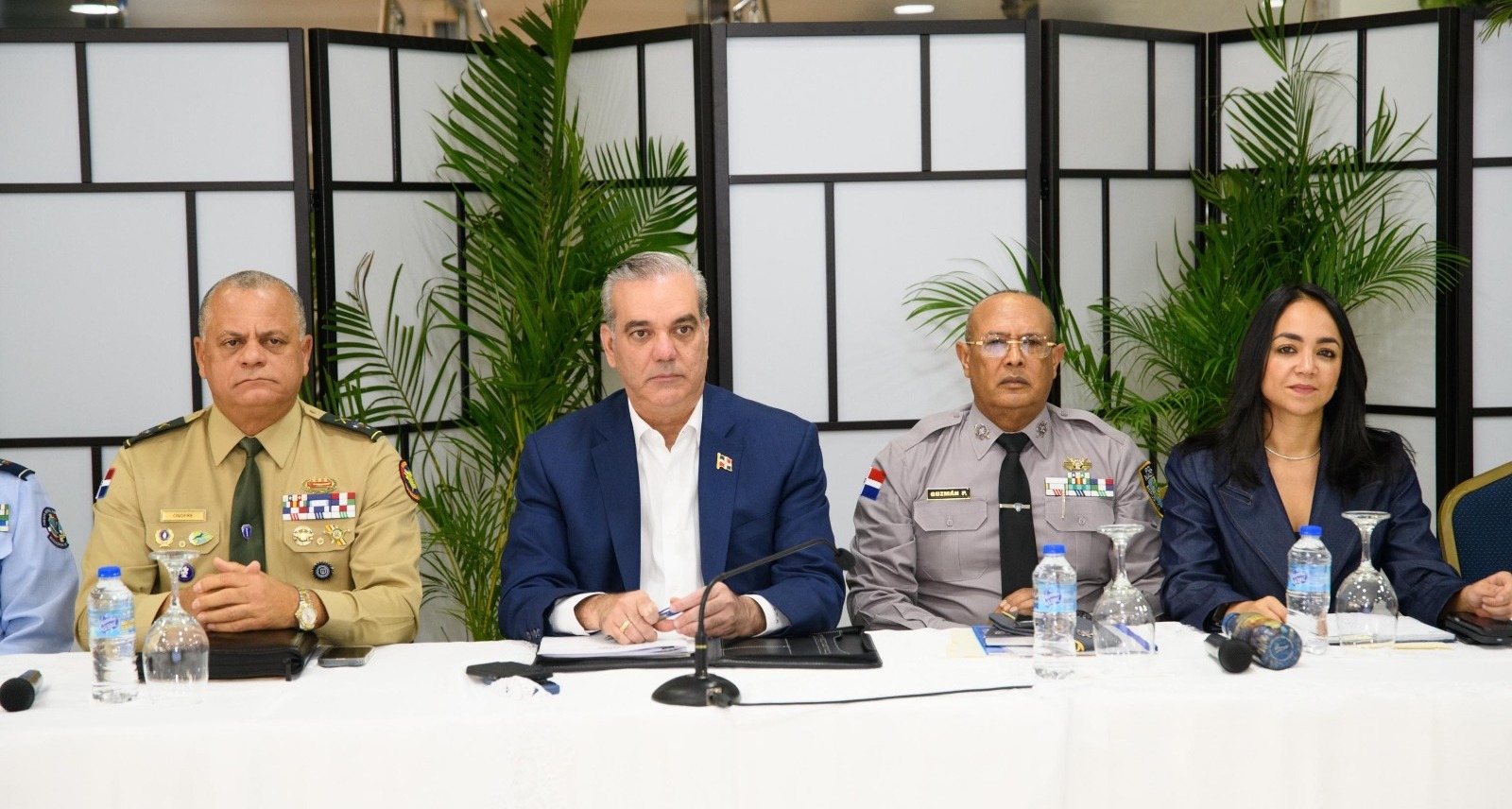
The accumulated homicide rate remains at 8.2 per 100,000 inhabitants and 25 provinces are still below a single digit, while the Joint Task Force is drawing up a strategic plan to reduce those incidents in the nine areas with the highest incidence. The information was provided by Minister Faride Raful at the end of the 103rd follow-up meeting on the Citizen Security Plan, headed by the President of the Republic Luis Abinader.
The official also specified that, according to the statistics of the National Police, the Attorney General’s Office and security agencies, reports of robberies continue with a downward trend, decreasing from 55,248 in 2024 to 5,3015 in 2025, which represents 4,933 fewer of this scourge. Regarding operations, he reported that directed patrols continue to prevent crimes such as illegal street races and reckless motorcycle maneuvers, in addition to the strict enforcement of the resolution that prohibits weapons in beverage dispensing centers. He also indicated that the new police model, in a trial-and-error pilot program to move forward, is under development in 72 quadrants with 119 assigned vehicles and agents who exhibit a new uniform, equipment, and foot and motorized patrol strategies. “It is a constant exercise of monitoring, evaluation and correction to consolidate a modern, close and effective police service,” he assured. Given the incident in Villa Mella, Santo Domingo Norte municipality, where a citizen pointed a weapon at police officers, the minister maintained that the law enforcement body is obliged to respect the rights of citizens, but also the population must exercise peaceful coexistence and respect for the authorities, who work to guarantee tranquility. He stated that the institution has the challenge of continuing the work in prevention, civic education and the involvement of citizens with the Police, and urged to respect social and noise pollution regulations to avoid social conflicts and homicides, and to achieve an increase in security in society. “What we experienced this weekend was something that moves us and hurts us quite a bit, because it means that there are still citizens who do not understand what the role of our authorities is. There will always be an opportunity to improve and review the protocol,” he said. He urged the population to understand that the authorities and citizens must work together to generate greater security, to know our rights, but also to know our duties. Also, the Director of Police, Major General Ramón Antonio Guzmán Peralta, explained that the institution’s protocol for the actions of the agents, which establishes first persuasion, communication and then responds at the same level of force with which the citizen acts. “The use of force protocol first establishes that the first measure the police take is presence, then comes persuasion, communication, and then the other non-lethal instruments, but when the citizen confronts the Police with a level of lethality such as a manipulated firearm, then the agents must use the same level of force with which they are being confronted,” he expressed. Migration interdictions advance with 18,067 undocumented Haitians returned in 15 daysRaful specified that the interdiction work to prevent the movement of undocumented immigrants has managed to return 18,067 Haitians, between August 1 and 16, in joint operations with the General Directorate of Migration, the Ministry of Defense and local authorities. “We work with permanent planning, monitoring, and evaluation. Security requires citizen co-responsibility, education, and prevention. That is the commitment we continue to assume,” he concluded.