
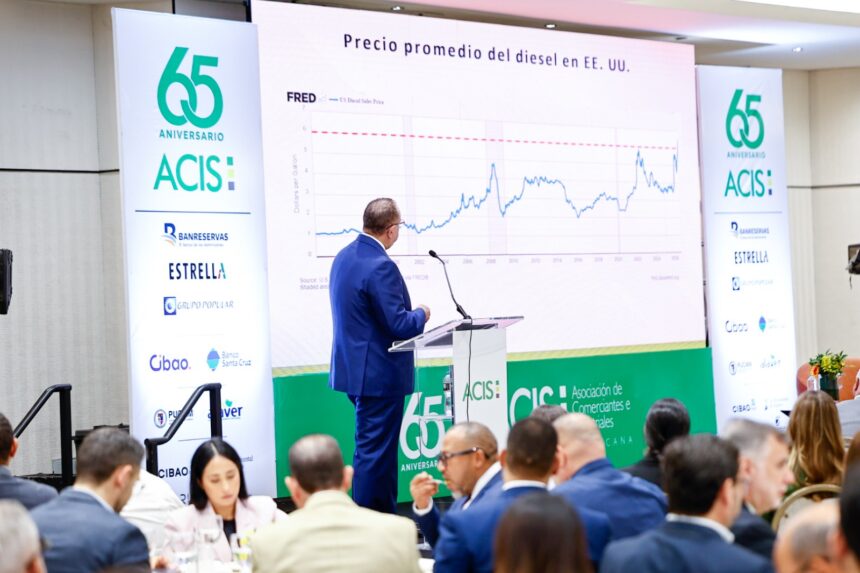
Santiago. – The rapid variation in international prices, especially that of diesel, is increasing the cost of the protection that the Government offers to Dominican consumers. The Minister of Finance and Economy, Magín J. Díaz, warned the Association of Merchants and Industrialists of Santiago (ACIS) that, if the conflict in the Middle East continues, the fuel subsidy could reach RD$50 billion this year, well above what was projected in the government budget.
While presenting the conference Challenges and Opportunities of the Dominican Economy, held for the 65th anniversary of ACIS, Díaz explained that risk is not measured solely by the price of a barrel of oil. According to the data presented, WTI crude was 68% above its level at the beginning of the year, while the price of diesel had increased by 130% in the same period. That difference helps explain why the fiscal cost can rise even when the movement of oil, by itself, does not seem to justify it.
For the week of September 26 to October 2, the Government estimated a subsidy of nearly RD$1.8 billion, and placed the cumulative total to date at RD$36 billion. Both regular and premium diesel receive a subsidy of more than RD$100 per gallon, equivalent to 40% and 45% of their respective consumer prices.
The minister framed that pressure within an international situation that can change rapidly, and without prior notice. Added to the rising prices of energy and fertilizers are US tariffs, high interest rates in the United States, and the cost of securing external financing.
Díaz also raised a distributive problem regarding generalized subsidies: higher-income households capture a considerable proportion of those benefits because they consume more in absolute terms.

According to the estimates presented, the richest 20% receive between 37% and 77% of the resources from the main subsidies of that type. Given this context, he advocated for better targeting that favors transfers to poor households.

Growth and public accounts
Despite the persistent external shock, the minister maintained that the Dominican economic activity demonstrates resilience and maintains growth capacity. The economy accumulated an expansion of 4.5% between January and July, and a monthly growth of around 4% is anticipated for August.
More Read

Díaz highlighted other indicators of support: international reserves of US$15.4 billion, remittances averaging more than US$1 billion per month, total exports with a growth of 11.4%, and foreign direct investment close to US$3.3 billion in the first half of the current year. Regarding domestic prices, he placed the year-on-year inflation for August at 5.13% and the core inflation at 4.76%.
The fiscal deficit accumulated to RD$165,000 million as of August, equivalent to 1.9% of the gross domestic product.
He recalled that the reformulated budget contemplates a deficit of RD$280.575 billion, or 3.2% of GDP. At the same time, capital expenditure grew by 34.4% compared to August 2025, with an execution of 56% of the budgeted amount, compared to the 45% that had been recorded in the same period last year.
The immediate challenge, according to the approach outlined by Díaz, consists of cushioning the rise in international prices without compromising fiscal stability or curbing public investment. Beyond this situation, he identified productivity as the necessary condition to sustain growth in the next decade. To raise it, he pointed to two linked tasks: reducing child poverty and improving educational outcomes.