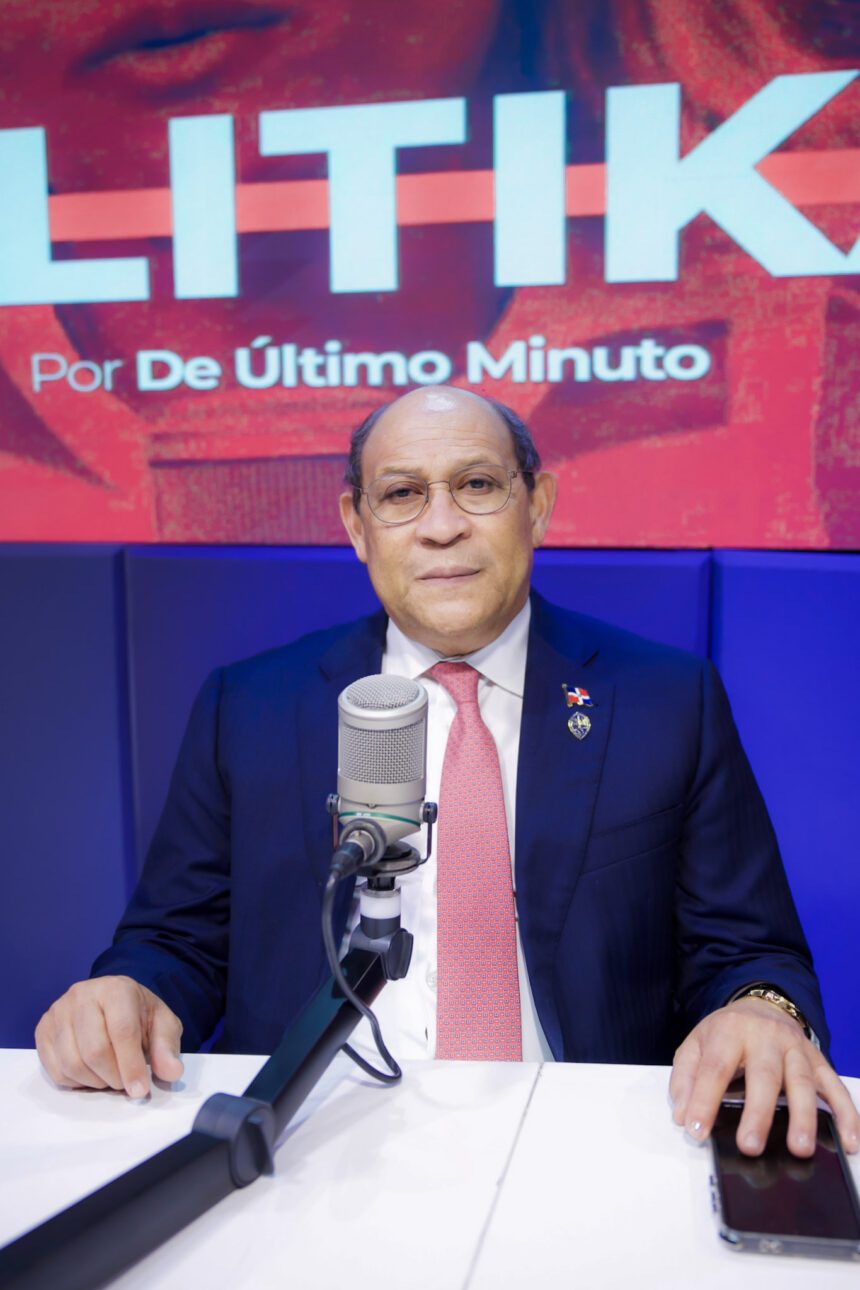
SANTO DOMINGO – In a revealing interview granted to the program Politikal, the Minister of Higher Education, Science and Technology (Mescyt), Rafael Santos Badía, offered a critical diagnosis of the current state of academic training in the Dominican Republic. According to the official, the country is facing a generational and structural gap that hinders full economic and social development.
“Dominican education is trapped in the 19th century, teachers think like in the 20th century, and students are from the 21st century,” stated Santos Badía, summarizing what he described as a “drama” that must be transformed if the country aspires to double the size of its economy by the year 2036.
YOU MAY ALSO BE INTERESTED IN: Santos Badía highlights the role of universities in the transformation of the Dominican educational system
A “bottom-up” reform
The minister raised the need for a total reengineering of the educational system that begins from early childhood and extends to higher education. Among his fundamental proposals, he highlighted that the university level requires a much more pragmatic and efficient approach.
“At the university level, a more abbreviated curriculum must be created… we must talk about content and relevance”, stated Santos Badía, noting that current programs sometimes include irrelevant topics that students do not know how to apply in practice. Likewise, he advocated for the implementation of “micro-credentials or micro-certifications” for adults who, due to the fourth industrial revolution, need to update their trades quickly so as not to become unemployed.
More Read


Balance between technology and humanism
Despite the growing demand for STEM (science, technology, engineering, and mathematics) careers, the head of Mescyt warned that critical thinking and the humanities should not be neglected. He reported that, although the focus is 70% toward technical and scientific careers, the remaining 30% should be dedicated to “soft skills” and disciplines such as linguistics, history, and philosophy.
“Let us not use fashion… we have to strengthen humanism, which is managing the algorithm”, the minister explained, highlighting the importance of training citizens with cultural sensitivity and analytical capacity.
Excellence scholarships and the salary challenge
Regarding the international scholarship policy, Santos Badía assured that priority is being given to agreements with world-class elite universities such as MIT, Harvard, the Complutense University of Madrid, and the University of Barcelona. However, he acknowledged that the country faces the challenge of “brain drain” due to the low salary offers that professionals encounter upon returning.

“Brain drain is avoided with good salaries. A good salary is one that allows people to afford a quality life,” he stressed, after admitting that a high-level graduate will not be attracted to positions in public administration that offer insufficient remuneration.
Finally, the minister reiterated that the goal of this “educational revolution” is to leverage the “magical revolution of knowledge” to accelerate national growth and offer real opportunities both to Dominicans in the territory and to the diaspora.