

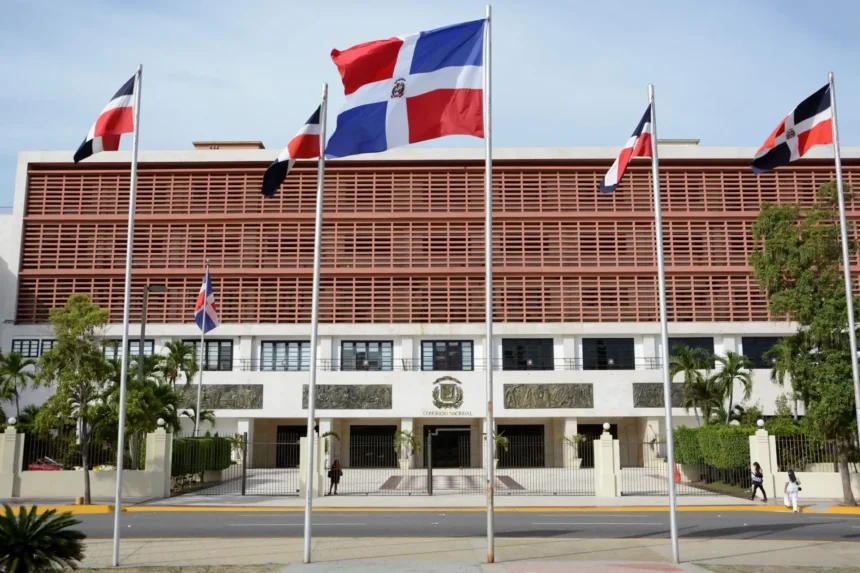
Santo Domingo.— The National Congress begins this Sunday, August 16, within the framework of Restoration Day, the Second Ordinary Legislature of 2026, with an agenda marked by priority projects and reforms that remain pending approval.
The sessions will be held in the halls of the Chamber of Deputies and the Senate of the Republic, under the leadership of their respective presidents, Alfredo Pacheco and Ricardo de los Santos.
You might be interested in: National Congress finalizes technical and decorative details for the start of the Second Ordinary Legislature of 2026
One of the main challenges of this new legislative term will be to advance the initiatives that remain on the agenda and cover areas such as security, health, education, justice, social rights, and technology.
Among the pending reforms are the amendment of Law No. 590-16, Organic Law of the National Police, the reform of the General Health Law, the Mental Health Law, the Civil Code, and the amendment of the General Education Law.
More Read

Also under discussion are initiatives related to the protection of the coastal-marine zone, the prevention and eradication of political violence against women, the prosecution of criminal organizations, sports, cybersecurity, and contentious-administrative jurisdiction.
Added to this agenda are projects on labor reform, the update of the Social Security Law, legislation on disability and freedom of expression, the Water Code, and regulations to govern the use and development of artificial intelligence.
The opening of this second legislative session takes place with the leadership of both chambers already defined, after the Modern Revolutionary Party (PRM) ratified the presidents of the Chamber of Deputies and the Senate for the period that begins.
More Read

In the Senate, furthermore, the composition of the leadership projects the scenario for 2027, when the arrival of Alexis Victoria Yeb to the presidency of the Upper House is scheduled.
Selection of management firms
As part of this Sunday’s activities, the directing boards for the 2026-2027 period will be selected and installed, both in the Senate and in the Chamber of Deputies.
With this process, the Second Ordinary Legislature of 2026 will be formally installed, which will have as one of its main challenges turning priority reforms into laws and providing continuity to a legislative agenda of high national impact.
The new legislature begins with dozens of pending initiatives
The opening of the Second Ordinary Legislature of 2026 comes at a time when the National Congress has before it a broad agenda of bills that have been the subject of discussion during the last legislative periods, but which still require consensus among the different political forces to become law.

The beginning of this new legislative stage also coincides with the commemoration of the 163rd anniversary of the Restoration of the Republic, a date of special historical significance for the country and which traditionally marks the beginning of the second ordinary session period of Congress each year.
Over the coming months, legislators will need to resume initiatives that remained pending at the close of the first ordinary legislative session, in addition to considering new proposals submitted by the Executive Branch, the congressmen themselves, and other actors authorized to present bills.
More Read

One of the topics that will continue to generate attention is the reform of the Organic Law of the National Police, at a time when citizen security remains among the population’s main concerns. The discussion seeks to update the institution’s legal framework and adapt it to the country’s current needs.
Regarding health, Congress also has pending progress on amendments to the legislation that regulates the healthcare system, including the General Health Law and the Mental Health Law. These initiatives seek to address challenges related to service provision, disease prevention, and the care of people with mental health disorders.
The legislative agenda also includes far-reaching reforms, such as the Civil Code and the General Education Law, two regulations that directly impact fundamental aspects of the social and legal life of the Dominican Republic.
Another issue that remains under public scrutiny is the regulation of the coastal-marine zone, due to the pressure these spaces face from urban, tourism, and economic growth. Added to this are proposals related to the protection of women’s rights and the prevention of political violence.
Congress will also have to address initiatives linked to the prosecution of criminal organizations and cybersecurity, areas that have acquired greater relevance due to the growth of crimes committed through organized structures and digital tools.
In the economic and labor sphere, the Labor Code reform and the update of the Social Security Law represent two of the projects with the greatest impact for workers, employers, and system beneficiaries. Any modification will require agreements between different sectors due to their social and economic implications.
Legislation on disability, freedom of expression, and water resources is also among the pending issues, while the regulation of artificial intelligence poses one of the most novel challenges for lawmakers, given the rapid development of this technology and its effects on privacy, employment, education, and economic activities.
With the PRM maintaining control of both legislative chambers, the ruling party has a favorable position to push its main initiatives. However, the progress of some reforms will depend on the ability to reach political and social agreements on issues that may generate conflicting positions.
The new legislature therefore represents an opportunity for Congress to advance projects that have been under discussion for months and to respond to demands that have gained relevance in the national debate.
The 2026-2027 period will also have a particular political dimension, due to the internal movements that are beginning to be projected towards the next electoral cycle. In that scenario, the decisions adopted by Congress and the reforms that manage to be approved could become an important part of the public debate in the coming months.