The small South Pacific nation that for decades was called Nauru for pure colonial convenience officially reclaimed its ancestral name and became the Republic of Naoero, as announced this week by its president, David Adeang. The constitutional amendment received the backing of Parliament in the two required rounds of voting, as reported by Associated Press.
The change is not just orthographic. The new name also modifies the country’s international code, which will change from NRU to NRO, and redefines the identity of its citizens, who from now on will be known as dei-Naoero and not as Nauruans. The pronunciation, which in English was read as Now-roo, will become Now-ero, aligned with the phonetics of the local language.
According to the AP, the government explained in a statement that Nauru had only been imposed as an international designation because the original name was difficult for foreigners to pronounce, “a matter of convenience, not choice.” The decision, Adeang maintained before Parliament last January, “seeks to more faithfully honor the heritage, language, and identity of our nation.”
A name that never completely disappeared
The government’s central argument for dispensing with a referendum was that Naoero never ceased to exist within society. The name appears on the national coat of arms, is used daily in local communities, and the Constitution itself recognizes it. “The name Naoero was never lost; rather, it was waiting to be fully adopted,” the government noted in its official statement released last week.

Adeang had announced in May, when Parliament voted for the change for the first time, that a popular consultation would be held to ratify it. After “extensive discussions,” the legislators determined that such an instance was not necessary. The president described the process as “the beginning of a renewed national pride.”
The AP detailed that the formal adoption of the new name has already resonated in international organizations: the United Nations website registers the country under its new designation after the government requested the change in June. The Ministries of Foreign Affairs of Australia and New Zealand, along with the embassies of the United States and China in the region, have also updated their digital platforms to reflect the new name.

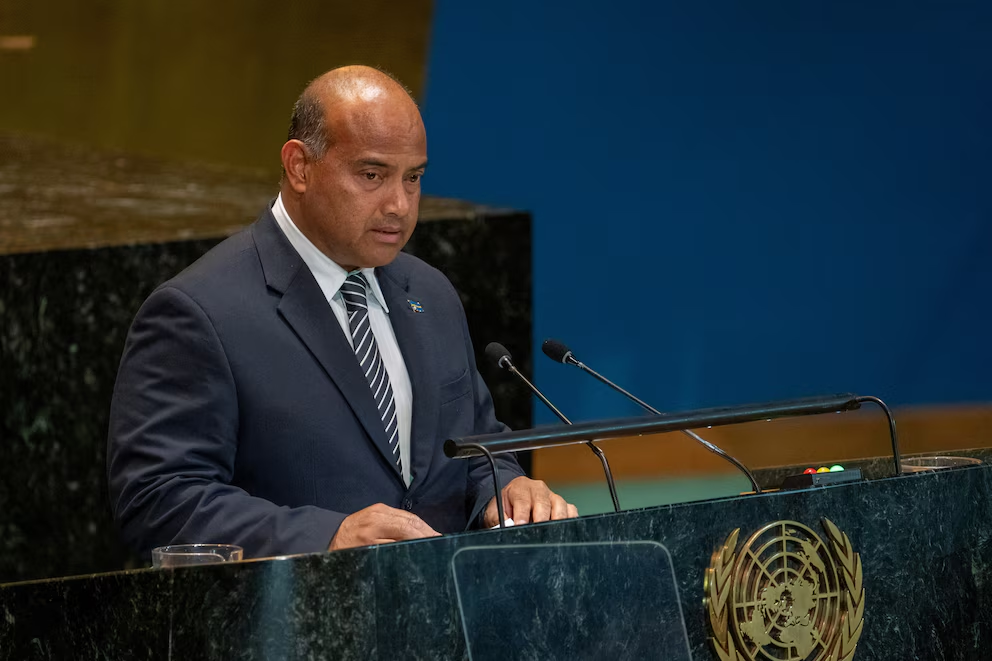
Parliament approved the constitutional amendment that changed Nauru’s official name to the Republic of Naoero (Illustrative Image Infobae)

An island with a turbulent history
Naoero is a tiny coral limestone atoll in the South Pacific with barely 12,000 inhabitants, making it the third least populous country in the world, behind Tuvalu and Vatican City. Its modern history was marked by foreign domination: it was a colony of Germany and later under Australian administration before proclaiming its independence as a republic in 1968.
Decades after independence, phosphate extraction generated unprecedented wealth for the island during the seventies. However, the collapse of that industry in the nineties brought it to the brink of economic ruin.
Today, Naoero faces another threat of magnitude: rising sea levels due to climate change place it among the most vulnerable nations on the planet, which led the government to create a paid citizenship program to fund the relocation of people and infrastructure in the face of the advancing ocean.
A gesture shared with other nations
Naoero‘s decision is part of a larger trend. In recent decades, several countries have chosen to shed names imposed during the colonial period or to adopt names with deeper local roots. The small African kingdom of Eswatini reclaimed that name in 2018, after having been known internationally as Swaziland. Turkey, for its part, requested in 2022 that the United Nations (UN) designate it as Türkiye, the form by which the country identifies itself in its own language.
In the case of Naoero, AP specified that the change will have immediate practical effects: national-flagged aircraft and vessels must be renamed, and the government is working with other countries and international institutions for the formal recognition of the new name.