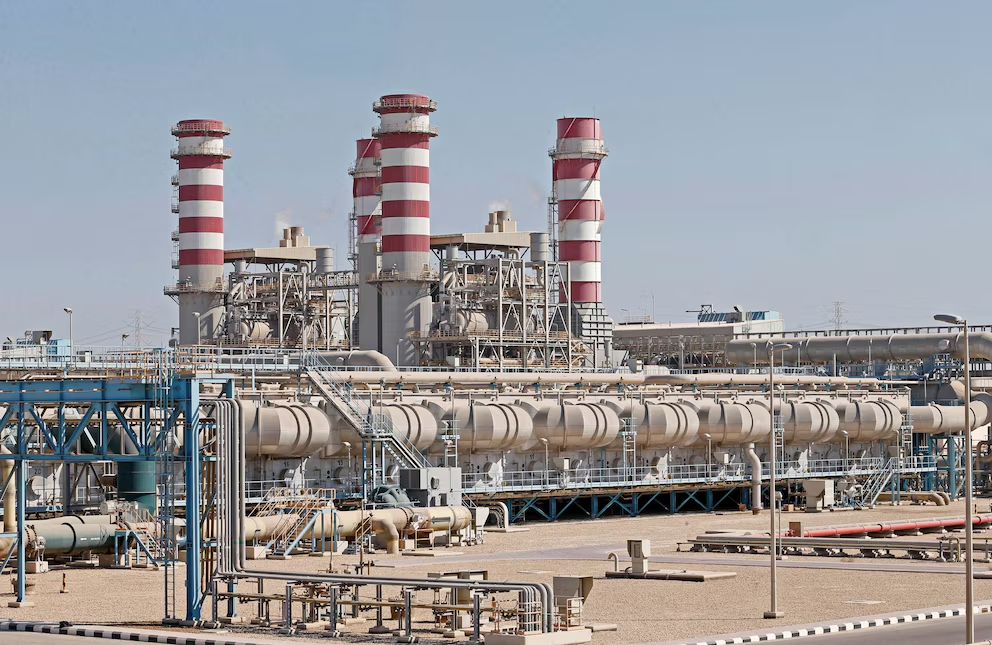
An attack by Iran damaged a power and water desalination plant in Kuwait this Friday, as the conflict between Tehran and its Gulf neighbors exposes a vulnerability that rarely makes headlines: the fragility of the drinking water supply in a region that depends almost entirely on technology to produce it.
As reported by the news agency AP, the Ministry of Electricity, Water and Renewable Energy of Kuwait confirmed that the attack caused a fire and damage to a large number of power generation units.
The incident was not isolated. Since the beginning of the conflict, Iran has attacked infrastructure near several desalination plants in the Persian Gulf. Kuwait had already reported damage to the Doha West desalination plant following debris from intercepted drones. In Bahrain, an Iranian drone damaged a desalination facility on March 8. In the United Arab Emirates, Iranian attacks struck the Fujairah F1 power and water complex, a few kilometers from one of the world’s largest desalination plants. According to AP, Kuwaiti authorities activated emergency contingency plans and managed to contain the fire.
The reason these attacks cause alarm goes beyond the immediate material damage. Kuwait obtains about 90% of its drinking water from desalination; Oman, 86%; and Saudi Arabia, nearly 70%. The process consists of extracting salt from seawater, mainly through the reverse osmosis technique, which pushes water through ultra-fine membranes. Without these plants, the large cities of the Gulf could not sustain their current populations.
We recommend reading:U.S. launches seventh night of airstrikes against Iran

The geographic concentration of that infrastructure exacerbates the risk. More than 90% of the Persian Gulf’s desalinated water comes from just 56 plants, all located along the coast and within range of Iranian missiles and drones. A 2010 Central Intelligence Agency (CIA) analysis, cited by AP, warned that attacks on those facilities could trigger national crises in several Gulf states, and that prolonged disruptions could last for months if critical equipment is destroyed. The document noted that “each of these plants is extremely vulnerable to sabotage or military action.”
An employee stands next to a wastewater collection pool at the Ras Al-Khair desalination and power plant, Saudi Arabia (REUTERS/Hamad I Mohammed/File)

Many of these facilities are physically integrated with power plants in cogeneration systems, which means that an attack on the electrical grid can simultaneously disrupt water production. The plants have multiple stages—intake, treatment, and energy supply systems—and damage to any link in that chain can paralyze the entire production.

The conflict also has a symmetrical dimension: Iran accused the United States of having attacked a desalination plant on Qeshm Island, in Hormozgan province, on March 7, which cut off the water supply to 30 villages. Washington did not acknowledge the attack. Time magazine reported that Houthi rebels from Yemen have attacked Saudi desalination facilities within the framework of regional tensions prior to the current conflict.
Outside of the Middle East, the primary concern regarding war with Iran has been the impact on energy prices. Fighting and attacks on vessels in the Strait of Hormuz have shaken global markets and pushed oil prices to record highs. But the water crisis represents a threat of equal magnitude to regional stability.
The war has caused at least $58 billion in damage to the Gulf’s energy infrastructure, according to data published by Time, and has cut tourism revenue by about $600 million a day since the start of hostilities. That drain on resources diverts government attention and funding from the climate resilience investments their populations urgently need.
Added to those pressures is climate change. Desalination plants are vulnerable to storm surges and extreme rainfall that can collapse infrastructure, while warming oceans increase the probability and intensity of cyclones in the Arabian Sea. The region was already recording some of the most severe climate-induced droughts before the start of the conflict, with temperatures projected to rise at twice the global average during the 21st century, as reported by Time.
Six people were injured in the latest attacks on Kuwait, including four members of the armed forces, according to an Asharq Al-Awsat count. Kuwaiti forces detected around 77 hostile drones and 18 missiles in their airspace between Wednesday and Thursday night.