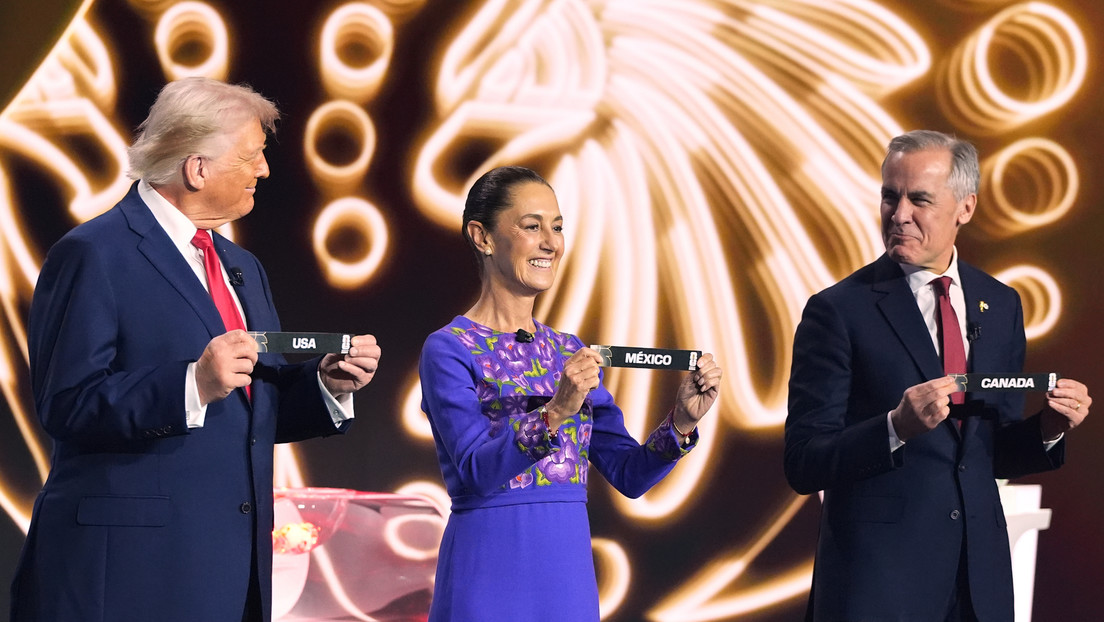
U.S. President Donald Trump met this Friday in Washington with his Mexican counterpart, Claudia Sheinbaum, and Canadian Prime Minister Mark Carney, in what is shaping up to be their first trilateral meeting.
Sheinbaum was the first to speak out about it, calling it an “excellent meeting”, while posting two photos on social media. “We talked about the great opportunity that the 2026 FIFA World Cup represents for the three countries and about the good relationship we have“, she pointed out.
You may be interested in: http://Trump says he is following situation in Venezuela «with great interest» and does not want «its oil»
“We agreed to
continue working together on commercial issues with our teams,” he added.
The three have been governing their countries for less than two years and
met after heading the draw for the 2026 FIFA World Cup that took place earlier at the Kennedy Center in Washington D.C.
Their first
conversation informally took place in the VIP box of the venue, while the event with which the groups of the great sporting event were known was taking place.
According to diplomatic sources,
cited by the Mexican newspaper El Universal, Trump and Sheinbaum met earlier in a cordial atmosphere to discuss economic cooperation,
border security, and coordination for the organization of the World Cup.
Previously, Trump
told TV Azteca that both Mexico and Canada are “helping to set records” in ticket sales for the World Cup.
“They have come together very well”, he added in relation to the organization.
Before her trip, last Wednesday, Sheinbaum commented that the draw was “a good moment” for them to be together, as a sign that North America and its commercial commitment “are moving forward”.
‘Give and take’
The relationship between Trump, who
assumed the Presidency again last January, and Sheinbaum, who
came to power in October 2024, has been marked by friction, but also by affable conversations. This has been generated mainly by the
economic, anti-immigrant, and anti-drug trafficking policies that the occupant of the White House has been committed to in his second term, which has led both nations to negotiate and reach agreements.
In economic matters, despite Trump’s eagerness to impose tariffs on Mexican products, thanks to those conversations the measures have been able to be postponed. At the end of October, Sheinbaum
reported that she agreed to another
extension of “weeks” in the negotiation of the imposition of tariffs, whose term —of
90 days— expired on November 1.
In justifying the tariffs, Trump has
accused Mexico, as well as Canada, of allowing the entry of “illegal immigrants” and “deadly drugs” into the U.S., including fentanyl. Also, from the White House they came to
denounce that Mexican drug trafficking organizations have established
“an intolerable alliance” with the Government of the Latin American country.
But in the midst of the ‘give and take’, Sheinbaum has
stated that the advances made in the bilateral relationship with the Trump Administration during the last months allowed to stop
interventionist policies.
Furthermore, at some point the Mexican president revealed how best to negotiate with Trump. “We may not agree, but the
treatment is respectful,” she said in this regard and indicated that the important thing “is
not to confront.”
For his part, the Republican has also had moments of tension with Carney, not only because of the usual topics of economy and immigration, but because of Trump’s desire to
annex Canada to the U.S.
“If Canada were a state, it wouldn’t cost us anything. It would be fantastic. It would be a very beloved state,” he
came to declare in a television interview. Despite this, the Canadian Prime Minister
has also navigated the differences between them.