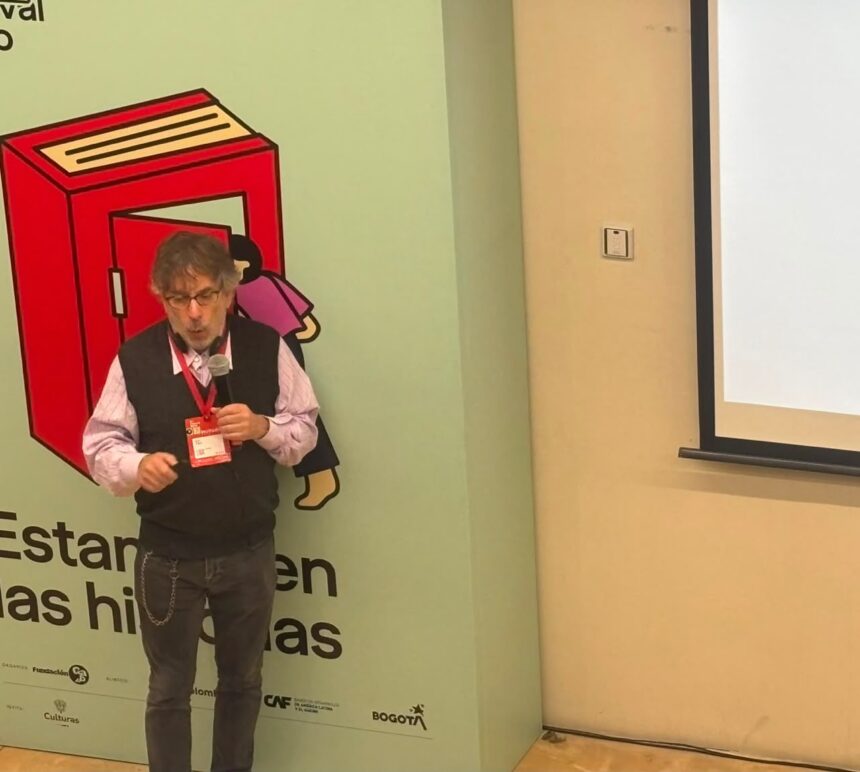
Bogotá, Colombia.- The stress, trauma, and burnout that journalists face during their work can become factors that limit the exercise of the profession and lead to a form of silent censorship. This was warned by Bruce Shapiro, executive director of the Global Center for Journalism & Trauma, during the workshop “Silent censorship: Trauma, burnout, and press freedom,” where he highlighted the importance of taking care of mental health to preserve the quality and independence of journalistic work.
With more than four decades of experience in journalism, Shapiro explained that those who practice this profession are “witnesses” to events that deeply mark people’s lives. Murders, armed conflicts, disasters, and other high-impact coverage are part of the daily work of many reporters, a reality that, far from sensationalism, responds to the responsibility of documenting events of public interest.
However, that constant exposure to violence and suffering can have consequences.
The speaker pointed out that journalistic stress not only leads to physical and emotional exhaustion, but can also affect essential skills for practicing the profession, such as concentration, decision-making, and the ability to handle complex coverage.
We recommend reading:
More Read

The specialist explained that trauma can arise both from witnessing shocking scenes and from continuous exposure to explicit images or situations that confront the journalist’s values and emotions. Furthermore, he recalled that stress has psychological, biological, and social dimensions, so its effects transcend the workplace.
In that context, he warned that neglecting mental health can lead to a form of silent censorship.

“When burnout accumulates, some journalists may avoid certain coverage, limit difficult questions, or step away from sensitive topics to protect themselves from emotional exhaustion. Although that decision may not come from an external order, it ends up affecting the public’s right to receive complete and timely information,” he/she stated.
More Read

As part of self-care strategies, Shapiro recommended incorporating mental breaks during the workday, walking for a few minutes, and performing simple breathing exercises. She also suggested looking at an image that generates well-being while breathing deeply three times to help reduce stress levels.
Rest also plays a central role. Sleeping little increases stress and hinders emotional recovery, the speaker noted. For this reason, he advised limiting the use of the cell phone before sleeping, turning off unnecessary notifications, and, if the need arises to write down an idea, doing so on paper instead of resorting to the mobile device, whose light and activity keep the brain in a state of alertness.
Regarding attacks on social media, he/she indicated that they must be taken seriously and not faced in isolation. Sharing those experiences with other members of the field can become a form of emotional support. As a personal practice, he/she commented that he/she usually reads fiction at night to disconnect from the constant flow of information and social media.
Shapiro also emphasized the importance of understanding that information sources may be going through traumatic situations. In those cases, he said, journalists must establish clear boundaries during interviews to avoid re-victimizing people while simultaneously protecting their own emotional well-being.
Finally, he called for newsrooms to promote a culture of self-care and for journalists to learn to recognize their own limits. Reducing workloads when necessary and speaking openly about the emotional impact of the profession not only strengthens the mental health of those who report, but also contributes to preserving a free journalism, capable of telling the stories that society needs to know without fear, exhaustion, or trauma ending up imposing a silent censorship.