Bangkok.- Philippine authorities confirmed this Tuesday the death of 36 people following the 7.8 magnitude earthquake that struck the southern island of Mindanao the day before, while emergency efforts continue to find the missing.
According to the preliminary report released today by the National Disaster Risk Reduction and Management Council (NDRRMC), four people remain missing and 167 were injured by the earthquake, which affected at least 88,000 citizens.
The tremor was detected at 07:37 local time on Monday (23:37 GMT on Sunday) about 24 kilometers southwest of the island of Burias -south of Mindanao- and at a depth of around 35 kilometers, according to the United States Geological Survey (USGS), which measures seismic activity worldwide.
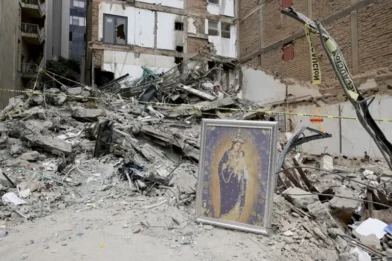
Government buildings, homes, roads, and bridges, among other infrastructure, were damaged by the powerful earthquake, which was followed by some 870 aftershocks, with magnitudes ranging from 1.3 to 6.7, official data indicate.
One of the most affected populations is the city of General Santos, with about 530,000 inhabitants, where several buildings collapsed and emergency teams have established shelters for the affected families.
More Read

You can also read: A strong 7.8 magnitude earthquake shakes the Philippines
Following the earthquake, a tsunami alert was activated in several Pacific countries, and at least five landslides were recorded in the affected area of the Philippines.

Following the initial alerts, the Philippines and the rest of the nations canceled the tsunami warning hours later.
The Philippine seismological agency (Phivolcs), which kept the alert active for nearly eight hours, confirmed the arrival of waves in at least six coastal towns, including Kiamba (Mindanao), where they reached 1.48 meters above sea level.
More Read

Other municipalities impacted were Kalamansig (with waves of 0.84 meters), Maasim (0.48), Zamboanga (0.25), Mai (0.21), and Tandag (0.09), according to the Phivolcs report.
The strong earthquake triggered tsunami alerts in other countries such as Japan, Indonesia, and Malaysia, and even on remote Pacific islands like Vanuatu and Nauru. All of them deactivated them afterward.
The Philippine archipelago sits on the so-called Pacific Ring of Fire, an area of high seismic and volcanic activity where about 7,000 earthquakes are recorded each year, most of them moderate.