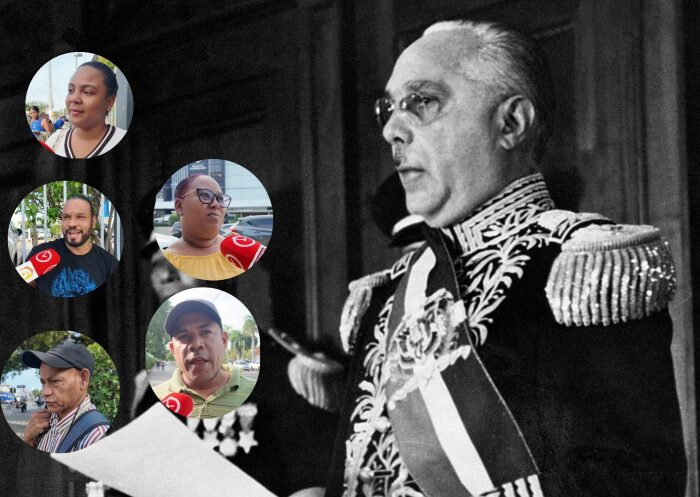
Santo Domingo.– Citizens consulted on the streets of the National District mostly supported the Constitutional Court’s (TC) decision to declare inadmissible the appeal filed by the descendants of dictator Rafael Leónidas Trujillo, who were demanding the return of a multi-million sum deposited in the Banco de Reservas since 1950.
Rafael José Ramón and Yolanda Altagracia Trujillo Lovatón, children of the extramarital relationship between Trujillo and Lina Lovatón Pittaluga, sought for the State to hand over the money corresponding to deposit certificate number 2117, established by the dictator on the condition that the funds would pass into the hands of Lovatón Pittaluga after his death.
However, through ruling TC/0737/26, the Constitutional Court declared the constitutional review appeal filed by the Trujillo Lovatón brothers inadmissible, thereby exhausting this legal avenue.
During a tour conducted by De Último Minuto to learn the citizens’ opinions on the case, some people considered that the funds should not be given to Trujillo’s descendants, while others questioned that the money had passed into state assets and raised doubts about the destination that could be given to those resources.
“I do not agree, not at all. When Trujillo was in power, what he produced was his and not the people’s. Therefore, that money does not belong to the Trujillo family, it belongs to the Dominican people,” declared Manuel Herrera.
In contrast, another citizen expressed agreement that the descendants should receive the money, considering that there is no certainty that those resources were transferred to the public treasury legitimately.
“Who ensures that it will be used in a good way and that it will not be used by other officials for personal works?”, he questioned.
Others consulted argued that the resources should be used for the benefit of Dominican society.
“That money can be used for infrastructure projects and for the benefit of Dominican society”, stated Anderson Núñez.
One of the citizens consulted also maintained that the descendants did not work to generate those resources and questioned that they could claim them as part of an inheritance.


“They did not work for that money. That money is there, but it is neither yours nor mine”, he expressed, considering that an inheritance whose origin or transfer does not have legal viability should not be recognized or delivered.
You can also read: Trujillo’s children claim millionaire sum deposited
Constitutional Court Decision
The plenary of the Constitutional Court, presided over by magistrate Napoleón Estévez Lavandier, based the inadmissibility of the appeal on the fact that the claim of the Trujillo Lovatón brothers does not meet the requirement of “special constitutional significance or relevance” established by Law 137-11.
According to the Constitutional Court (TC), the appellants alleged that the Supreme Court of Justice (SCJ) had incorrectly applied and interpreted Law 57-85, regarding the confiscation of the Trujillo family’s assets, as well as provisions of the Civil Code related to stipulations in favor of third parties and deposit contracts.
The case refers to judgment SCJ-PS-25-086, issued by the First Chamber of the Supreme Court of Justice on April 30, 2025, through which the appeal in cassation filed by the Trujillo Lovatón brothers was rejected.
With that decision, the Supreme Court upheld the rulings of the lower courts that had ruled in favor of Banco de Reservas.
More Read

The judicial conflict dates back to a deposit made in 1950 and has pitted the descendants of Trujillo against the Dominican State for years, in a dispute that converges on succession, patrimonial, and asset-related aspects linked to the dictatorship’s regime.