By: Manuel García
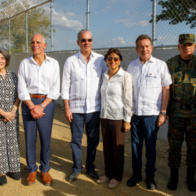
Dajabón.– The Director General of Migration, Vice Admiral Luis Rafael Leé Ballester, conducted a supervisory visit to the Migration Processing Center and the Dajabón border crossing, accompanied by a commission from the United Arab Emirates, with the purpose of learning about the progress in technological modernization that the institution is promoting to strengthen migration control and streamline the transit of travelers in the Dominican Republic.
During the tour, the delegation inspected the facilities of the Dajabón Migration Processing Center, considered one of the most active in the country due to the number of people in irregular migratory status who are processed and deported to Haiti through this border crossing. Likewise, the commission toured the Dajabón border crossing, where a new biometric control center is in the process of being installed, an infrastructure that will allow for greater comfort for users, optimize operations, and make migration control at this important border point more agile and efficient.
Leé Ballester explained that the visit from the United Arab Emirates commission is part of the evaluation and implementation process for new technologies aimed at strengthening security and modernizing migration management, in line with the digital transformation policy promoted by President Luis Abinader.
Among the innovations contemplated are the expansion of the biometric system, the use of facial recognition, the installation of electronic gates (e-Gates), and the automation of immigration controls at airports, ports, and border crossings, with the aim of streamlining the entry and exit of passengers, reducing waiting times without compromising security.
More Read


We recommend reading: ERD soldiers intercept vehicle with 19 undocumented migrants in Santiago Rodríguez
The Migration Director indicated that the institution maintains permanent supervision of all its operations, including migration interdiction processes, airports, ports, border crossings, and other operational areas. Likewise, he assured that any complaint or irregularity detected by intelligence agencies, migration control, or internal affairs is investigated immediately, as part of the institutional commitment to transparency and compliance with regulations.
As part of his agenda in Dajabón, Leé Ballester also held a meeting with business owners and merchants, where he addressed the progress in the implementation of migration control measures carried out by the Government in the border area and explained the new technological mechanisms that will be incorporated to strengthen security at the binational market.
More Read

During that meeting, he reported that the resolution establishing biometric control for access to the border market has already come into effect and announced that the institution is working on expanding biometric stations, in addition to finalizing the terms of reference for the bidding of a modern video surveillance system with cameras equipped with facial recognition, which will be connected to the biometric database of the General Directorate of Migration.
The official explained that this platform will allow for the identification of individuals with a history of deportation or those who appear on immigration restriction lists, preventing their access to the binational market. Likewise, he highlighted that the General Directorate of Migration maintains a permanent offensive against irregular migration throughout the national territory and noted that, according to the institution’s most recent figures, around 216,000 foreigners with irregular immigration status have been deported so far this year.